
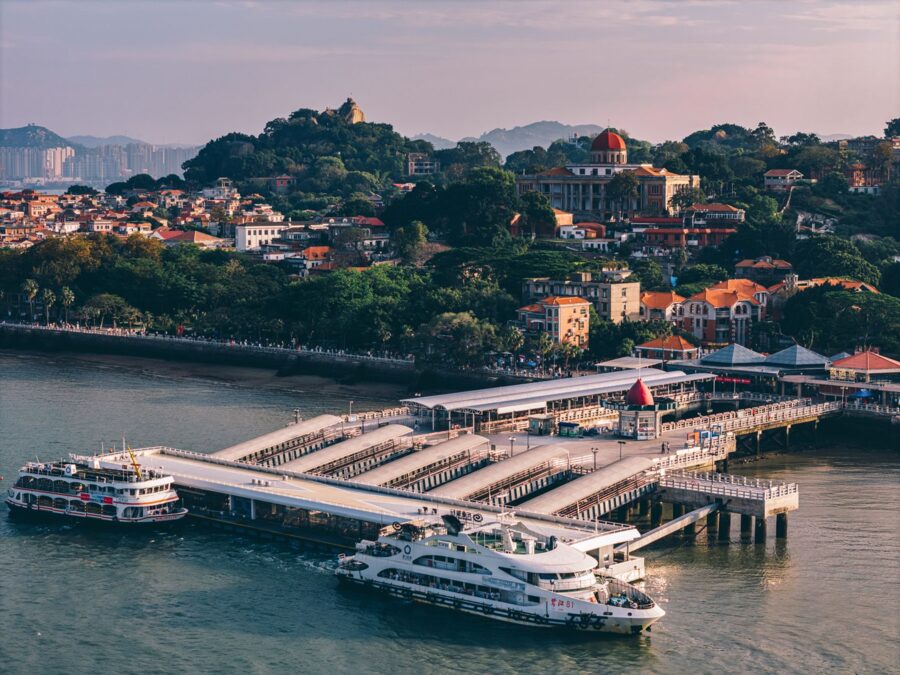
The ferry from Dongdu takes about twenty minutes, and the island at the end of it has no cars, no bicycles and, on an ordinary day in October 2026, about twenty-three thousand people coming over. They step off at Sanqiutian pier into a hillside of red tile and gray granite, and within a few lanes the only engines left are the electric buggies and the boats behind you.
Gulangyu (鼓浪屿) is 1.88 square kilometers of rock and garden sitting 600 meters off the southwest corner of Xiamen Island. Between 1903 and the Second World War it was an international settlement run by a council of foreigners and wealthy Chinese, and the people who made money elsewhere in Asia came here to build. The result is 931 historic buildings packed onto a hill you can cross on foot in under an hour, listed by UNESCO in 2017 as “Kulangsu, a Historic International Settlement”.
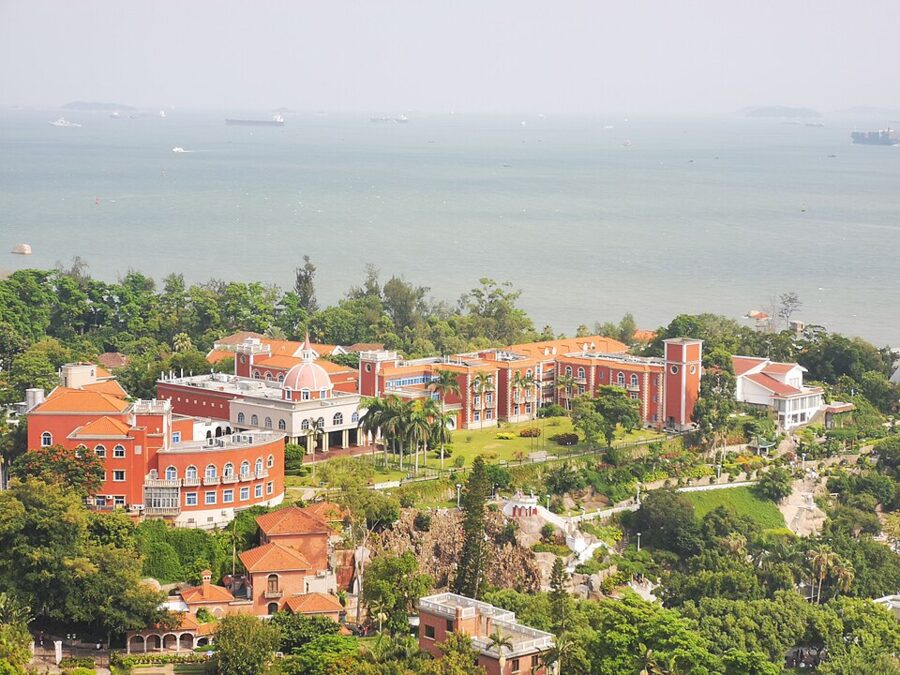

The name means “drum-wave islet”, after the reefs where the surf booms like a drum. Most people now come listening for something else: the island’s other nickname is the “piano island”, a claim that holds up better in its museums than in its lanes.
The practical decision comes first, though. You cannot simply turn up. Everyone except residents crosses on a real-name ferry ticket from a fixed pier at a booked time, the day’s tickets are capped, and on holidays they sell out days ahead. Book the boat before you plan anything else.
On this page
- Drum waves, a drill ground and a treaty port
- The settlement of 1902
- Who built the villas
- A walk through the architecture, in an order that works
- The piano island: museums, a hall, and what is still real
- Sunlight Rock, Shuzhuang Garden and the south shore
- Ferries, tickets and the daily cap
- A day and an evening on the island
Drum waves, a drill ground and a treaty port
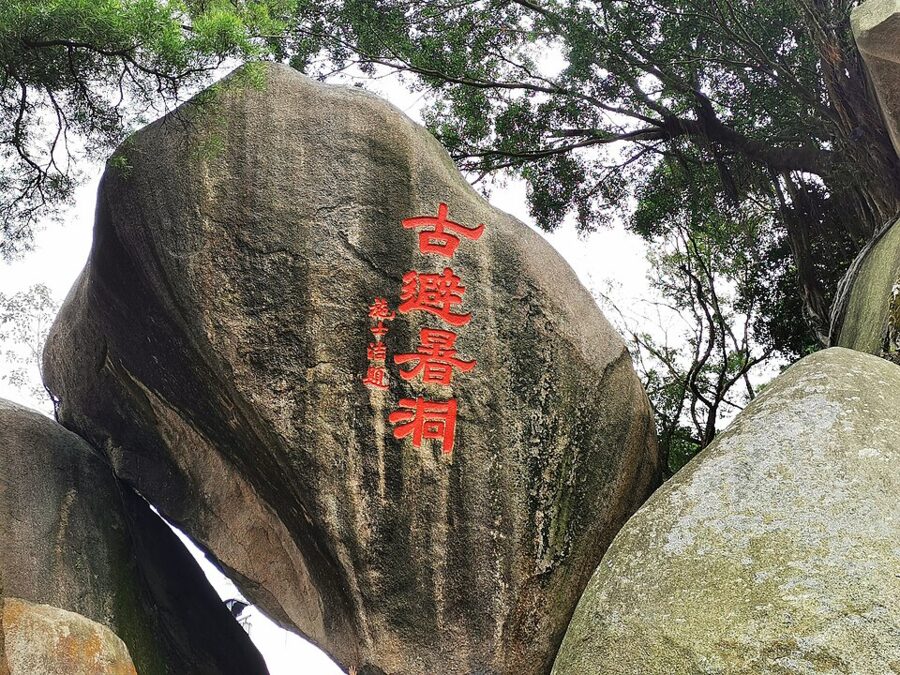
Before the nineteenth century Gulangyu was a fishing and farming islet called Yuanshazhou, “round sandbar”. Its oldest dated mark is on the rock at its summit: the four characters Gulang dongtian (鼓浪洞天), “the grotto-heaven of the drum waves”, carved in 1573 by a Ming official named Ding Yizhong.
Its first military moment came in 1650, when Zheng Chenggong, the Ming loyalist commander Europeans called Koxinga, used the summit to drill his navy. The ruins of his water-drill platform and a stone gate of his hill camp are still on Sunlight Rock. Eleven years later he sailed from the Xiamen coast to take Taiwan from the Dutch, which is why the city put up a fifteen-meter statue of him in 1985.
The island’s real change came with the First Opium War. British forces took Xiamen, then usually written Amoy, in 1841 and held Gulangyu until 1845. The Treaty of Nanjing in 1842 made Amoy one of five ports open to foreign trade, and it opened in 1843. Amoy had been shipping tea for a long time already: the English word “tea” comes from te in the Hokkien spoken here, and “Bohea”, the name London once gave to black tea, is the Hokkien pronunciation of Wuyi.
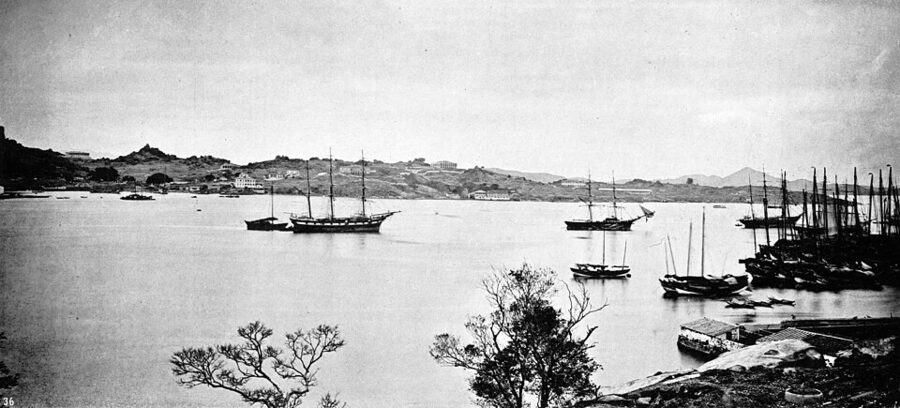
Merchants, consuls and missionaries settled on the island rather than in the crowded port across the strait. Three Protestant missions jointly opened the Union Church for English-language services in 1863. The Dutch-American missionary doctor John Abraham Otte opened Hope Hospital in 1898, and in the same year an English missionary couple founded the Huaide kindergarten, usually counted as the first kindergarten in China.
The settlement of 1902
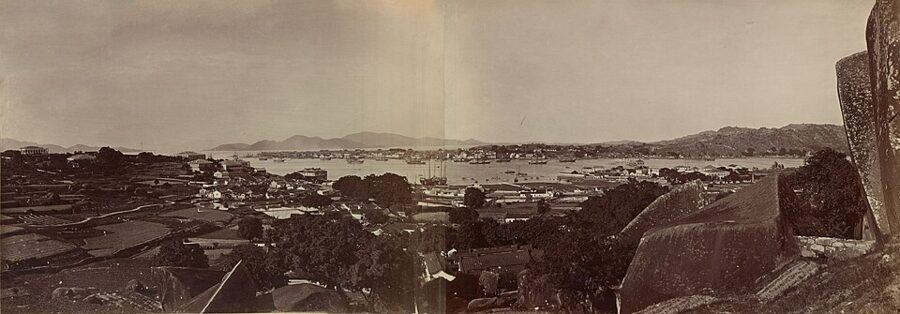
Japan took Taiwan in 1895, and Qing officials in Fujian feared Amoy would be next. Their answer was to make the island too international to seize. On January 10, 1902, the foreign consuls and the Qing circuit intendant signed the Land Regulations for Kulangsu in the Japanese consulate on Lujiao Road. The Kulangsu Municipal Council was set up in January 1903 and began work on May 1 of that year, which is why UNESCO dates the settlement to 1903 and Chinese sources to 1902.
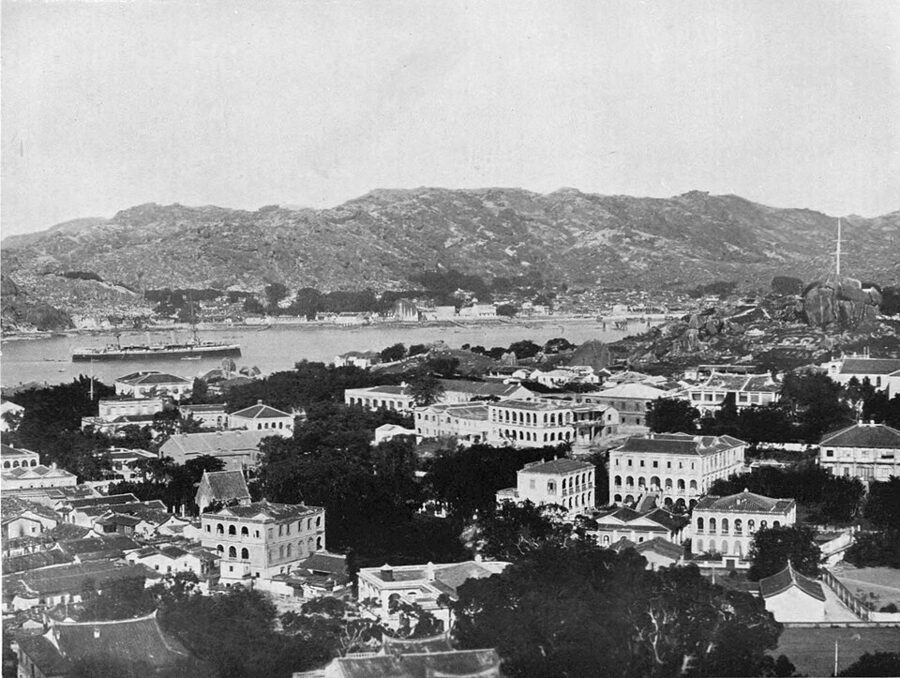
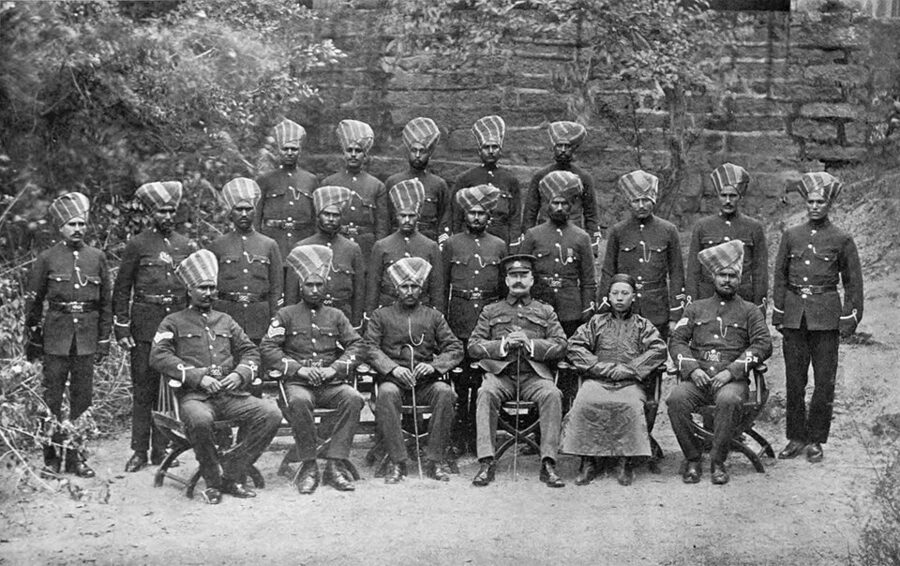
The council collected rates, built roads and drains, and ran a police force largely made up of Sikh constables recruited through British India. It was smaller and quieter than Shanghai‘s International Settlement: a residential island with almost no industry, which is one reason so much of its fabric survived.
Chinese residents were not shut out for long. Lin Erjia, of the Taiwanese Lin family who had moved here after 1895, became the council’s first Chinese member in 1912. In 1927 Huang Yizhu, a returned sugar magnate from Java, became its vice-chairman, and the number of Chinese seats rose to five. A mixed court for cases involving Chinese and foreigners sat on Bishan Road from the late 1920s.
When Japan occupied Xiamen in 1938, refugees poured onto the international island. Japan took Gulangyu itself during the Pacific War and held it until 1945. After 1949 it became a district of Xiamen, the smallest in the country, and in 2003 it was folded into Siming District.
Who built the villas
The foreign consulates and mission houses came first, but most of the grand houses on Gulangyu were built by Chinese families with money made overseas: in Taiwan, the Philippines, Java, Singapore and French Indochina. They had the capital, they wanted the security and the clean water of the settlement, and they wanted to be seen.
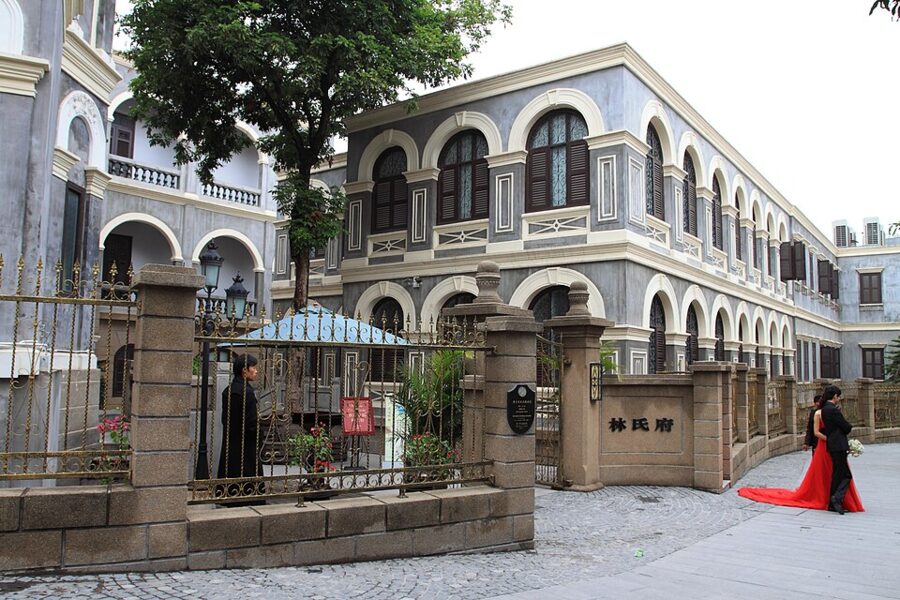

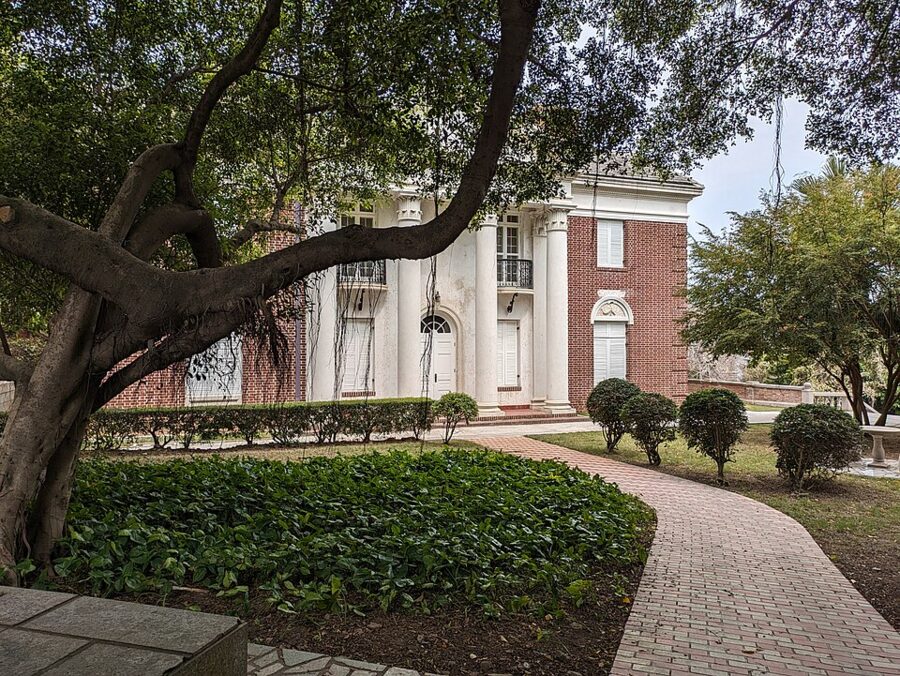
Huang Yizhu, who left Nan’an as a barber and became one of the four “sugar kings” of Java, returned in 1919; his Huang family garden at 25 Huangyan Road went up between 1918 and 1923, and in the 1950s the city used it as its state guesthouse. Huang Xiulang, a merchant from the Philippines, bought the site of the old foreigners’ club on Fujian Road and built Haitian Tanggou. Philippine Chinese families built the Pumpkin House on Quanzhou Road in 1922, named for its melon-shaped roof domes, and Fanpo Lou on Anhai Road in 1927.
Their architects mixed what they had seen: Greek columns, Southeast Asian verandas, Minnan red brick and swallowtail roof ridges, steel and concrete. UNESCO’s citation names a style that grew out of this, Amoy Deco, a fusion of local building traditions, early Western modernism and Art Deco that later spread to Chinese communities across Southeast Asia. Its criteria call Gulangyu “the origin and best representation” of it.
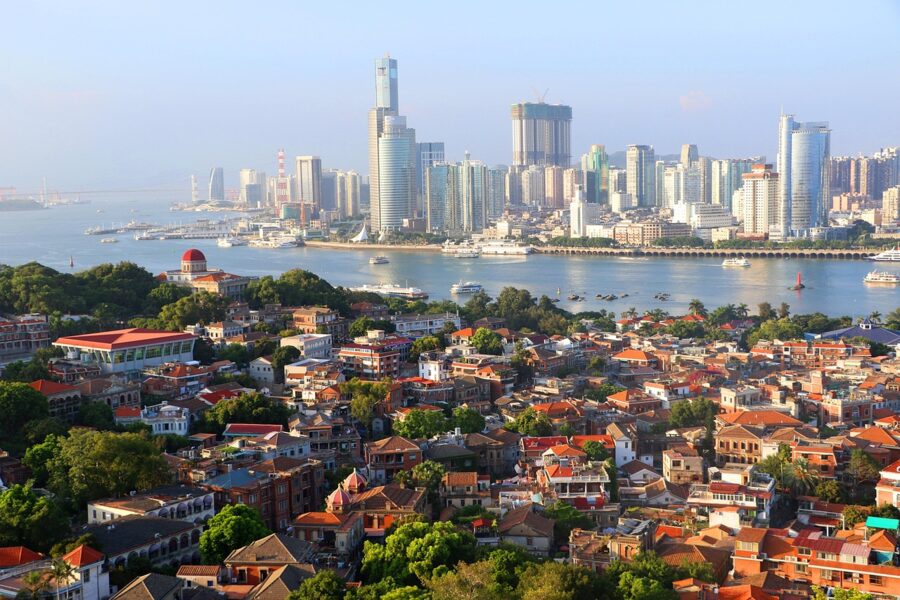
Most of these houses are still private homes, schools, offices or guesthouses. The World Heritage listing covers the whole island and its coastal waters out to the reef, with 51 buildings and sites individually protected. The practical result for you is that much of the architecture is seen from the lane, through a gate, and a handful of buildings can be entered.
A walk through the architecture, in an order that works
The sensible circuit starts at Sanqiutian, climbs to Bagua Lou, runs south along Guxin Road and Fujian Road, drops to Longtou Road, and finishes on Lujiao Road among the consulates. It is a few kilometers with a lot of steps, and it fits into a morning if you only go inside two or three buildings.
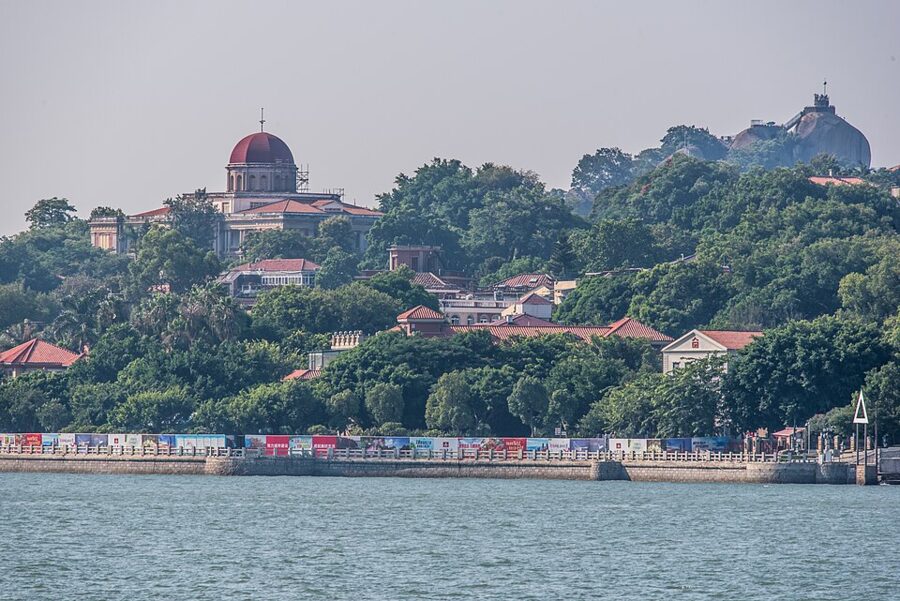

Bagua Lou and its red dome
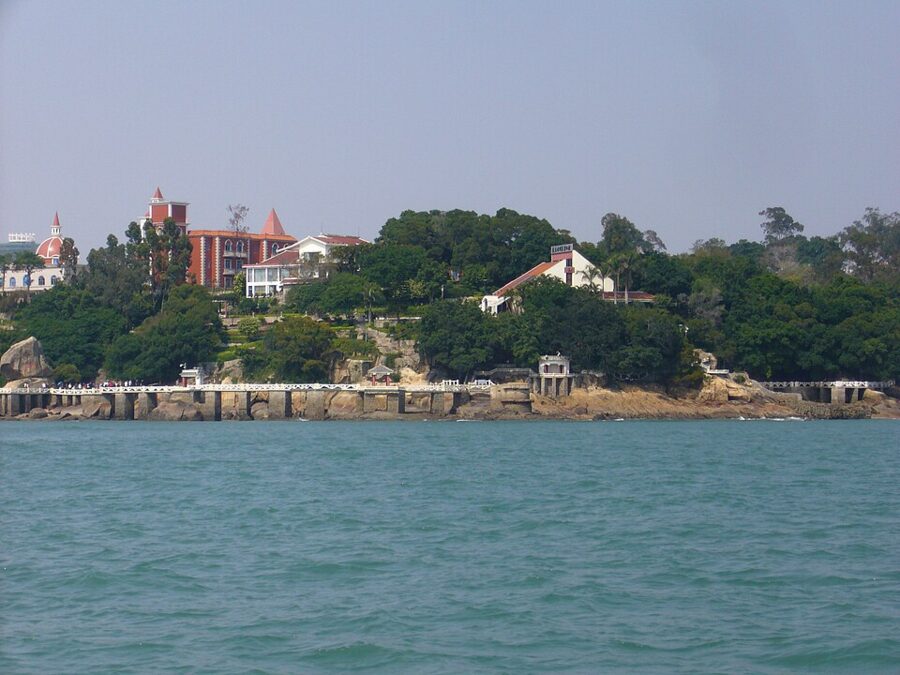
Bagua Lou (八卦楼), the Eight Trigrams Building, is the biggest house on the island and the first thing you see from the boat. Lin Heshou, a cousin of Lin Erjia, began it in 1907 to a design by John Otte, the hospital doctor, who also worked as an architect. The money ran out. The dome, ribbed in eight segments above an eight-sided platform, which gave the building its name, was only closed in 1930, twenty-three years after work began.
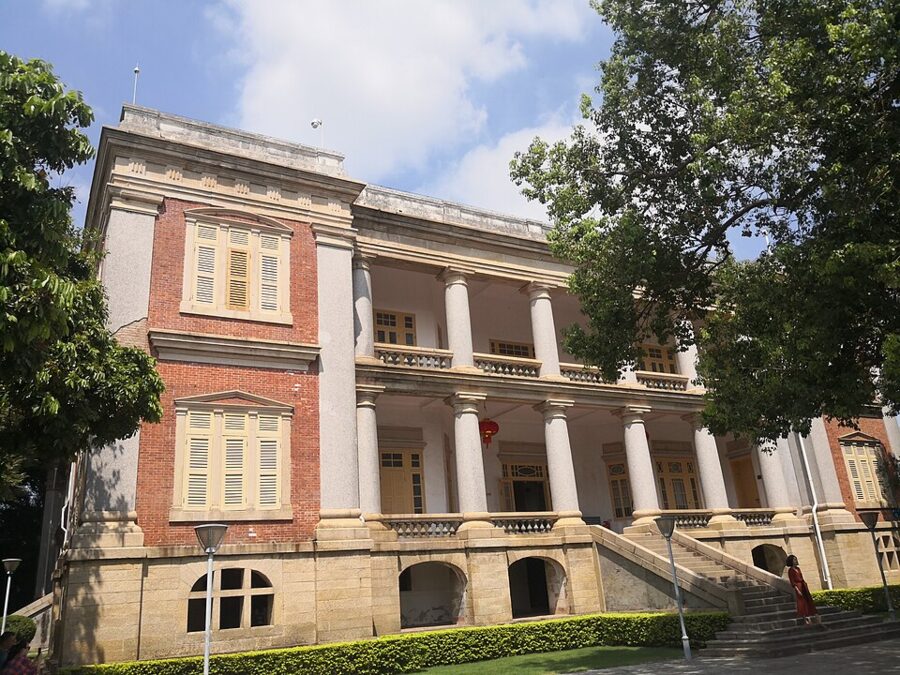

The city made it the Xiamen Museum in 1983. Since 2006 it has housed the Gulangyu Organ Museum, built on the collection of Hu Youyi, a Gulangyu-born collector who settled in Australia; the centerpiece is a 1909 Norman and Beard pipe organ with 1,350 pipes and three manuals. A long restoration from 2021 replaced failing mortar with traditional shell-lime and restored the red-brown window frames, and the building reopened on February 6, 2024.
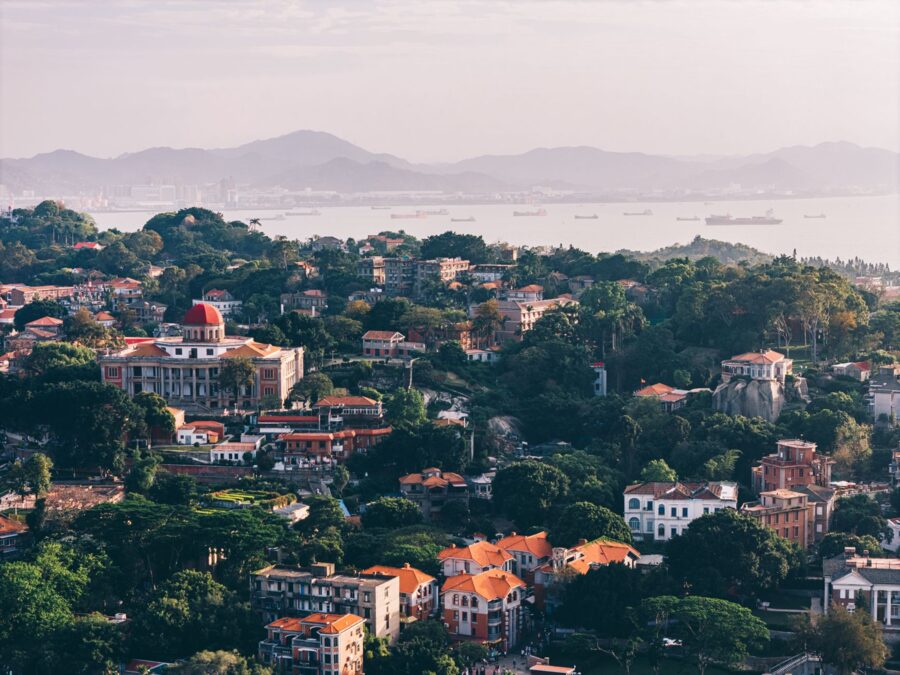
Bagua Lou opens 08:30–17:30 from October to May and to 18:00 in summer, at 43 Guxin Road. Entry is 30 yuan since September 2025. Time your visit to one of the explanation-and-performance sessions at 09:30, 10:30, 11:30, 14:30, 15:30 or 16:30: the organs are the point, and hearing one is worth planning around.
Guxin Road: a hospital turned museum
Walk south along Guxin Road past the former HSBC residence, built in 1876, to the arcaded brick blocks of John Otte’s Hope Hospital at No. 80. Since 2017 they have held a branch of the Palace Museum in Beijing, showing objects from more than twenty countries that entered the Qing imperial collection alongside Chinese pieces. In December 2025 it was renamed the Gulangyu Palace Museum Gallery (鼓浪屿故宫文物馆), with 226 objects on show.
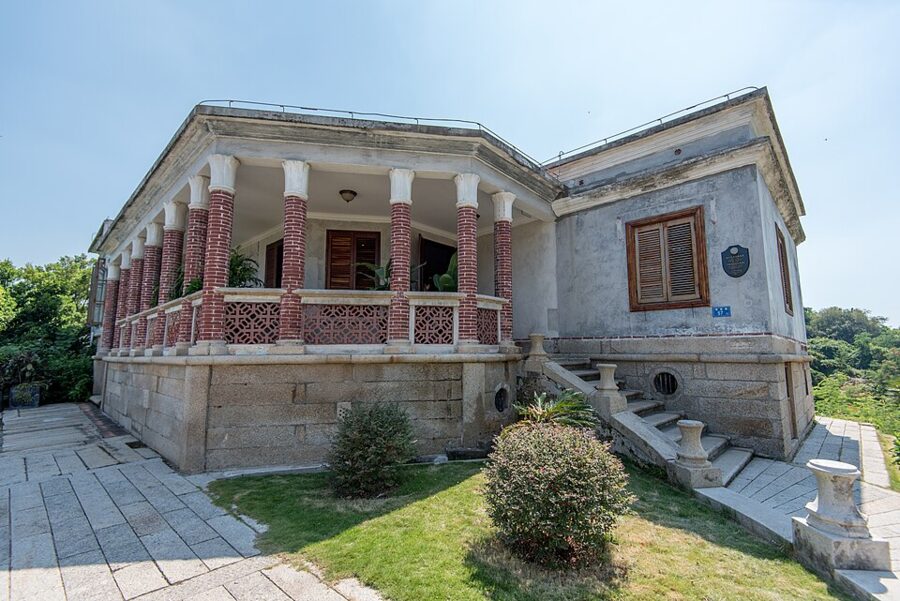

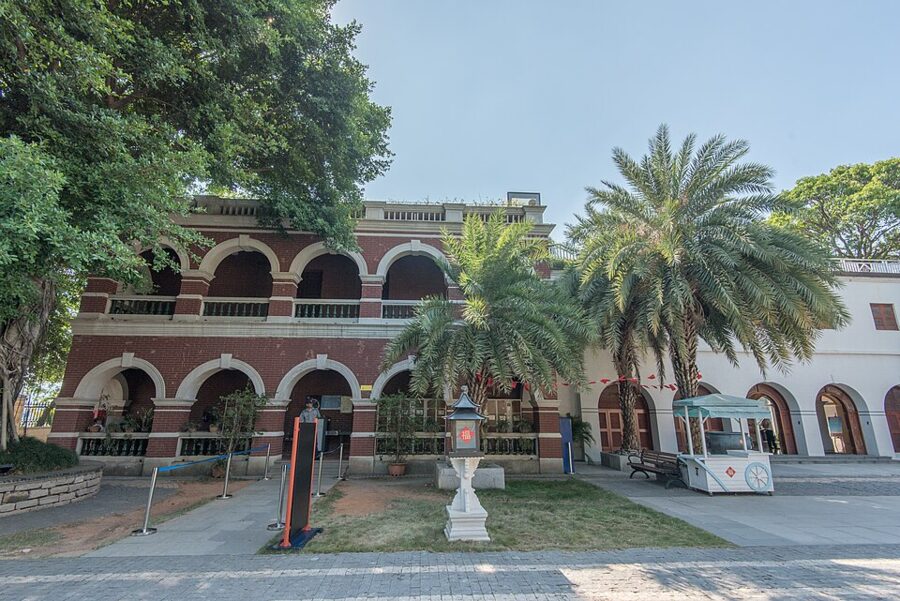

It costs 25 yuan and opens 09:00–18:00, last entry 17:30, with late opening to 20:00 at weekends and on holidays. If you have time for only one museum on the island and you are not an organ person, I’d make it this one.
Fujian Road: Haitian Tanggou and Huang Rongyuan Tang
Haitian Tanggou (海天堂构, “a hall built between sea and sky”) is a group of five villas built between 1921 and the early 1930s by Huang Xiulang and his fellow townsman Huang Nianyi, both from the Philippines. It is the only villa group on the island laid out along a symmetrical axis, the way a Chinese mansion would be.
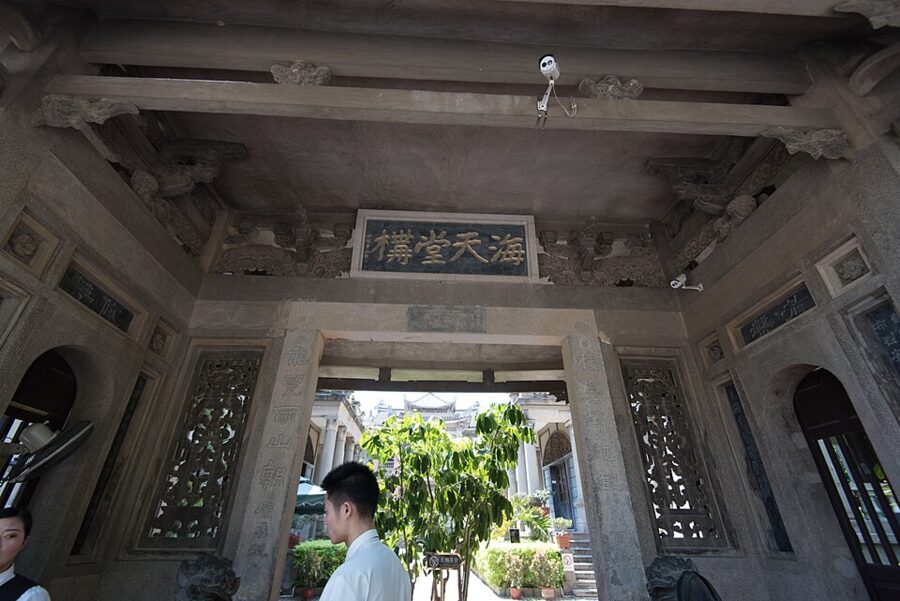

Three of the five buildings are open: the central villa, No. 38, as an architecture museum, No. 42 as a performance space for nanyin, the slow ballad music of southern Fujian, and for glove puppets, and No. 34, which has been run as a bookshop.
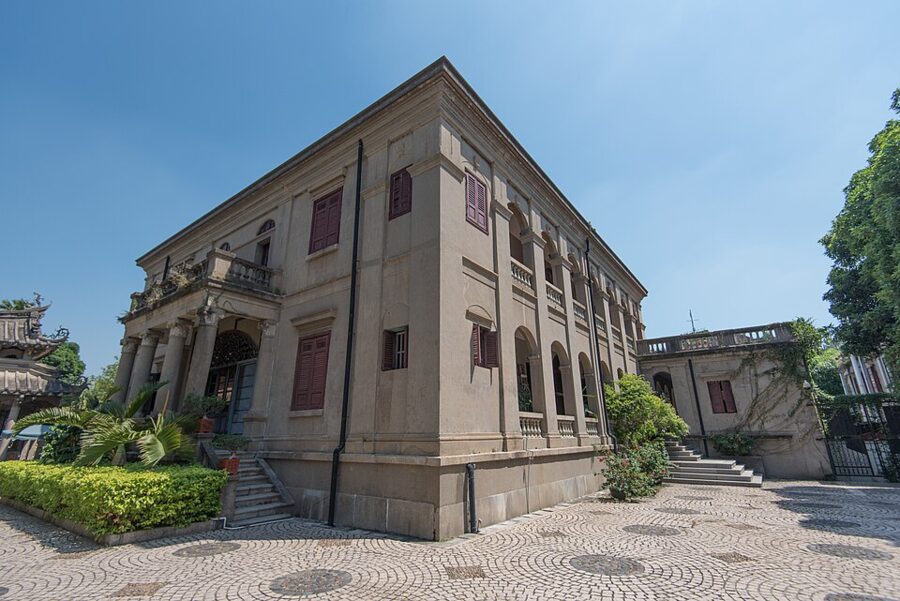

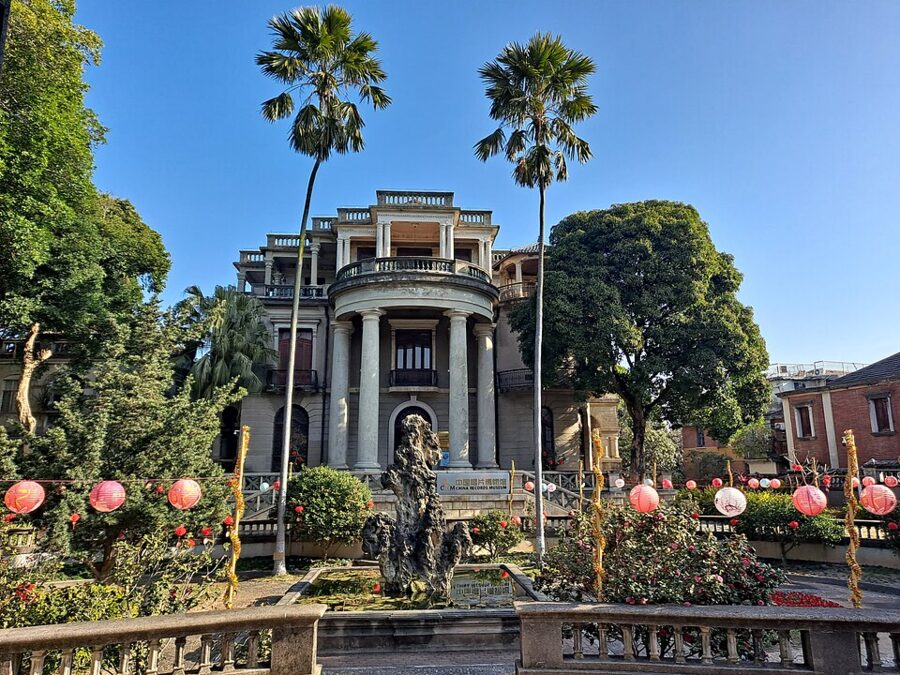
A few doors along at 32 Fujian Road, Huang Rongyuan Tang was built in 1920 for Shi Guangming, another merchant from the Philippines, and later sold to Huang Zhongxun, who had made his fortune in French Indochina; sources date the sale to 1931 or 1937. Its curved Tuscan portico is one of the most photographed fronts on the island. Since 2017 it has housed the China Record Museum, whose collection includes the first master disc of “March of the Volunteers”, the song that became China’s national anthem.
Lujiao Road and the consulates
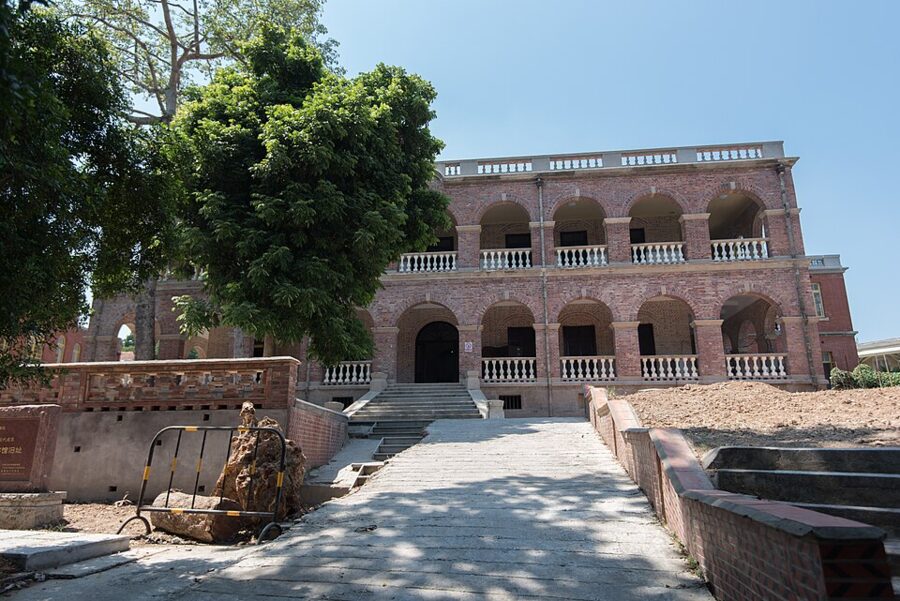
From Fujian Road drop down to Longtou Road, the shopping street, and turn onto Lujiao Road along the east shore. This is consulate row. The former Japanese consulate at number 26, red brick with deep arcades, was built in 1897–98, and the 1902 regulations were signed inside it. Behind it stand the consular police headquarters of 1928.

The British consulate stood at No. 14, and the British consul’s residence was among the heritage buildings restored in 2025. The former American consulate of 1930 is a short climb away at 26 Sanming Road, on the bluff from which Lai Afong had taken his photograph sixty years earlier.
Three churches
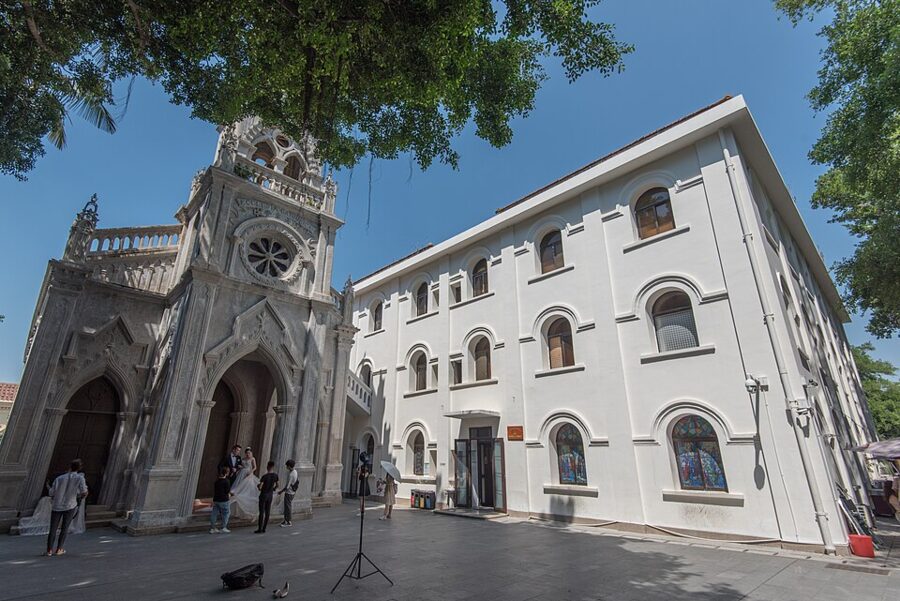
The Catholic church at 34 Lujiao Road is a small white Gothic building of 1917, built by Spanish Dominicans on land that had held the Spanish and then the French consulate. Its single bell tower and pointed windows are pure Gothic revival, rare on an island of verandas.

Trinity Church at 67 Anhai Road is bigger and later. Three Protestant congregations joined to build it in 1934–36, to a design by a German-trained Chinese architect working with a Dutch engineer, and the name refers both to the three churches and to the doctrine. The octagonal bell tower and ceiling took until the autumn of 1945 to finish. It opens its doors for Sunday morning worship.
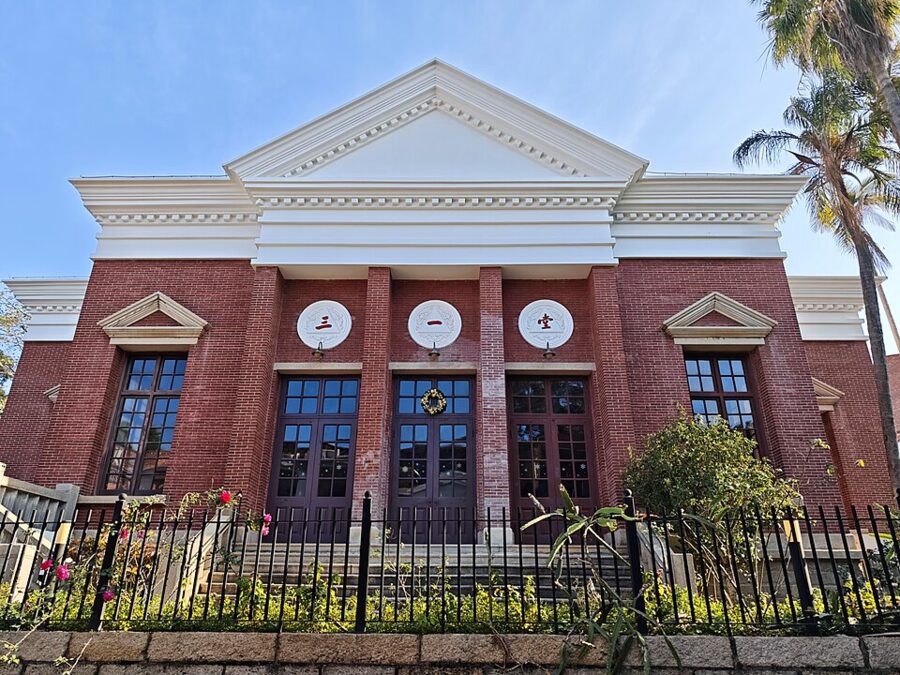

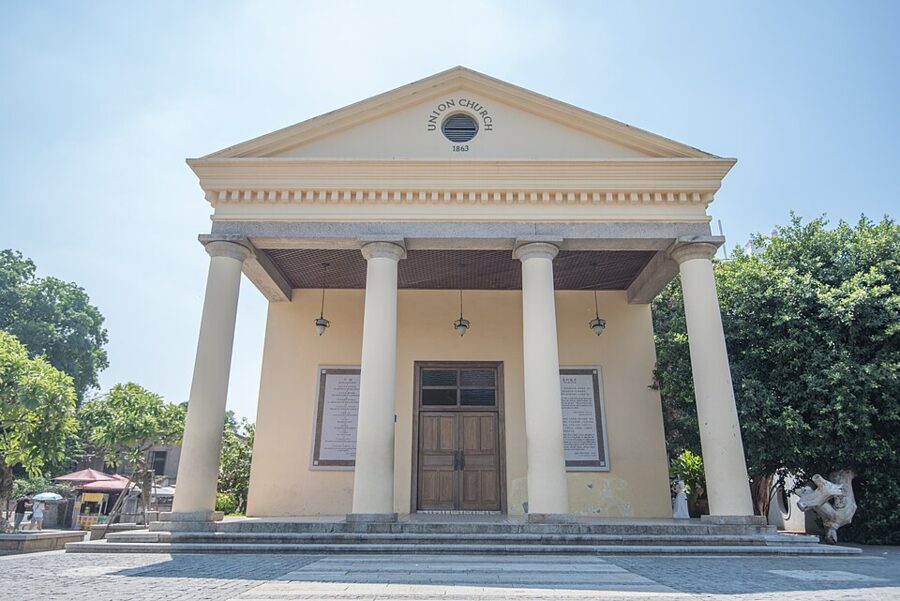
The Union Church, off Fujian Road, is the oldest congregation of the three, founded in 1863 for English-language services. It is a single hall behind four Tuscan columns, closer to a Greek temple than to anything Gothic.

What you can go inside
Most of the island’s houses are seen from outside. These are the ones you can enter, with the government ceiling prices that took effect on September 15, 2025:
- Bagua Lou and the Organ Museum: 30 yuan.
- Gulangyu Palace Museum Gallery, in the former Hope Hospital: 25 yuan.
- Organ Art Center: 25 yuan.
- Haitian Tanggou: the courtyard and the open villas.
- Huang Rongyuan Tang: the China Record Museum.
- Trinity Church: Sunday mornings only.
- Yu Garden, the memorial garden to Lin Qiaozhi: free, 08:00–17:30.
The 2025 price notice also confirms Sunlight Rock at 50 yuan, Shuzhuang Garden at 30 yuan, Haoyue Garden at 10 yuan and the International Carving Art Museum at 5 yuan.
The piano island: museums, a hall, and what is still real
Western music came with the missionaries. Hymns were sung in the churches from the 1860s, the mission schools taught music, and returning families brought pianos home to their villas. By the twentieth century Gulangyu was producing professional musicians at a rate no Chinese town of its size could match.
The best known is the pianist Yin Chengzong, born in Xiamen in 1941 and raised on the island, who took second prize at the Tchaikovsky Competition in 1962 and was one of the composers of the “Yellow River” Piano Concerto in 1969. His family house stands at 16 Jishan Road. Before him came Zhou Shu’an and Lin Junqing, and after him the pianist Xu Feiping and the conductor Chen Zuohuang.
The claims built on that are worth reading carefully. The island is often said to have the highest number of pianos per head in China, and in 2002 the Chinese Musicians Association named it the “Island of Music”. A music school affiliated with Xiamen University opened here in 1990, and a piano school affiliated with the Central Conservatory of Music in 2006.
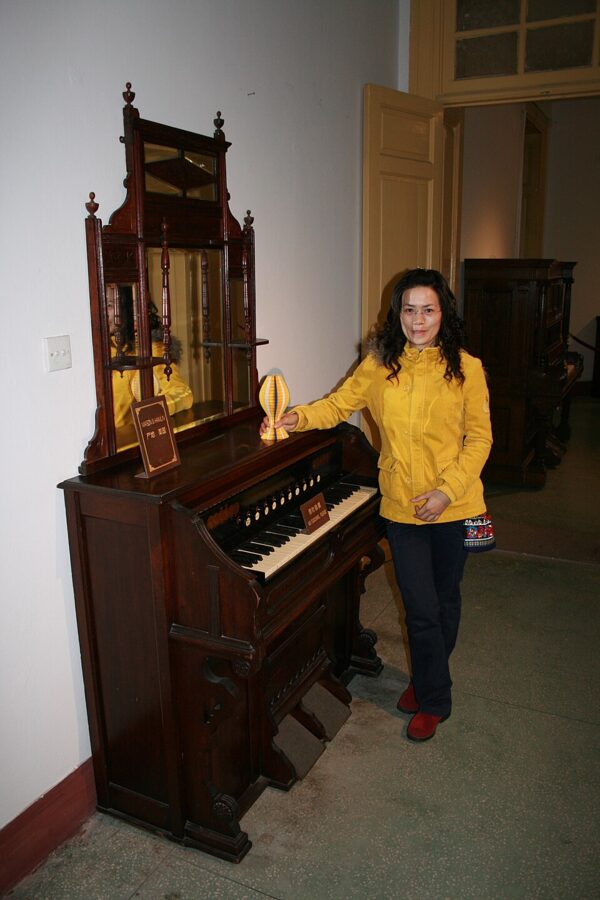
The Piano Museum in Shuzhuang Garden
Hu Youyi, born on Gulangyu in 1936, spent his career in Australia collecting antique pianos, and on January 8, 2000, he opened China’s first piano museum in the Tingtao Xuan, the “listening to the waves” hall at the back of Shuzhuang Garden. A second hall followed in 2001. The collection runs from square pianos and a hand-cranked piano to gilded cases, one of the earliest and largest uprights, and pedal-operated player pianos about a century old.
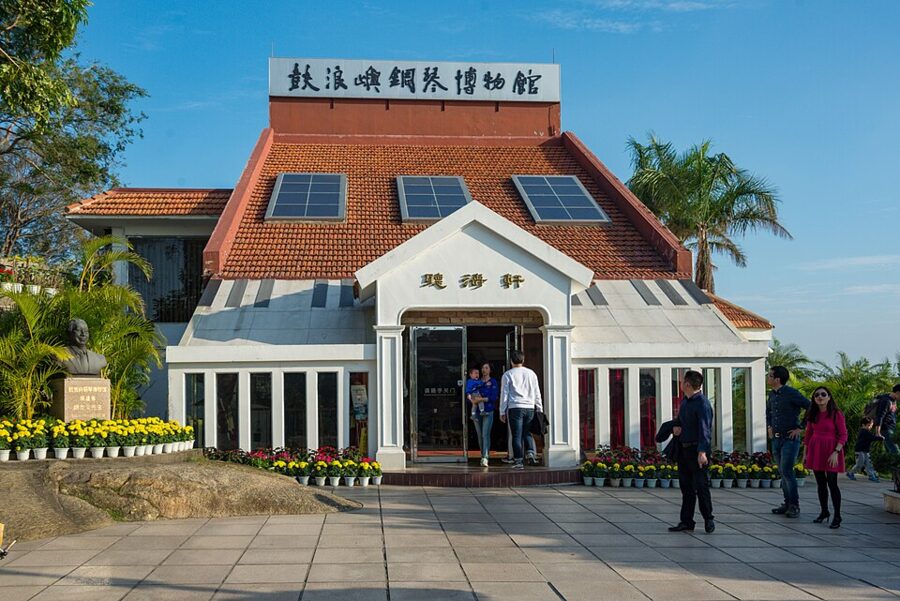

The museum keeps the garden’s hours, 08:30–17:30 from October to May and to 18:00 in summer. The first hall demonstrates its player pianos after short talks at 09:30, 10:30, 14:30, 15:30 and 16:30; the second hall has live playing after talks at 10:00, 11:00, 15:00, 16:00 and 17:00, and a music salon at 15:30 on Saturdays. The scenic area’s Shuzhuang Garden page posts any changes.


The concert hall and the festivals
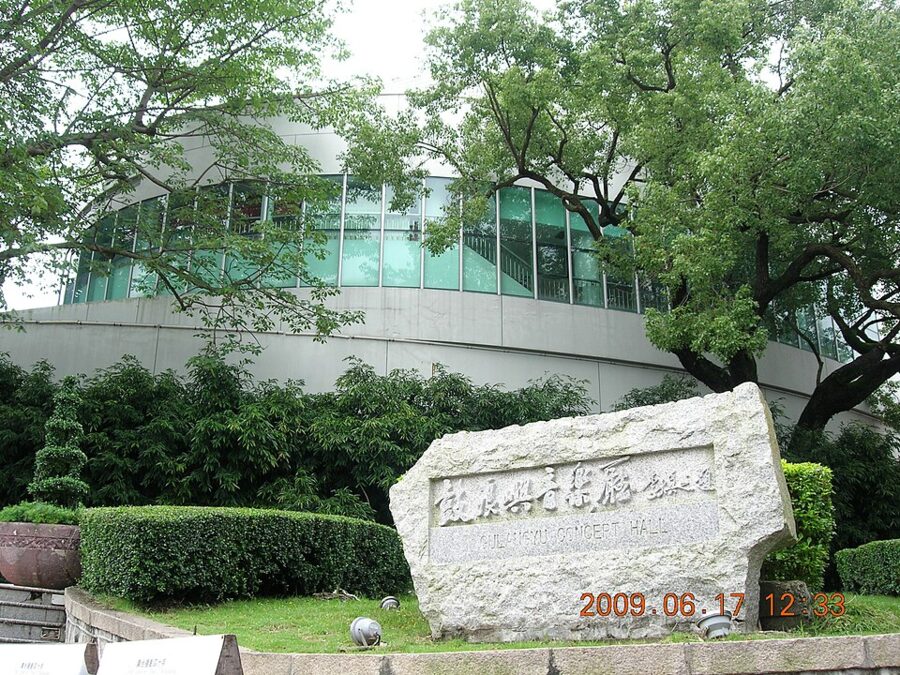
The Gulangyu Concert Hall opened in 1987 and was renovated in 2001 as a 571-seat hall designed for unamplified sound. It hosts concerts most months, and the island’s management runs a calendar around it: a music season, a poetry festival, a New Year concert and the Gulangyu Piano Arts Week, whose fifteenth edition ran from September 30 to October 6, 2026, with recitals in courtyards and squares as well as in the hall. In 2025 the administration also signed the organist Ludger Lohmann and the pianist Marc-André Hamelin to its artists-in-residence program.

So how much is real? The museums and the hall are, and the festivals have grown. The resident island has shrunk: about 12,500 people lived on Gulangyu in 2023, and many of the old families have long since moved to Xiamen or abroad. In the daytime you will hear more amplified pop from Longtou Road than practice scales from the villas.
Walk the quiet lanes of the north and west after the day boats have gone, though, and you may still hear a piano through a window. I would not promise it.
Sunlight Rock, Shuzhuang Garden and the south shore
The island has five state-run “core sights”: Sunlight Rock, Shuzhuang Garden and Haoyue Garden in the south, Bagua Lou in the northeast, and the small International Carving Art Museum. All of them open 08:30–17:30 from October through May and 08:30–18:00 from June through September, closing and clearing at those times.
Sunlight Rock
Sunlight Rock (日光岩, Riguangyan) is the island’s summit at 92.7 meters, two giant boulders leaning together on top of a granite hill. The climb is mostly stone steps between inscribed rocks, and the view from the railings at the top covers the whole island, and the Xiamen waterfront across the strait.
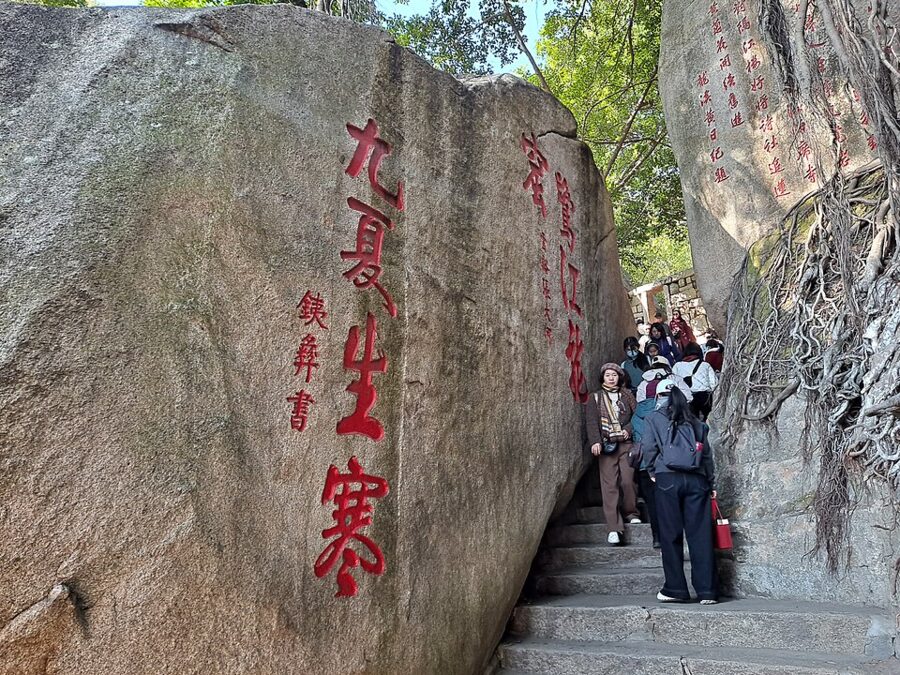
On the way up you pass the Sunlight Rock Temple, sheltered under a single overhanging boulder, the 1573 inscription, and the remains of Koxinga’s camp gate and water-drill platform. The 50-yuan ticket also covers the Qin Garden on the next hilltop, where Koxinga is said to have planted his flags. A 202-meter cable car once linked the two; it was taken down in 2012 as part of the clean-up for the World Heritage nomination.

Go early. Sunlight Rock’s managers set its comfortable capacity at 650 people at a time, and the summit stairs are narrow enough to queue by late morning. It is one of the few places on the island where arriving at 08:30 changes the visit completely. The published capacity figures for each of the core sights explain why queues form where they do.
Shuzhuang Garden
Lin Erjia built Shuzhuang Garden (菽庄花园) in 1913 on the south shore, and named it with a pun on his courtesy name, Shuzang. His father had brought the family from Taiwan after Japan took the island in 1895. In 1955 his family gave the garden to the city.
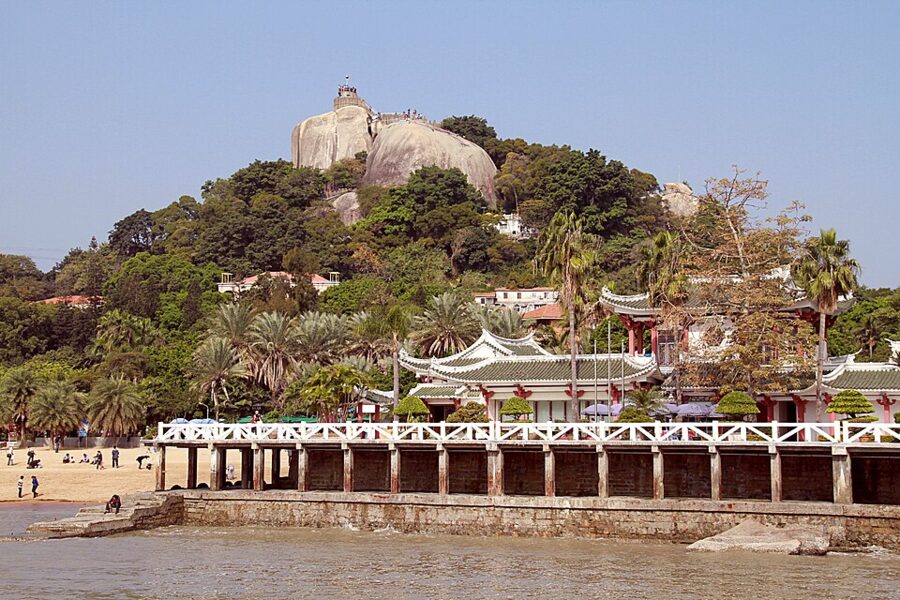

It covers 20,328 square meters in two parts. The “hidden sea” half has the Forty-Four Bridges, a white zigzag causeway laid over the surf, and pavilions that open suddenly onto the water. The “mending the hill” half is a rockery maze of tunnels and grottoes called the Twelve Caves, built from coral-like stone and easy to get lost in.
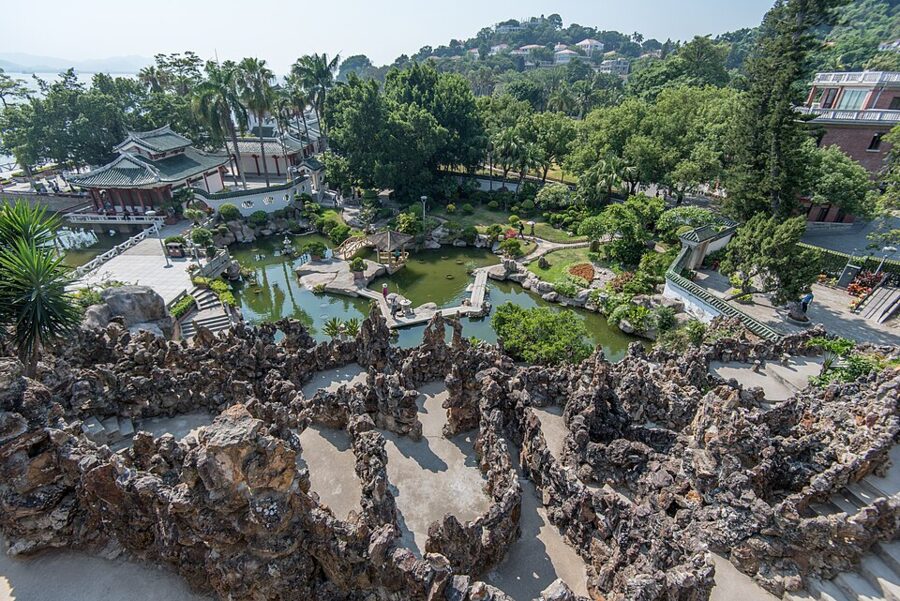

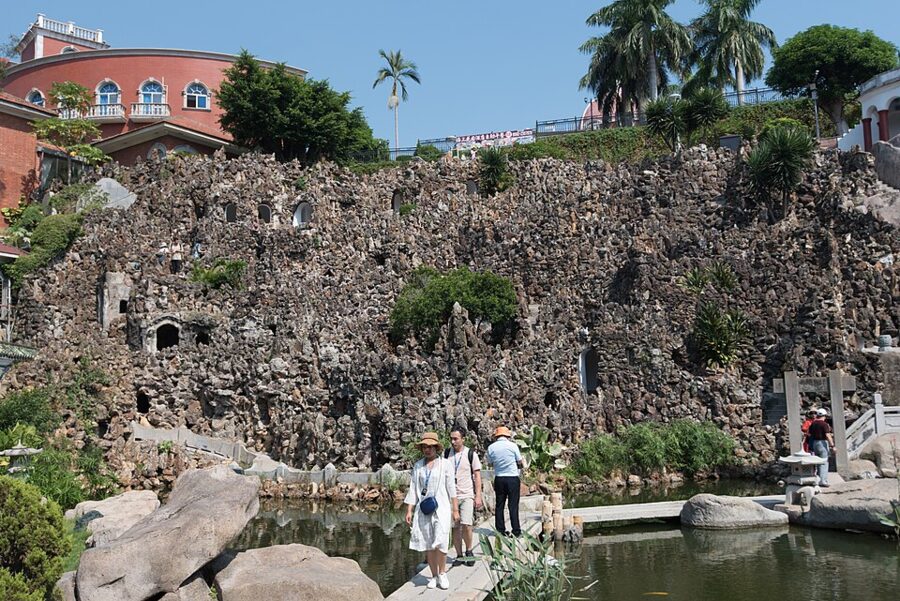

The Piano Museum sits at the back of the garden, so the 30-yuan garden ticket covers both. The garden’s own talks on its history run at 10:00, 11:00, 14:00 and 15:00. Give the pair two hours.
Haoyue Garden and the Koxinga statue
Haoyue Garden (皓月园), at 3 Zhangzhou Road on the island’s southeast point, is a sculpture park dedicated to Koxinga; its name comes from one of his poems. The statue, unveiled on August 27, 1985, stands on Fuding Rock, which juts thirty meters into the sea. It is 15.7 meters tall and made of 625 blocks of white Quanzhou granite, and it shows Koxinga in armor, hand on sword, facing the strait toward Taiwan.
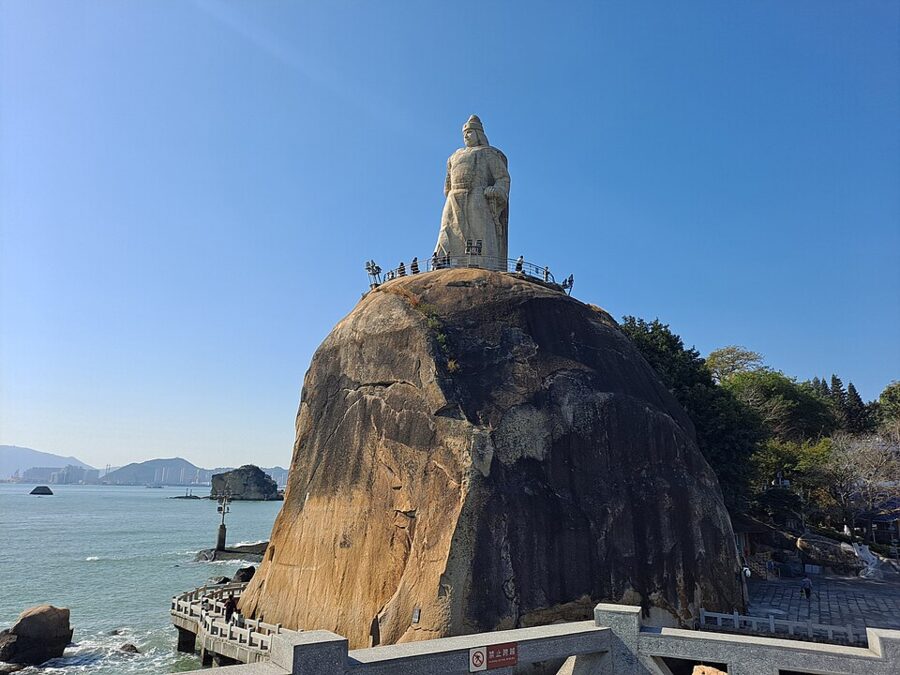
The garden ticket is 10 yuan, the cheapest of the core sights after the carving museum. The statue can also be seen from the shore path outside, so whether you go in is a question of how close you want to stand.
The beaches, and Yu Garden
Gangzaihou beach, just west of Shuzhuang Garden, is the island’s main beach: free, open all day and all year, with fine sand, a gentle slope and calm water. It was the venue for the national Optimist sailing championships in 1998, and in summer it fills with swimmers. Smaller coves run along the south and east shore toward Haoyue Garden.
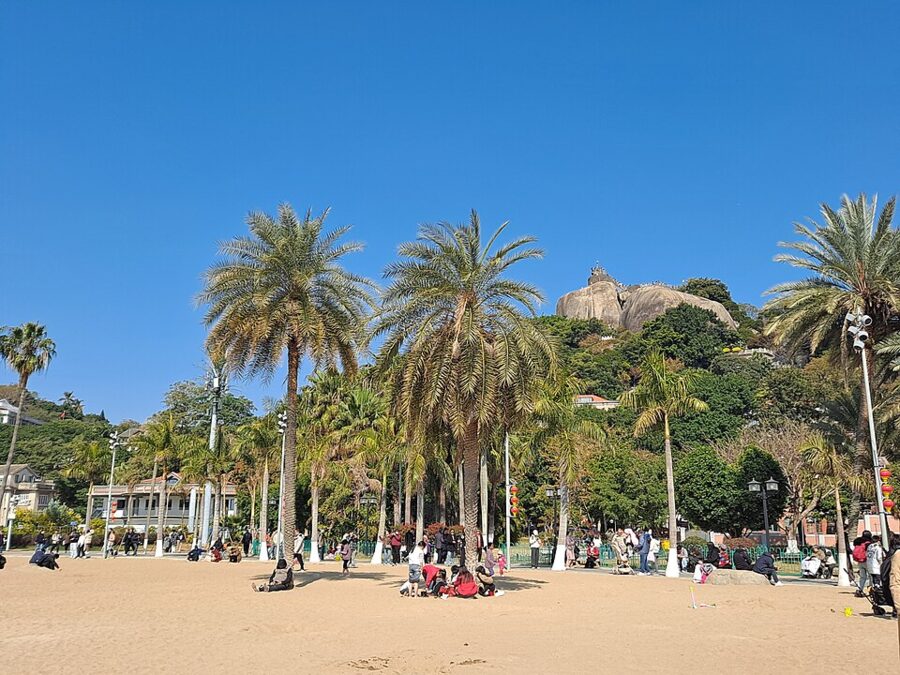
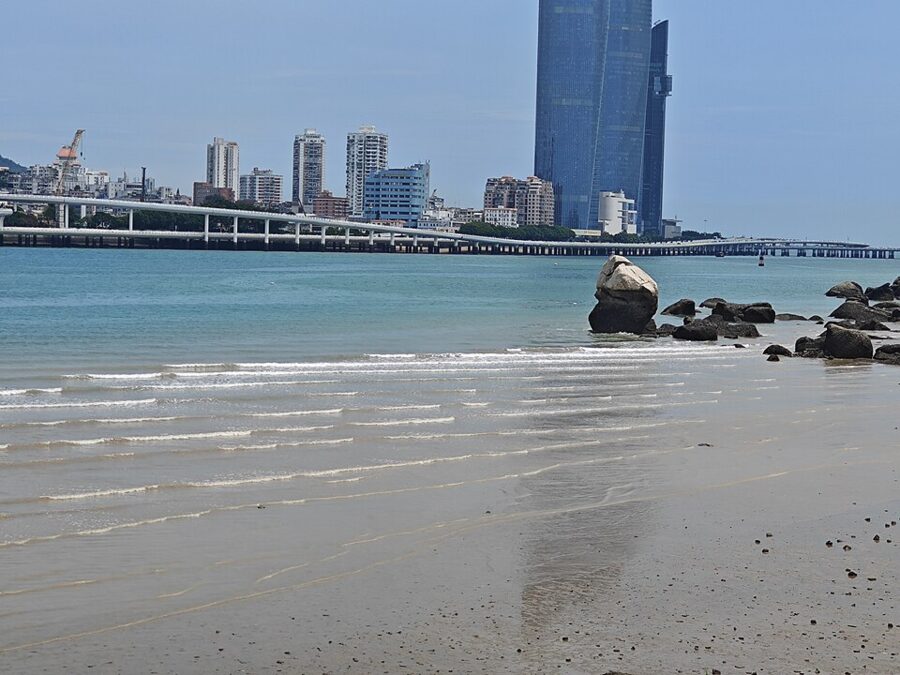

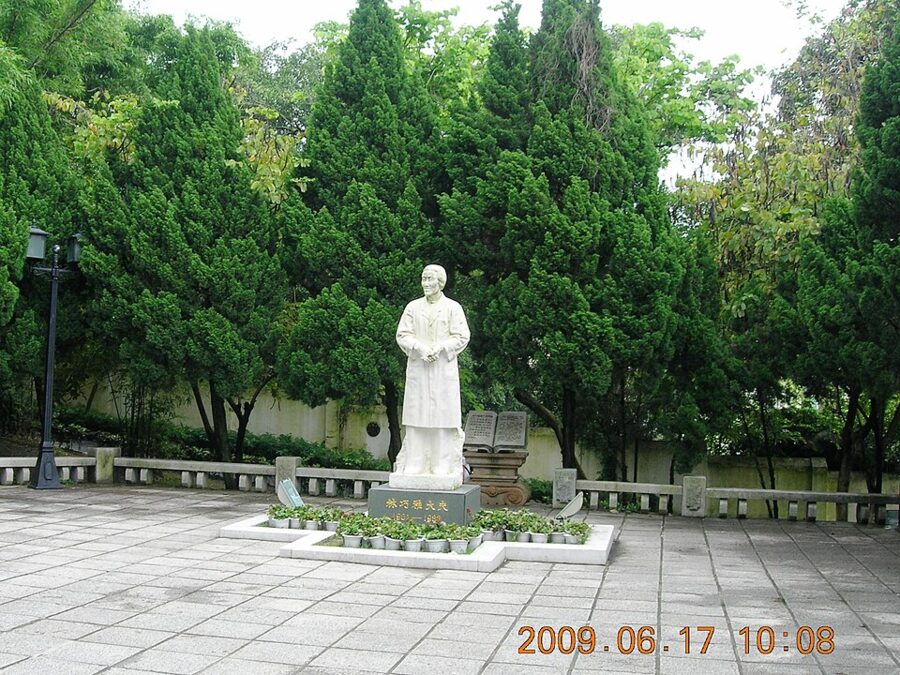
Yu Garden (毓园) on Fuxing Road is free and quiet, and it honors Lin Qiaozhi, born in 1901 below Sunlight Rock, who became China’s leading obstetrician and delivered more than 50,000 babies. Her ashes were placed here in 1988. It is a short detour from the south-shore sights and a good place to sit in the shade.

Which sights are on the combined ticket
The five-sight combined ticket covers Sunlight Rock with the Qin Garden, Shuzhuang Garden with the Piano Museum, Haoyue Garden, Bagua Lou with the Organ Museum, and the International Carving Art Museum. The administration’s posted price list gives it as 90 yuan, but that list predates the September 2025 rise for Bagua Lou, and some 2026 listings quote 100 yuan, so check the figure in the booking mini program before you pay. Singly, the five now add up to 125 yuan.
Is it worth it? Only if you will really go into four or five of them. Sunlight Rock and Shuzhuang Garden together cost 80 yuan, and those are the two that most people would choose. Fewer and fewer people buy the combination: from January to October 2026 only 97,900 combined tickets were sold.
Ferries, tickets and the daily cap
There is no admission fee for the island itself. The thing you book is the ferry, run by Xiamen Ferry, and its rules shape the visit.

Which pier
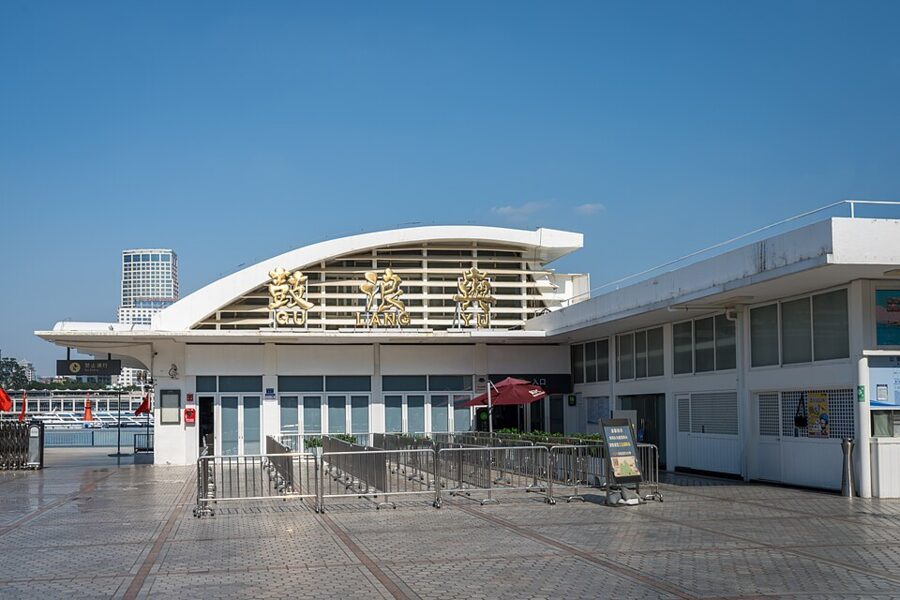
Since October 2014 the residents’ ferry and the visitors’ ferry have run from different piers, and you cannot use the residents’ line from the Xiamen Ferry Terminal to the Piano Wharf. By day you cross from one of three piers:
- Dongdu Passenger Terminal (东渡客运码头, at the cruise terminal on Xiamen Island): boats to Sanqiutian 07:30–17:30 and to Neicuo’ao 08:10–17:10. This is the main route.
- First Pier (第一码头, near the old town): to Neicuo’ao 08:45–16:45.
- Songyu Passenger Terminal (嵩屿客运码头, in Haicang on the mainland): to Neicuo’ao 07:30–17:50, and to 19:00 from June to September.
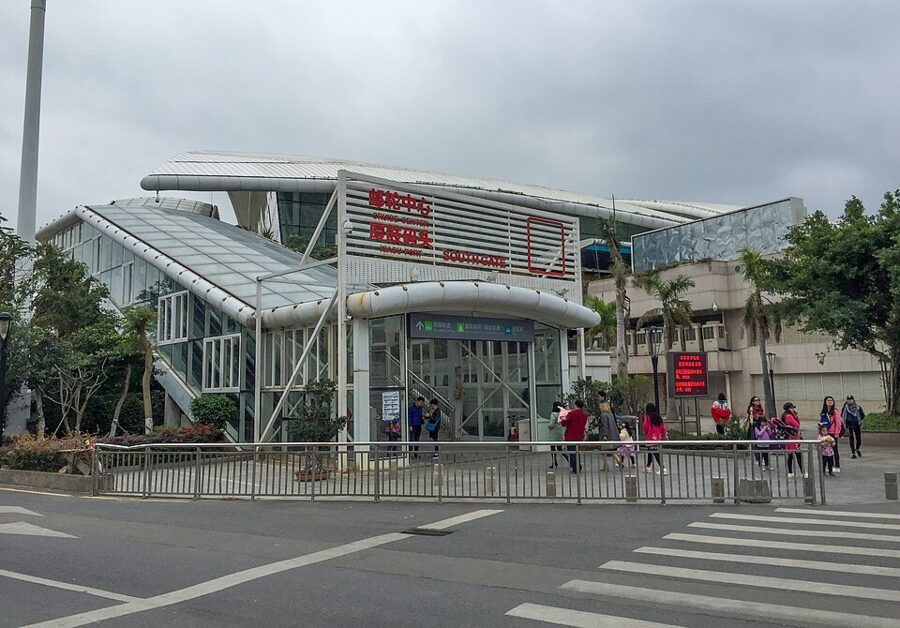

After dark, visitors cross from Hall 2 of the Xiamen Ferry Terminal near Zhongshan Road, the city’s old waterfront. Night boats to Sanqiutian run from 17:50 (18:50 from June to September) until 06:30 the next morning, and between 00:45 and 04:45 they go to the Piano Wharf instead. The night crossing takes about seven minutes. These are the times in force since November 16, 2026, set out in the operator’s timetable notice.
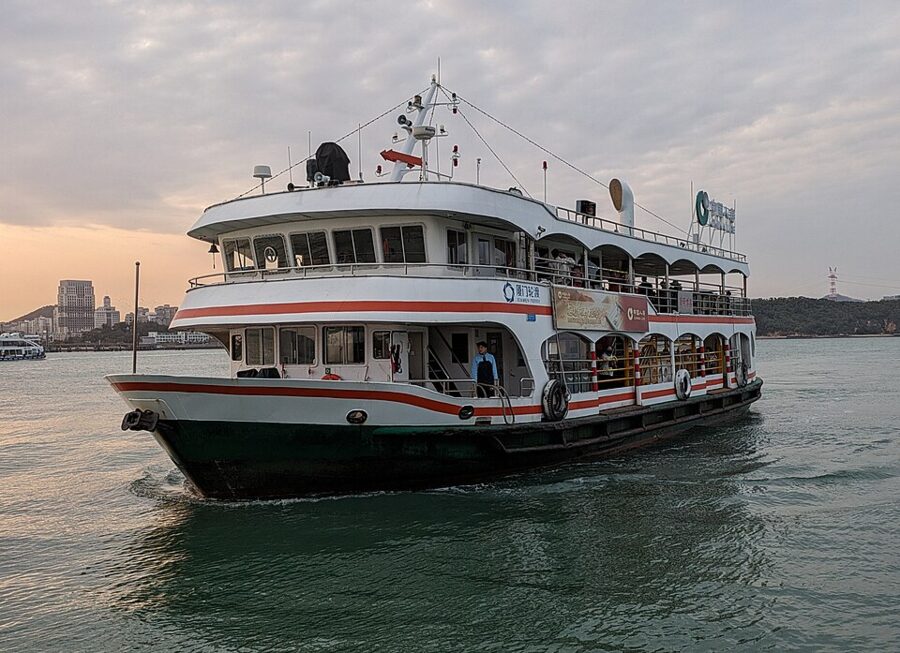
Which island pier should you choose? Sanqiutian puts you next to Bagua Lou and Longtou Road, and its morning boats sell out first. Neicuo’ao, on the west side, is closer to the beaches and to the quieter northern lanes, and leaves you a longer walk to the busy core. For an architecture walk, Sanqiutian is the better start.
Booking and the cap
Tickets are sold through the official “屿见厦门” (Yujian Xiamen) mini program in WeChat or Alipay, which is the ferry company’s own channel. The standard round-trip fare is 35 yuan, with an 80-yuan premium cabin on some boats. Sales open fifteen days ahead, and new dates are released at 09:00 each day. There are ticket counters at the terminals, but on weekends and holidays the day’s visitor boats are usually gone online before anyone reaches them.
Tickets are in your real name. You book with your passport number if you do not hold a Chinese ID card, bring the same document, and the gate checks that the ticket, the document and your face match. Each adult can take two children under 1.2 meters or aged six and under for free; children aged six to fourteen, or 1.2 to 1.5 meters tall, pay half. Check-in closes ten minutes before sailing, and a missed boat means a new ticket, so the ferry company advises arriving 30 to 60 minutes early.
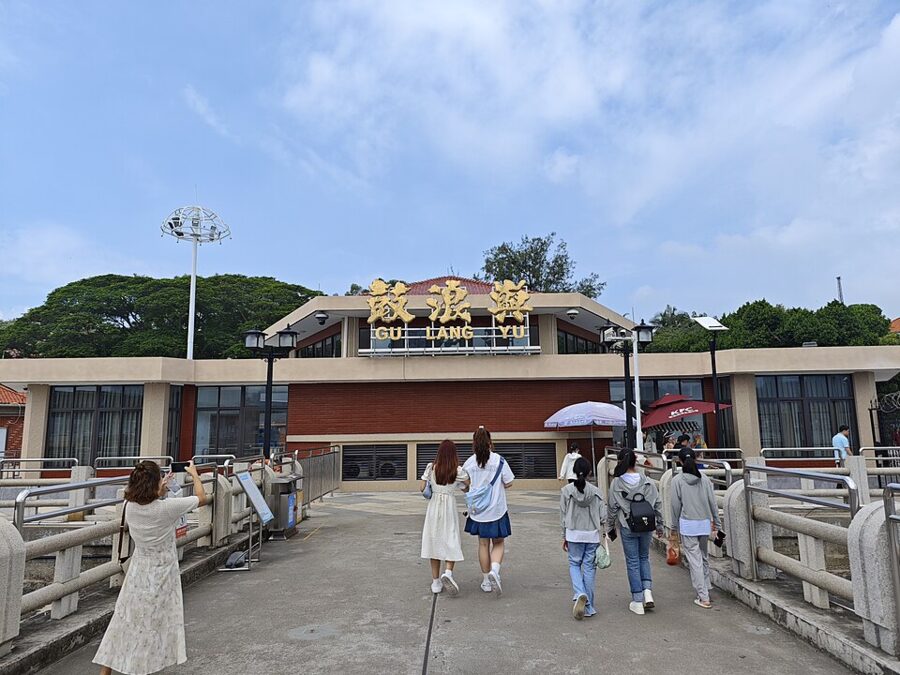

The cap is the reason for all this. In 2017 the island’s maximum carrying capacity was cut from 65,000 to 50,000 people a day, and since that figure includes residents and commuters, the World Heritage file gives the effective limit for visitors as 35,000. On ordinary days it is not reached: in October 2026 arrivals averaged 23,300 a day. On public holidays it is, and the daytime visitor boats on October 3 and 4, 2026, sold out completely.
Changes and refunds cost money as departure nears. A refund six days or more ahead is free; after that it costs 5 percent of the fare, rising to 10 percent inside 48 hours and 20 percent inside 24 hours, and from September 2026 a booking cancelled within 30 minutes of payment and at least four hours before sailing is refunded free once a day. The full schedule is on the ferry company’s visitor guide.
Coming back, and staying the night
Your ticket includes one free return trip within 20 days, on any boat and from either island pier. From Sanqiutian and Neicuo’ao, boats to Dongdu run 07:40–17:40. From 18:00 to midnight, and at 06:15, 07:00 and 07:20 the next morning, boats from Sanqiutian go to the Xiamen Ferry Terminal near Zhongshan Road instead. Between 01:00 and 05:00 a boat leaves the Piano Wharf every hour on the hour.
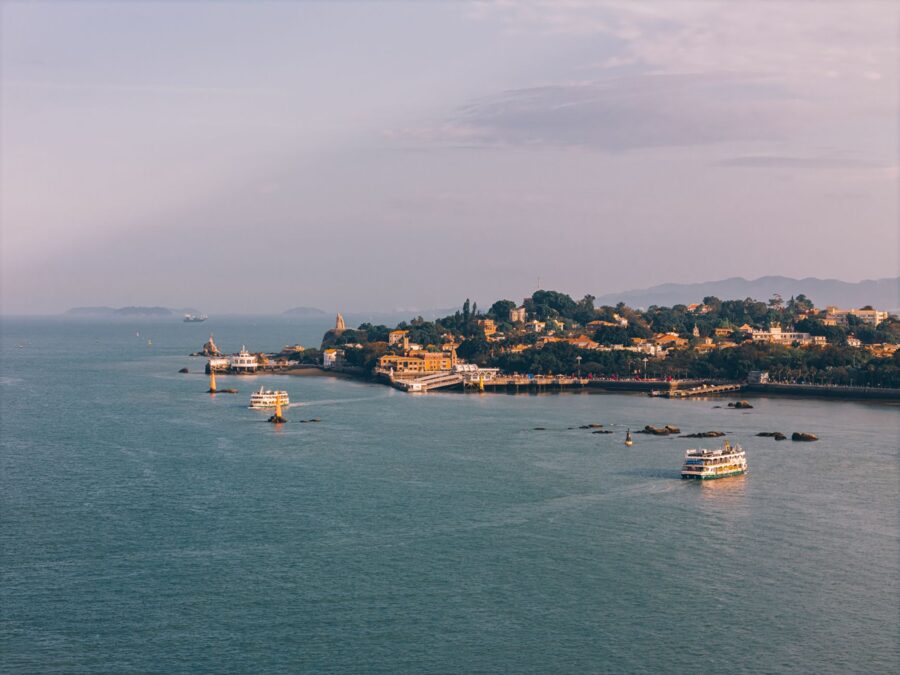
The 20-day return makes staying overnight simple: you book only the outbound boat. The island has many small guesthouses in old villas, and staying lets you see Gulangyu at its best, before the first boats at 07:30 and after the last day boats leave. Nothing on the island moves on wheels except the electric buggies and the handcarts that still carry freight, so pack light or expect to haul your bag up steps.
Two warnings. Typhoons and summer storms close the whole ferry network; it shut down three times in August and September 2026. Dates of official events also change the timetable: on December 3, 2026, the last boat from Dongdu leaves at 16:10, and night service from the Xiamen Ferry Terminal starts at 17:00, according to a notice of November 17.
A day and an evening on the island
Pick a weekday outside the holidays, book an 08:00 boat from Dongdu the morning sales open, and wear shoes made for steps. The day loops the island and ends on the east shore after dark.
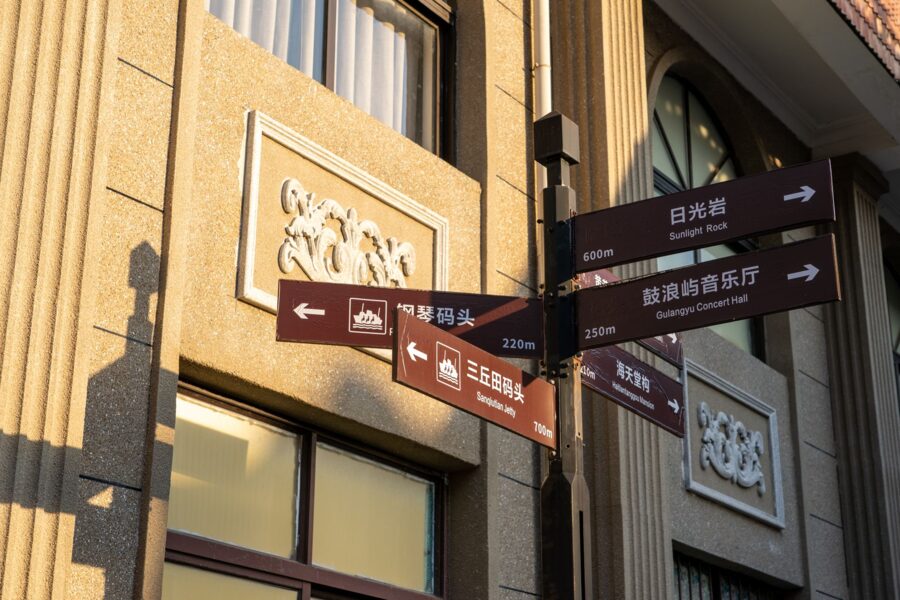
08:30, Sanqiutian to Sunlight Rock. Walk straight up through the lanes and be at the Sunlight Rock gate soon after it opens. For the first half hour the summit is nearly empty. Come down through the inscriptions and walk across to the Qin Garden on the same ticket.
10:00, Shuzhuang Garden and the Piano Museum. Cross the Forty-Four Bridges, lose yourself in the Twelve Caves, then catch the live playing in the second hall at 11:00. Step out onto Gangzaihou beach afterward.
12:00, lunch. The lanes around Longtou Road and the market behind it sell the Xiamen staples: shacha noodles in a peanut and dried-seafood broth, oyster omelet, fish balls and the cold sea-worm jelly called tusun dong (土笋冻). Eat where locals queue rather than where touts wave menus.
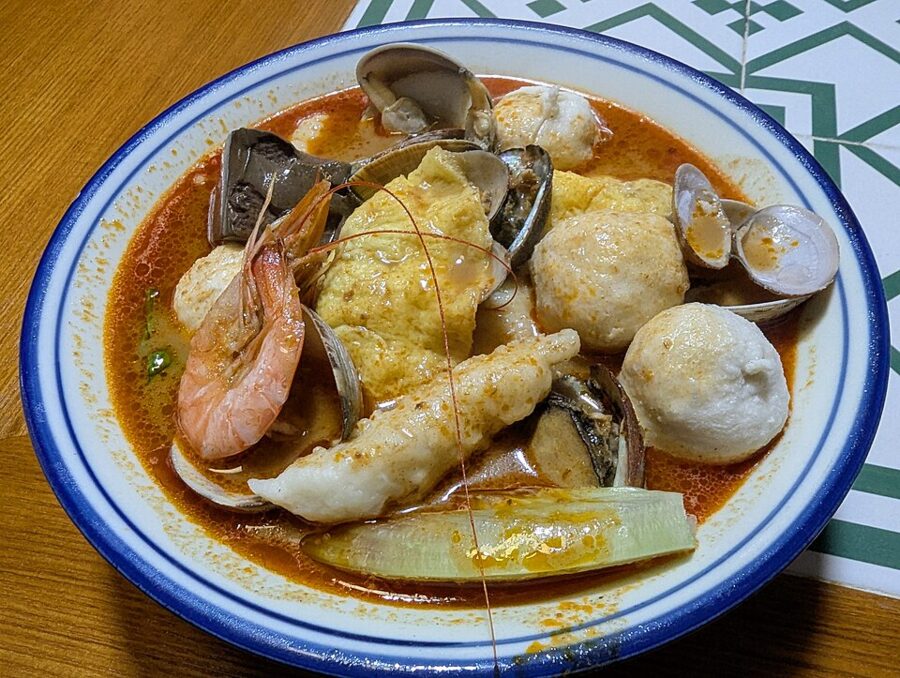

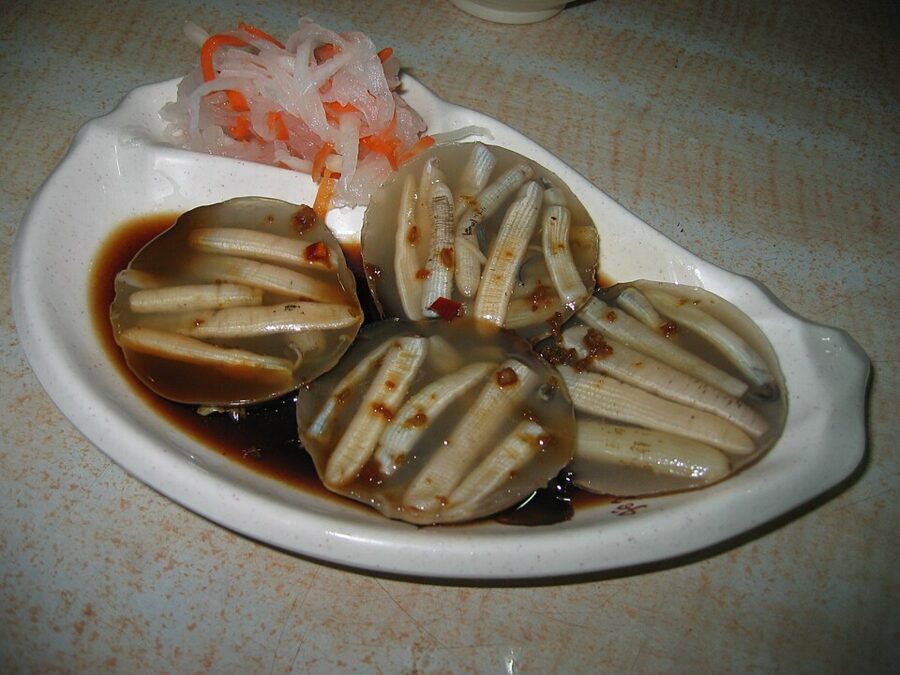

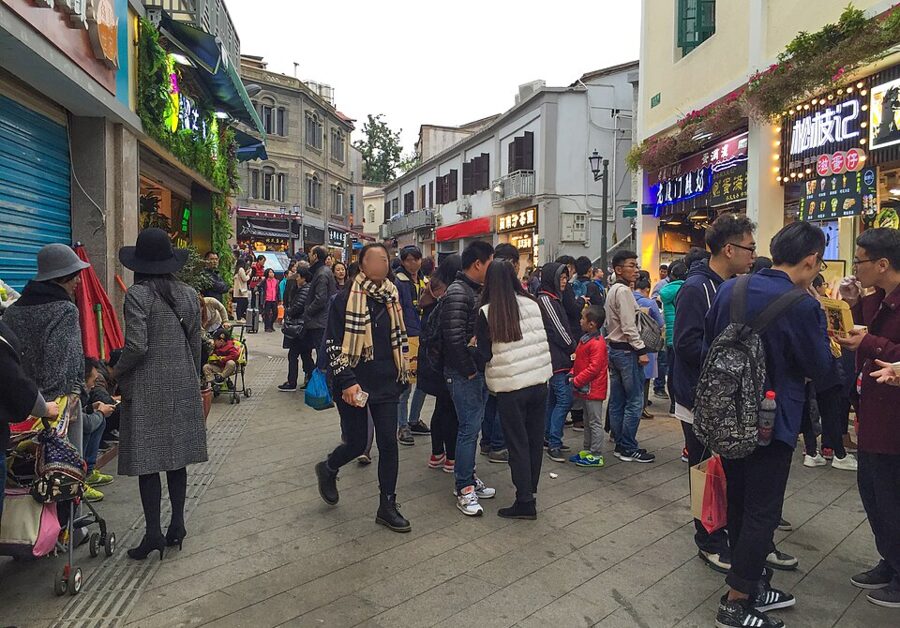

13:30, the architecture walk. Take the circuit in reverse: Lujiao Road and the consulates, Fujian Road for Haitian Tanggou and Huang Rongyuan Tang, then Guxin Road to the Palace Museum Gallery. End at Bagua Lou in time for the 15:30 or 16:30 organ session.
17:00, Haoyue Garden or the shore path. If there is time before closing, walk south to Koxinga’s statue; if not, follow the shore path round the southeast point as the light goes, with Xiamen’s towers lighting up across the water.
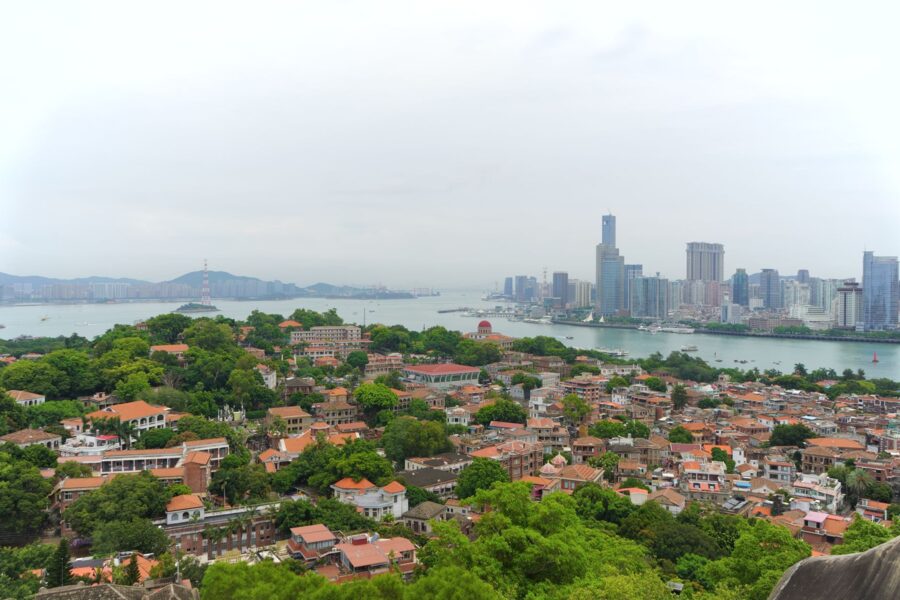
19:00, evening. With the day boats gone, the lanes of the north and west go quiet. Eat on the island, then walk back toward Sanqiutian after dark, past the floodlit Bagua Lou.
21:00, the night boat. Take any Sanqiutian boat to the Xiamen Ferry Terminal; they run until midnight and the crossing takes seven minutes. Sit on the open deck facing back.
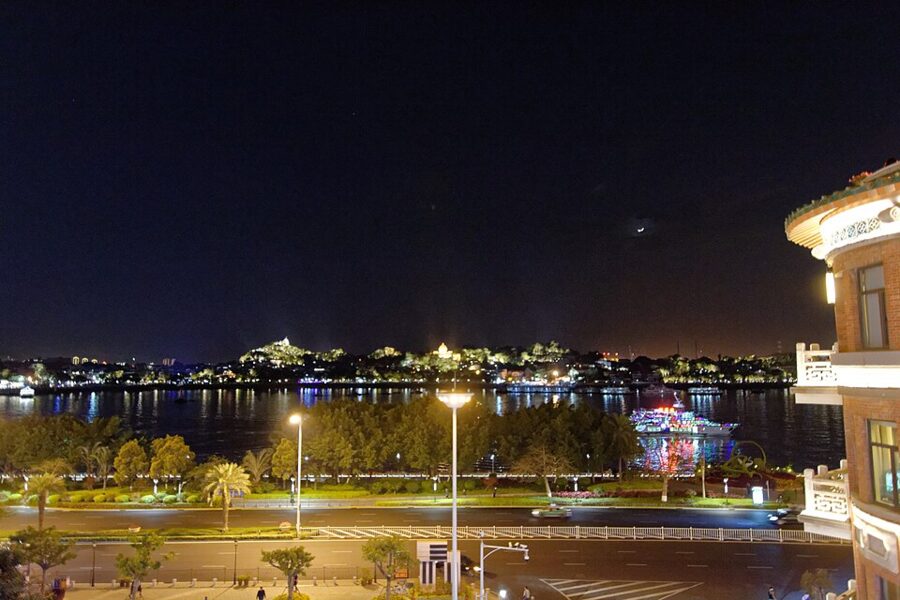

The boat swings out into the strait, Sanqiutian falls behind, and for a few minutes the whole hill is visible at once: the dome lit on its ridge, the rock dark above it, the villas showing as scattered windows. Then the Zhongshan Road pier comes up, and the island without cars is just a set of lights across 600 meters of water.