
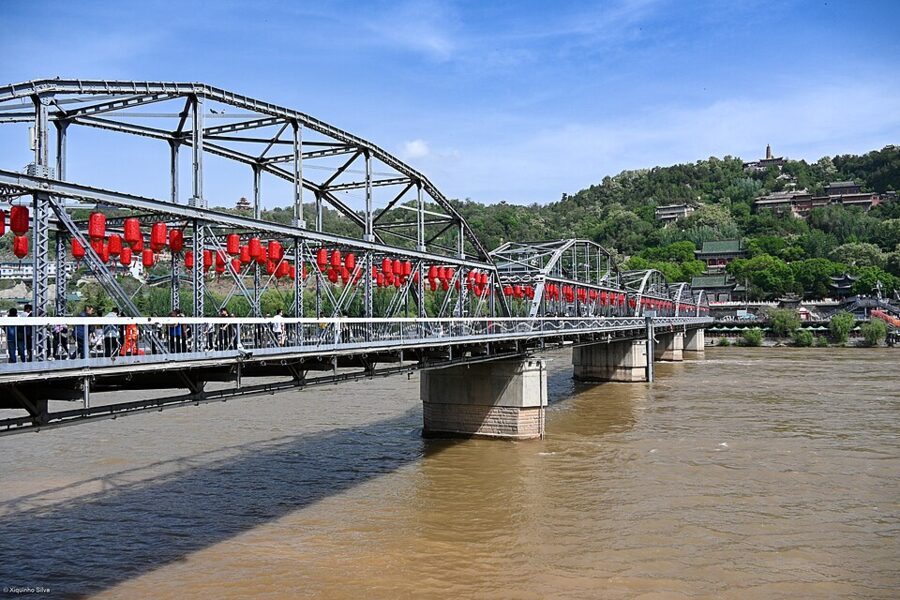

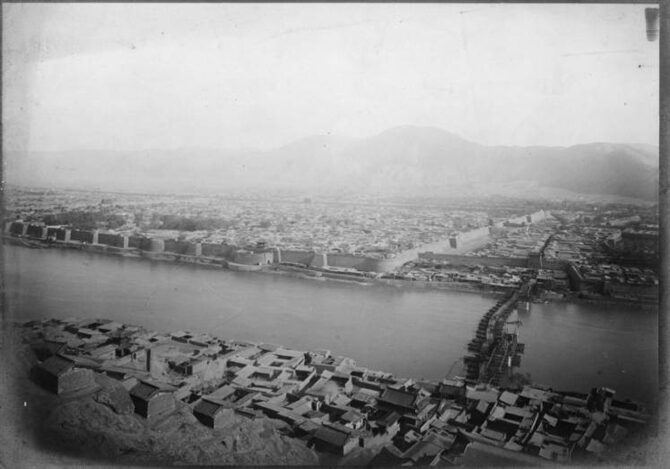
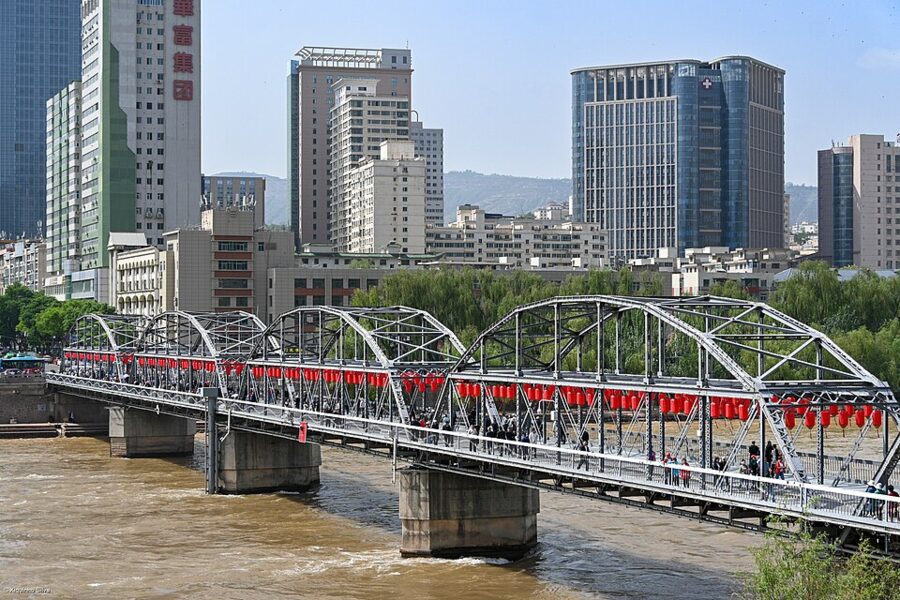
Five spans of steel, 233.5 meters end to end, carry you from the south bank of the Yellow River to the foot of Baita Shan. Before they arrived in 1909, the crossing at this spot was a line of 24 boats chained together, taken out of the water every winter and put back every spring, and it had been that way for 524 years.
Lanzhou is the only provincial capital the Yellow River runs straight through, and nearly everything worth seeing along it sits within a few kilometers of that one crossing: the bridge, the wooden waterwheels, the sheepskin rafts, the granite mother and child on the south bank, and the white pagoda on the hill to the north.


On this page
A city squeezed between two hills
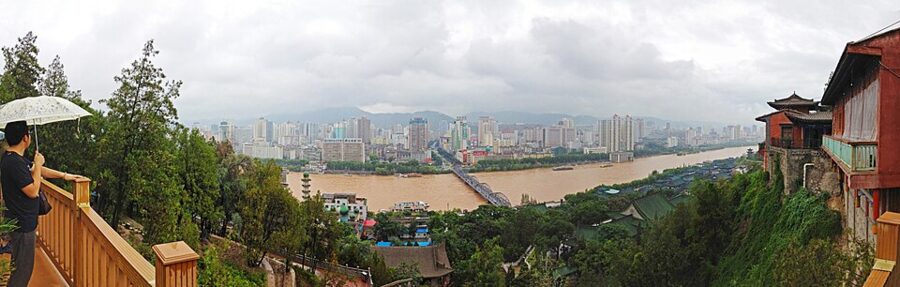
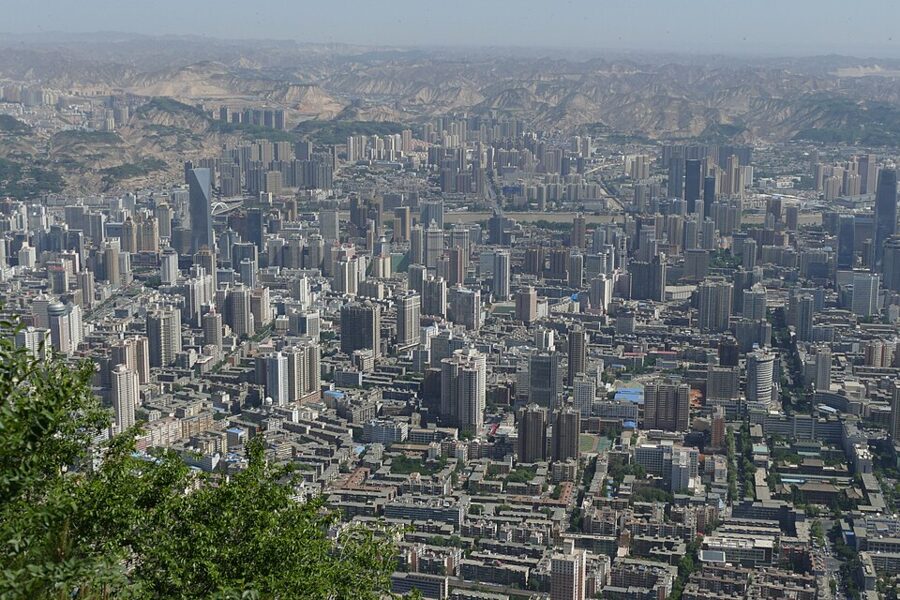
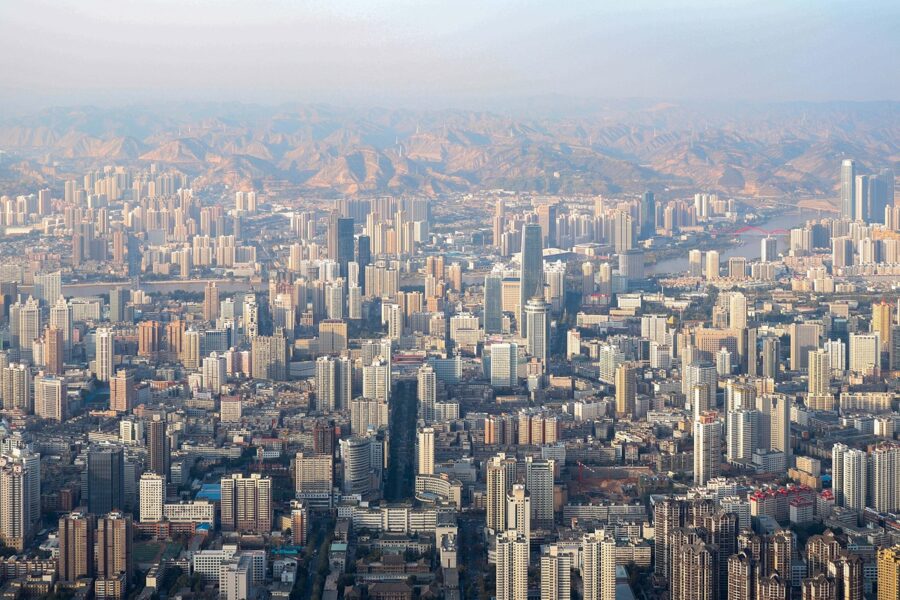
Lanzhou (兰州) is long and thin because it has no choice. Gaolan Shan (皋兰山) rises steeply on the south side, Baita Shan (白塔山) on the north, and the river runs west to east between them. Local planners describe the layout as “two mountains holding one river” (两山夹一河), and from either summit the city looks like something poured into a trench.
The name comes from the southern hill. Under the Han the settlement was Jincheng (金城), “Metal City”, a county from 86 BC that gave its name to a commandery in 81 BC; the Sui (581–618) renamed it Lanzhou in 583 after Gaolan Shan. The older name never left: Lanzhou people still call their city Jincheng.

The river is why anyone built here. In 121 BC the Han general Huo Qubing marched west through this valley against the Xiongnu, and from then on the crossing at Lanzhou was the door from the Chinese heartland into the Hexi Corridor, the chain of oases that leads to Dunhuang and the Silk Road beyond. Armies, caravans and the tea-for-horses trade all had to get across somewhere, and the reach below Baita Shan was where they did it.
The Ming general Feng Sheng threw the first boat bridge across in 1372 to move an army west and took it up again when he came back. A pontoon named Zhenyuan (镇远, “guarding the distance”) followed four years later, and in 1384 or 1385 (sources give both years) the local commander Yang Lian moved it to the slower water under Baita Shan, where Zhongshan Bridge stands now. Twenty-four boats were lashed together with iron cables and ropes of twisted grass and made fast to iron “general’s pillars” on each bank. Every winter the boats came out before the ice could crush them.
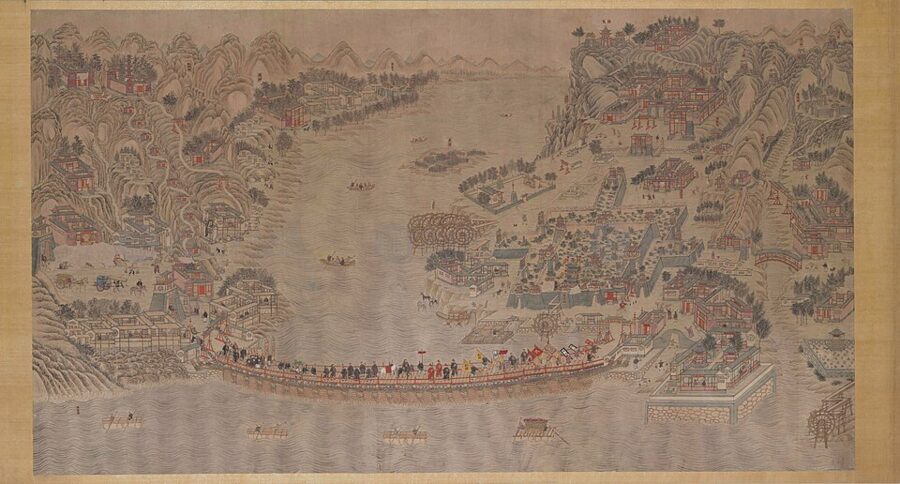
The north end of the crossing was guarded by Jincheng Pass (金城关), a gate first built under the Song in 1081 and pulled down in 1942 to make room for the road to Xinjiang. The name lives on in the Jincheng Pass cultural district just west of Baita Shan, where a troupe of Lanzhou guzi (兰州鼓子) ballad singers, accompanied by sanxian lute and yangqin dulcimer, performs every week.
Where Lanzhou sits on the river
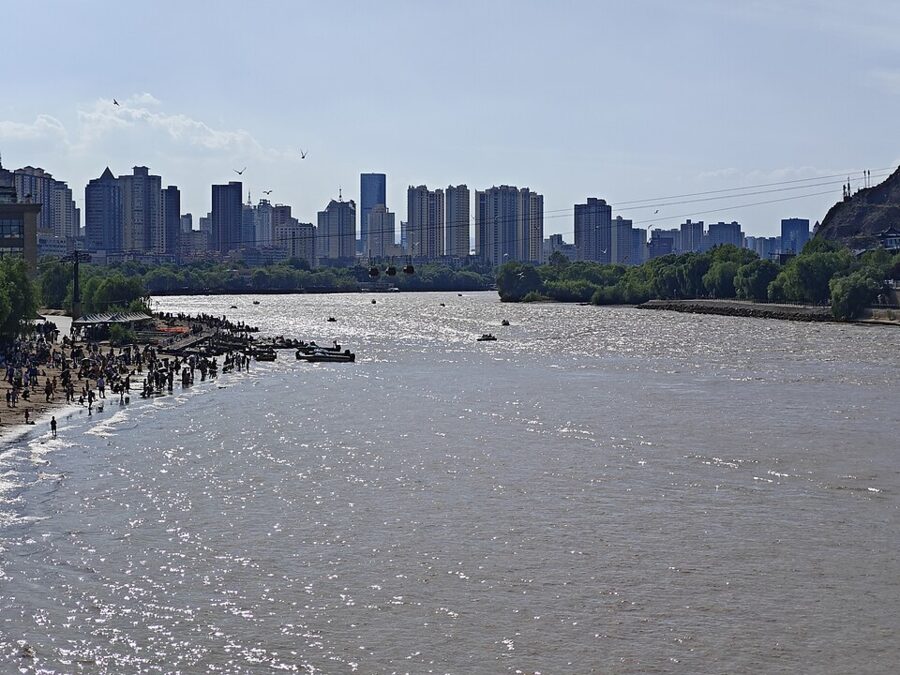
The Yellow River (黄河) runs about 5,464 kilometers from the Yueguzonglie basin on the northern flank of the Bayan Har range in Qinghai to the Bohai Sea at Kenli in Shandong, crossing nine provinces on the way. Lanzhou sits on its upper course, below the gorges and reservoirs of Qinghai and southern Gansu, below Liujiaxia where the Tao River comes in, and after the Huangshui joins in the far west of the municipality.
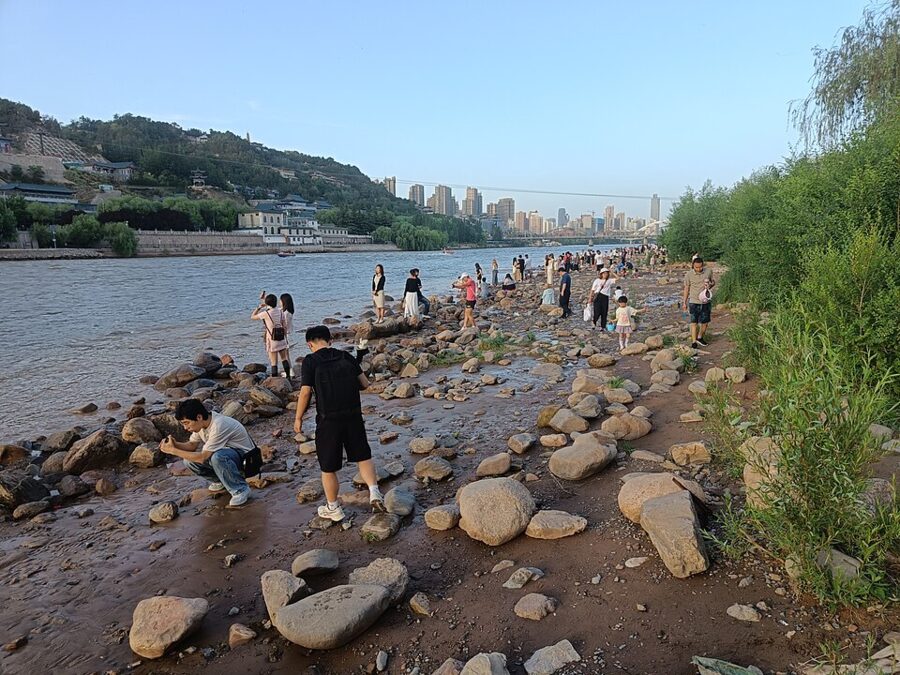
The yellow is silt, and most of it comes later, when the river loops through the Loess Plateau. At Lanzhou the water is brown after summer rain and noticeably clearer from autumn into winter, when flocks of wintering birds settle on it.

Zhongshan Bridge, the “first bridge”
The pontoon was never safe. Summer floods broke it, winter ice crushed it, and people drowned at the change of seasons; between 1730 and 1736 it was wrecked twice. Zuo Zongtang, governor-general of Shaanxi and Gansu from 1866, asked a German merchant what an iron bridge would cost and was quoted 630,000 taels of silver, which ended that conversation. A flood broke the pontoon again in 1904, the year an iron bridge opened at Tianjin, and this time the province found the money.
On October 28, 1906, the Gansu foreign affairs bureau signed with Telge & Schroeter (泰来洋行), a German firm in Tianjin, for 165,000 taels and eighteen months’ work. The contract carried an 80-year guarantee with one exception worth quoting: if the bridge were swept away by a flood “raised by a jiao dragon”, the firm was not liable.
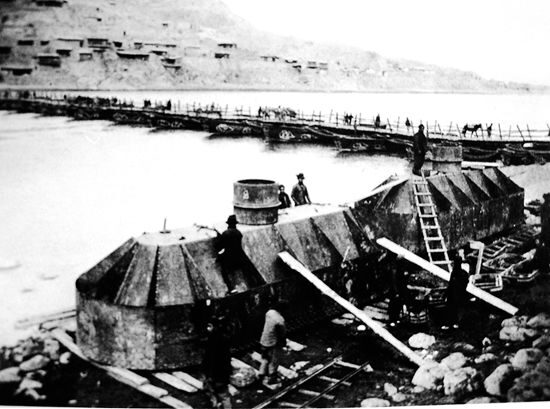
Getting the steel here was the hard part. Every truss, beam and rivet was made in Germany and shipped to Tianjin, then sent by rail to Xinxiang in Henan, then hauled by horse cart through Xi’an to Lanzhou in 36 consignments over 21 months, about 1,140 tonnes in all. The carting from Tianjin cost some 124,000 taels against 160,000 for the bridge itself, and the final bill came to 306,691 taels.
An American bridge company drew the design. On the riverbank the work was run by an American engineer, Robert Coltman, known in the Chinese records as Man Baoben (满宝本), with a German engineer and a Tianjin foreman named Liu Yongqi, about sixty smiths, carpenters and masons hired in Lanzhou and a hundred-odd laborers. Construction began on May 9, 1908, and the first carts rolled across on August 19, 1909.
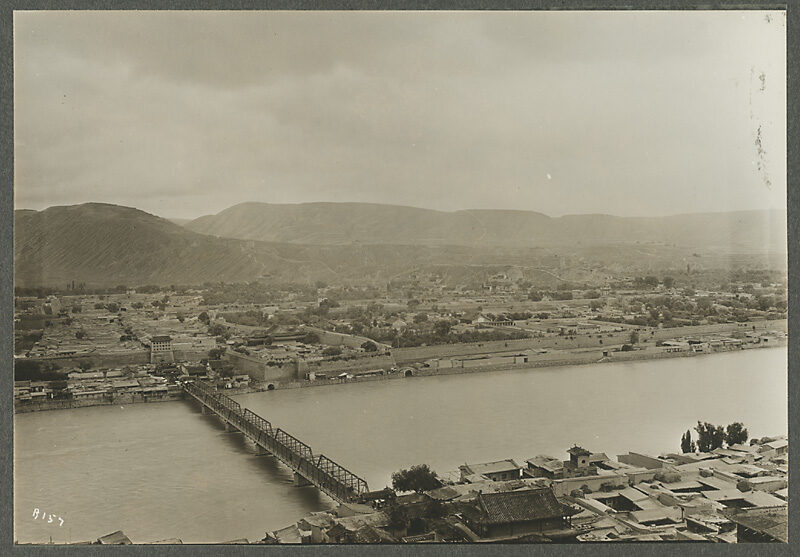
The governor-general Shengyun wrote the plaques reading “First Bridge” (第一桥) for gate pavilions at both ends, and the title stuck as “the first bridge on the Yellow River”. It is a title rather than a record: a railway bridge across the river at Zhengzhou had opened in 1905. What Lanzhou could claim was the first permanent bridge on the upper river. In 1928 the provincial chairman Liu Yufen renamed it Zhongshan Bridge after Sun Yat-sen (Sun Zhongshan).
What the bridge has been through
It was built orange-red, painted with fish oil and red pigment cut with turpentine. When Japanese bombers attacked Lanzhou between 1937 and 1943, the bridge was a prime target and was repainted lead gray, and gray it has stayed. On the evening of August 25, 1949, during the battle for Lanzhou, a shell hit an ammunition truck crossing it; the blast burned the deck of the two southern spans, and crews rebuilt it in eight days and nine nights.
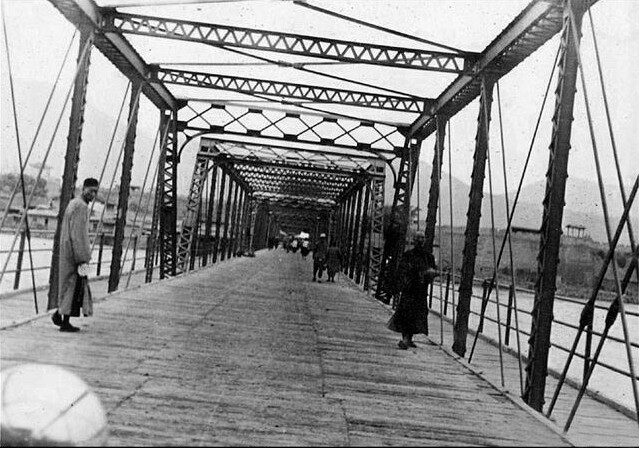
The shape in every modern photograph dates from 1954. With trucks making the spans bounce six to eight centimeters, engineers added a curved steel arch above each flat truss to raise the load limit to ten tonnes. So the bridge you walk across is a 1909 structure wearing a 1954 crown.
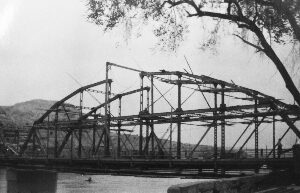
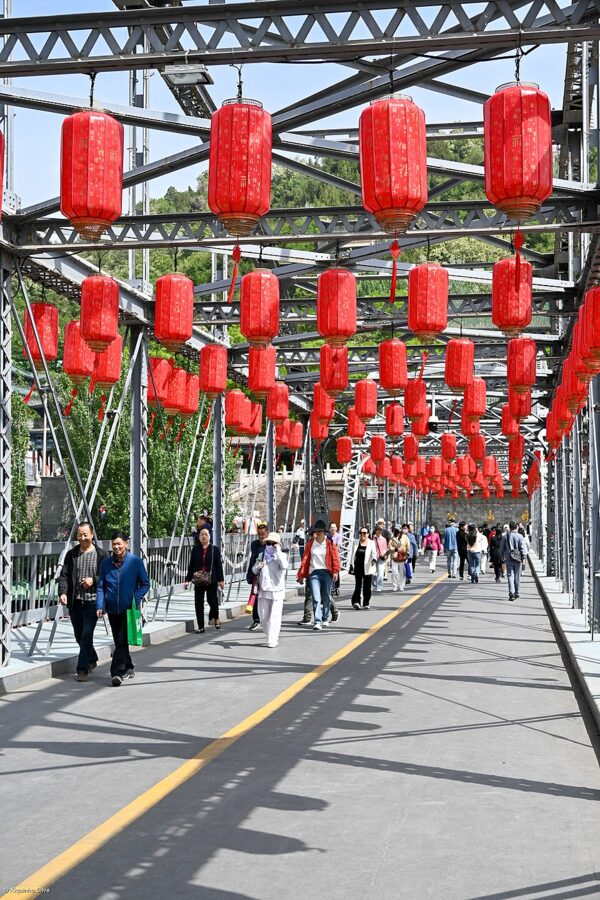
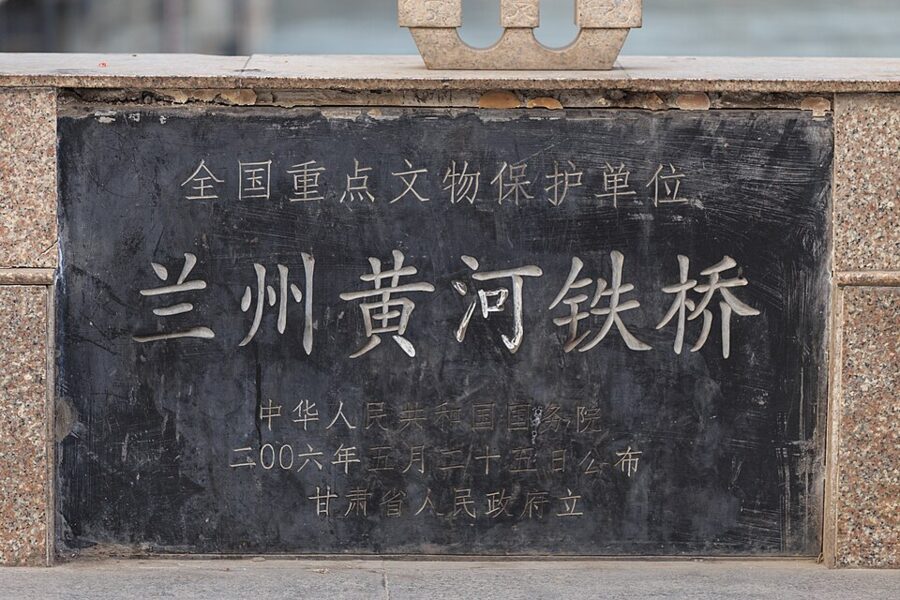
In 2004 the bridge was rebuilt as a footbridge with floodlighting and plazas at both ends. In 2010 and 2011 it was jacked up by 1.2 meters to give floods more room, briefly reopened to small cars, and closed to every motor vehicle for good on March 30, 2013. It has been a national key cultural relic since 2006.
In October 2026 Coltman’s descendant Charles Coltman, in his eighties, walked the bridge his family calls “Rob’s bridge”. The Gansu Provincial Archives hold 566 Qing documents on the project, eight of them about his ancestor, including a letter in Coltman’s hand of March 23, 1908, about the boats he needed.

Walking it today
The bridge is free and open all day, for people on foot only. At the south end look for the black national protection marker, the 5.5-meter stele carved “黄河第一桥” in 1992, and, in a small pavilion on the east side, the last Ming general’s pillar: 5.8 meters of cast iron that once held the pontoon’s cables, its 34-character inscription still faintly legible. The north end lands about 100 meters from the gate of Baita Shan Park.


Duan Xu and the waterwheels
Lanzhou’s oldest problem was water it could see but not reach. The river runs several meters, in places more than ten, below the terraces on either bank, so the fields beside the biggest river in northern China were dry. Locals had a phrase for it: guarding the Yellow River while farming dry land.
The answer came from Duan Xu (段续), a Lanzhou man who passed the palace examination in 1523, was flogged and demoted the next year for opposing the emperor in the Great Rites controversy, and spent the next two decades in posts far from home. In Huguang he studied the bamboo tube-wheels that lifted water onto rice fields, drew them, and came home in 1541 with the plans. Bamboo was scarce in Gansu, so he rebuilt the idea in local wood: elm for strength, willow for the buckets, locust for the spokes.
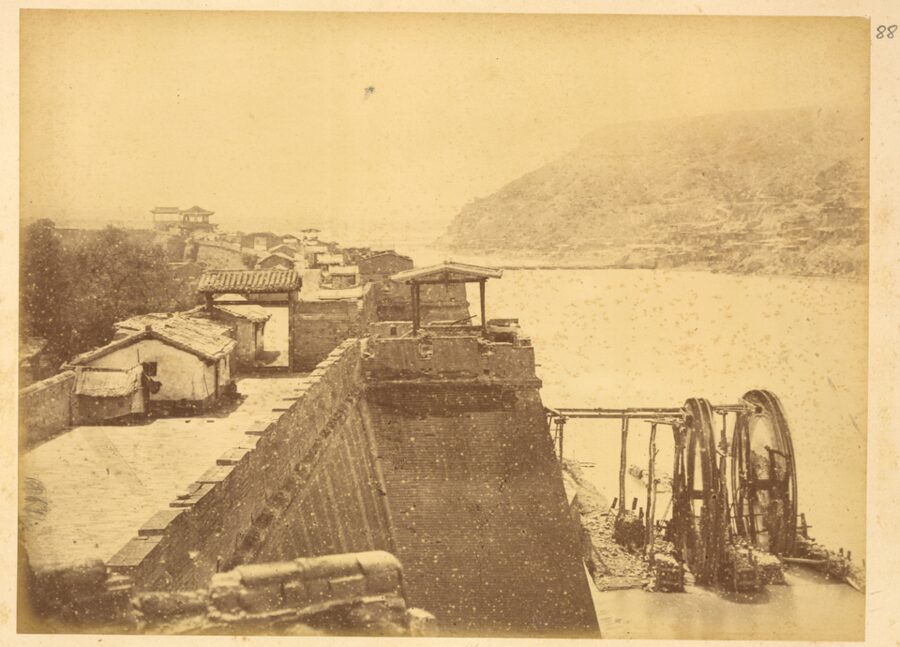
He made the wheels far larger than their southern models, up to nearly 20 meters across, and dug a stone-lined pit beneath each so the current hit the paddles harder. The river turns the wheel; buckets on the rim dip, fill and rise; at the top they tip into a raised wooden trough, and the water runs downhill to the fields with no animal or person doing any work. After years of trials, his first wheel turned in 1556. Lanzhou still calls it the “ancestor wheel” (祖宗车).
Farmers copied it up and down the river, from Guide in Qinghai to Zhongwei in Ningxia. Lanzhou had 157 wheels by 1891 and 252 by 1952, watering about 100,000 mu (some 6,700 hectares) of orchards and fields, before electric pumps replaced them in the 1950s. The craft went on China’s first national intangible heritage list in 2006, and in 2018 Duan Yicun, a twentieth-generation descendant of Duan Xu, was named its national inheritor.
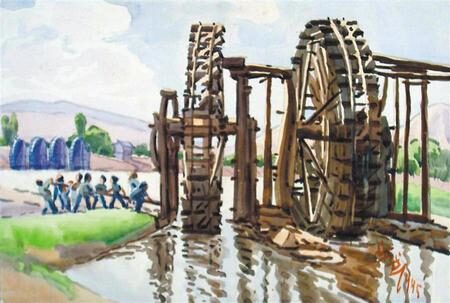
Where to see the wheels
The main collection is the Waterwheel Expo Garden (水车博览园) on Nanbinhe East Road, on the south bank about 2.5 kilometers downstream of Zhongshan Bridge. It opened in 2005, is free, and keeps roughly 08:00–18:00, later in summer. A granite Duan Xu stands in the square facing south with the river at his back and a scroll of plans in his hand, and a dozen or so full-size wheels stand along the bank. They turn now for show and to keep the ponds moving.
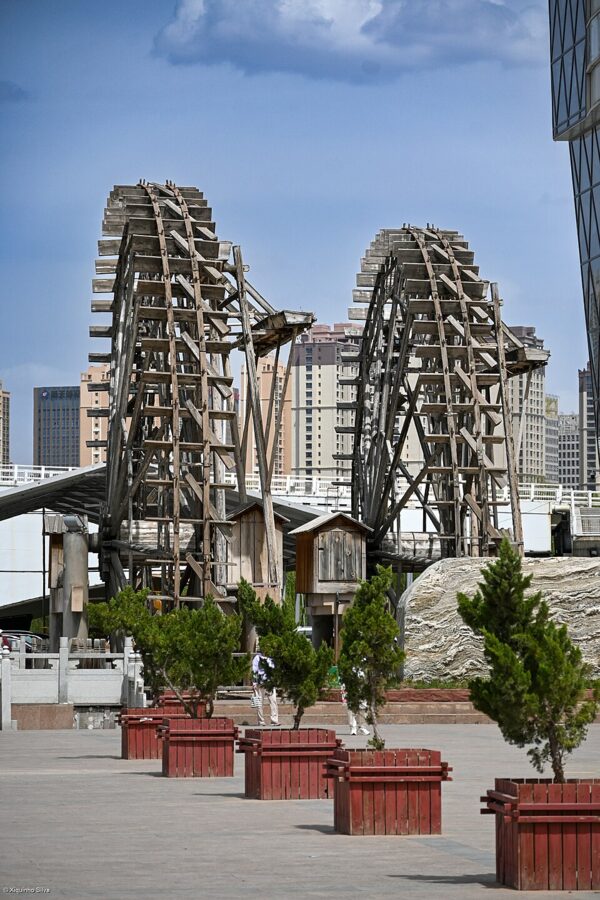

West of the bridge, about 450 meters east of the Mother statue on Nanbinhe Middle Road, the smaller Lanzhou Waterwheel Garden (兰州水车园) sits right on the riverfront walk. A contract to rebuild its wheels was awarded in February 2026. If you are only walking the central riverfront this is the garden you pass; the Expo Garden is the better collection and worth the separate trip.
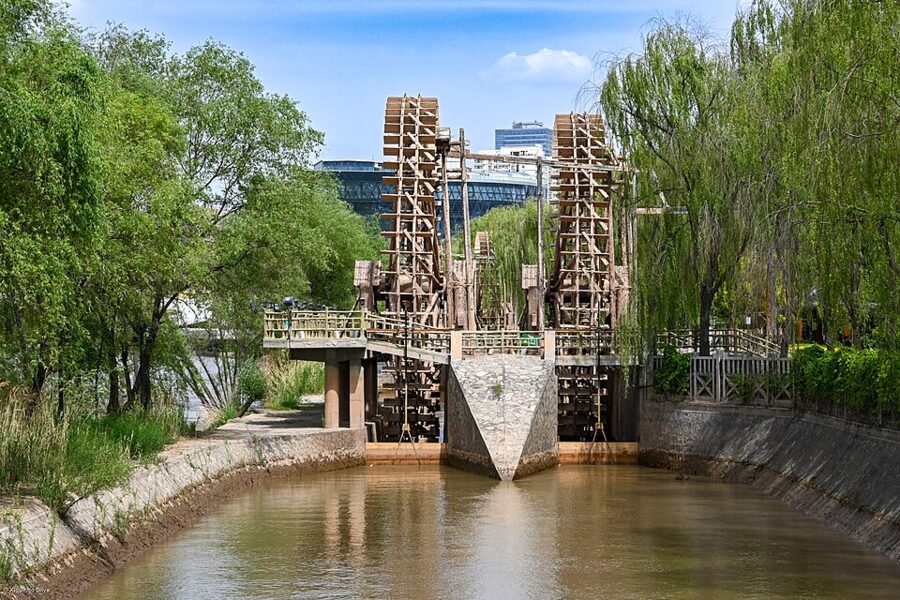

Sheepskin rafts: the history, the ride, the price
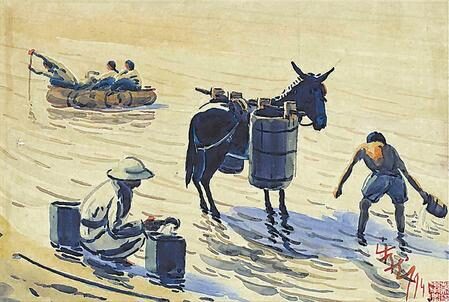
A yangpi fazi (羊皮筏子) is about as simple as a boat gets. A sheep or goat skin is taken off whole, the hair removed, the hide cured with salt and linseed oil, the openings tied and the skin blown up like a balloon. A dozen or so of these floats are lashed under a lattice of willow or ash poles; sources give anything from nine to sixteen skins for a passenger raft.
Cargo rafts were another matter. Big hide rafts strung together hundreds of skins, and a Japanese photographic record from the 1920s and 1930s describes cowhide rafts of 280 to 800 hides, packed with wool, taking about a month to float down to Baotou, crewed almost entirely by Hui Muslim raftsmen. A raft only ever goes downstream. One that reached Lanzhou from Xining or Xunhua with millet in its skins was simply taken apart on the bank.
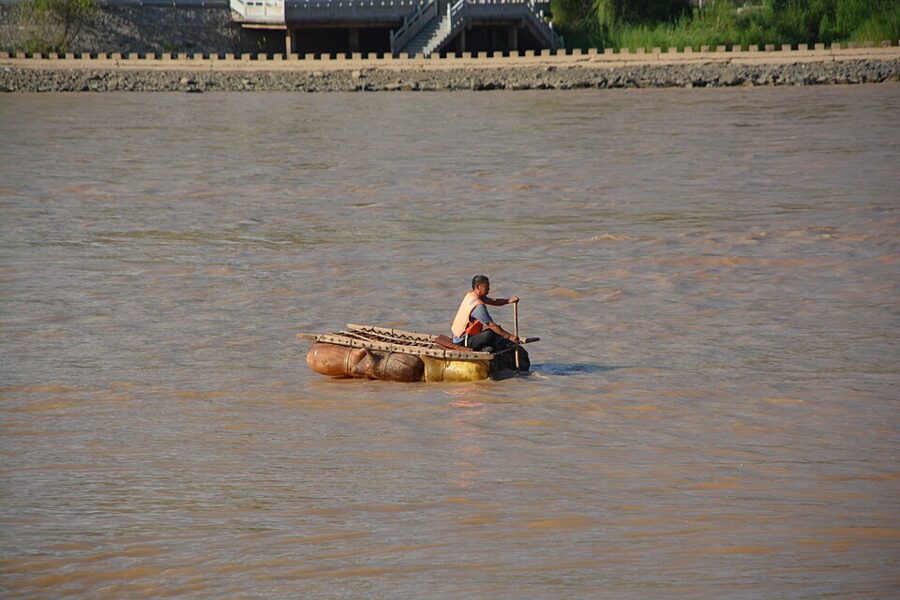

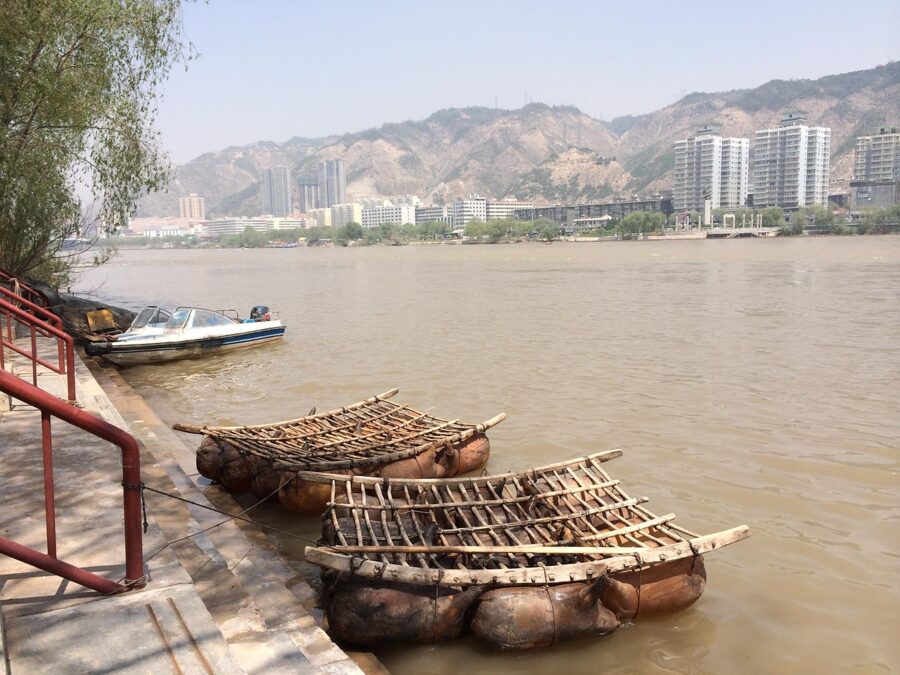
Lanzhou has a saying about the city’s treasures that ends “a sheepskin raft beats a warship” (羊皮筏子赛军舰). The craft has been on Gansu’s provincial intangible heritage list since 2006. A 56-year-old raftsman, Nie Duiping, told reporters in October 2026 what crossing meant before the bridge: “Across the river is as far as heaven.”
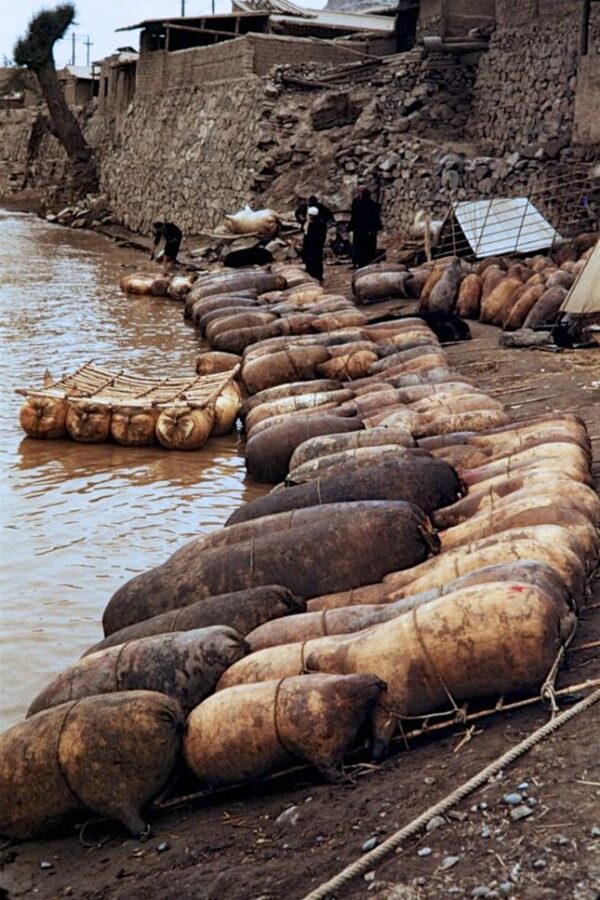
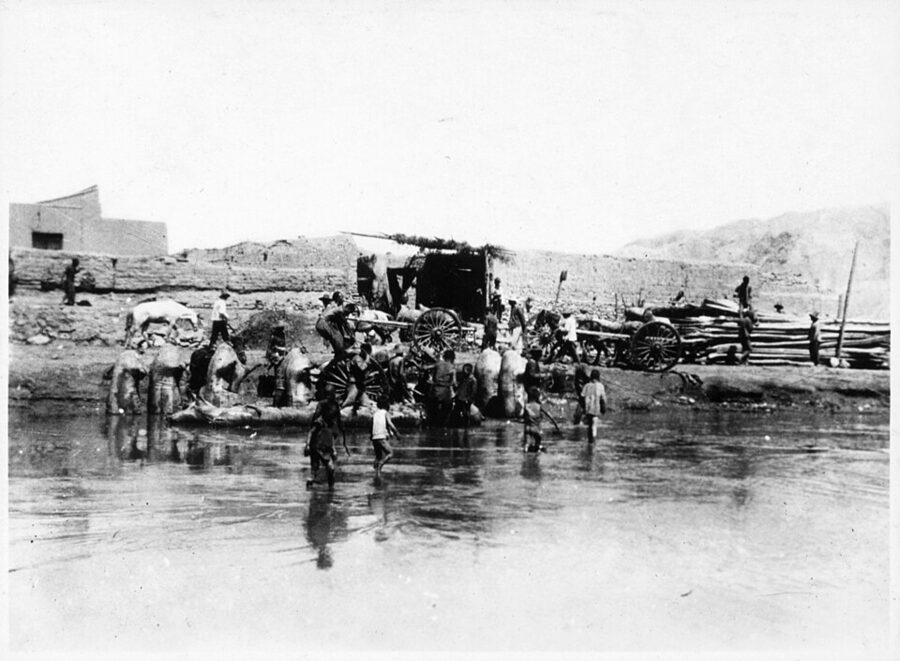
Is the ride real?
Half and half. The skins are skins, the current is the Yellow River, and the raftsman steering with one long oar is doing what his grandfather did. The packaging is modern: on most routes a speedboat runs you upstream, the float down takes 20 to 40 minutes, and the raftsmen often sing qinqiang (秦腔) opera on the way. I think it is worth doing once, for the view of the bridge from water level.
The usual run is from the Mother statue down to Zhongshan Bridge for about 80 yuan a person, the going rate in 2025 and 2026; packages with a speedboat leg run 80–120 yuan. Landings are along the south bank near the statue and under the bridge, and the operators work roughly 09:00–18:00 in season. Agree the route, the price and where you will be dropped before you sit down. In summer, go after 16:00: at noon the skins are hot to sit on.
Put the life jacket on before you step aboard, not after. Downstream in Ningxia, the rules for the same rafts cap each one at four passengers, so if a Lanzhou raftsman is loading six, wait for the next. After heavy rain upstream the river runs fast and thick; that is the day to watch from the bridge. Wear dark trousers, since the splashes are brown.
Baita Shan and the north bank
Baita Shan Park is free and opens roughly 06:30–19:30, to about 20:00 in summer and autumn. The gate is a two-minute walk from the north end of the bridge, and the climb is a long staircase of terraces, temples and pavilions, with a few hundred steps between you and the top.
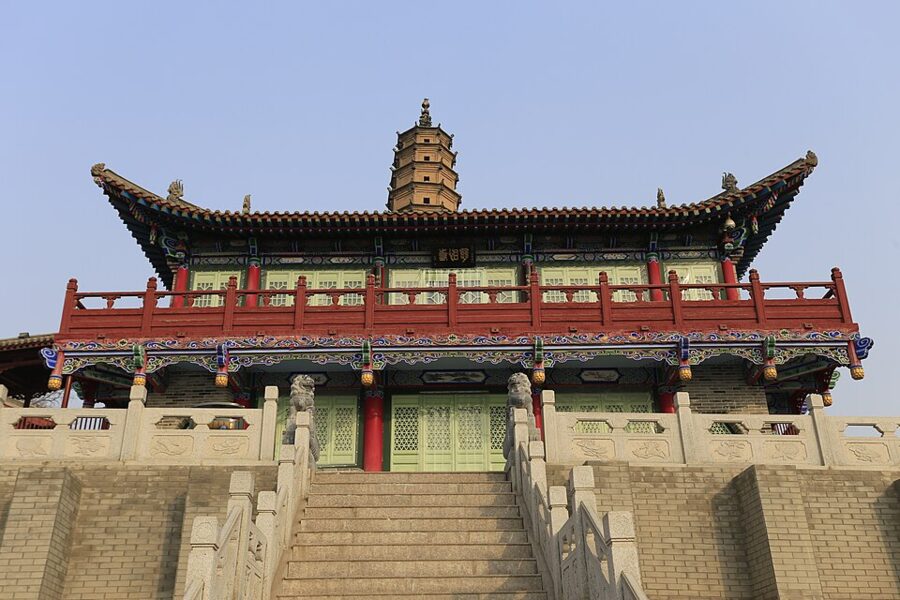
The first thing you climb through is a 1958 piece of salvage. The architect Ren Zhenying built the three stepped terraces of halls above the gate in a single year, with about 200 craftsmen, out of beams, brackets and carved bricks taken from Lanzhou buildings being demolished in the old city. The result looks several centuries older than it is.
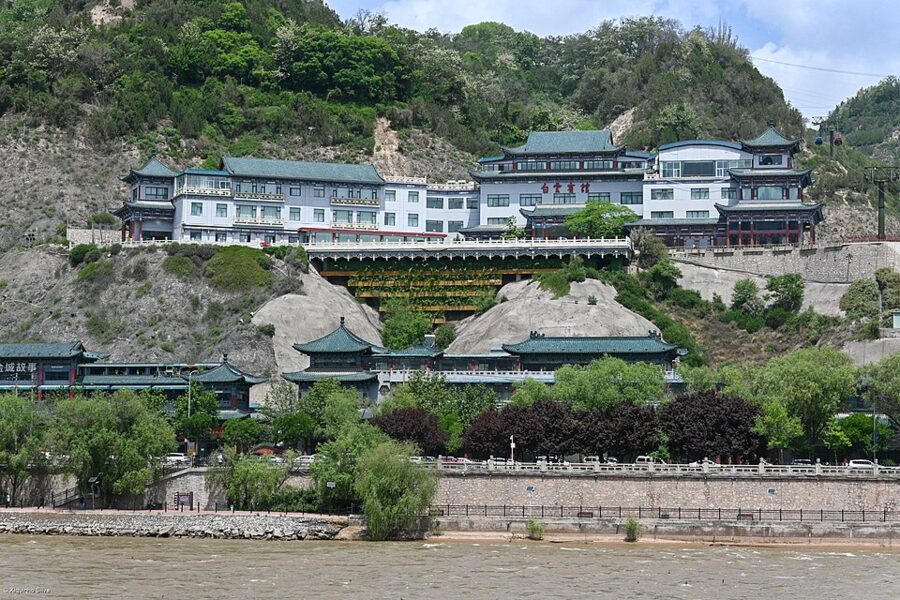

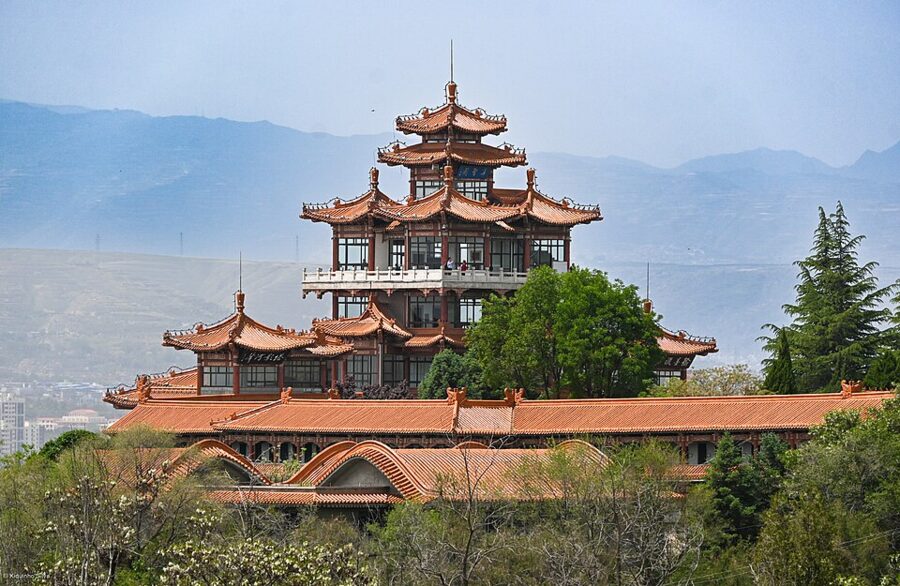

The hill is named for the white pagoda at the top. A Sakya lama sent from Tibet to meet Genghis Khan died in Lanzhou on the way, and a tower was raised for him in 1228. It fell at the end of the Yuan, and the eunuch commander Liu Yongcheng rebuilt it in the middle of the fifteenth century (sources give 1448 or the Jingtai years, 1450–1456). The solid brick tower is eight-sided, seven tiers and about 17 meters tall, coated in white lime, and the temple around it has been Ci’en Temple since 1715.
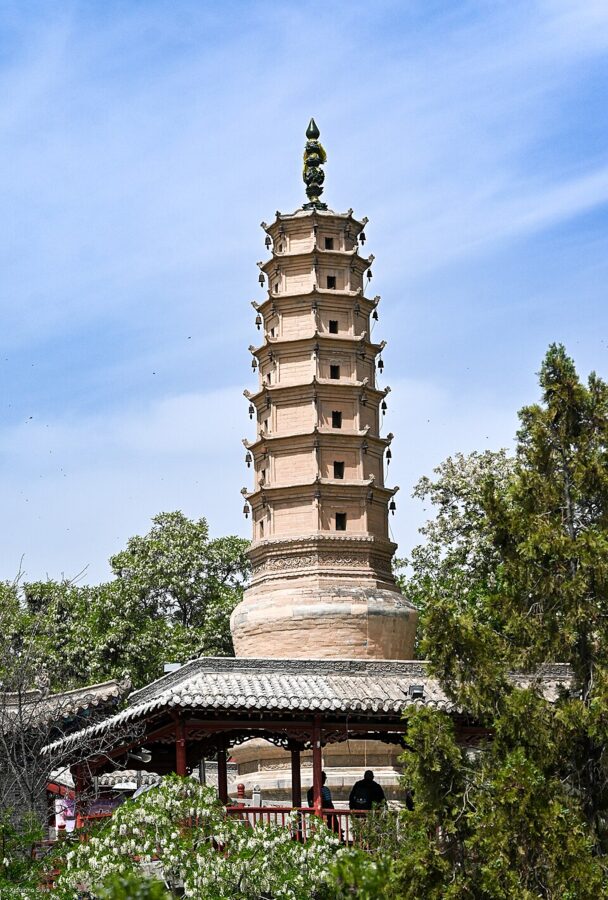

The temple’s bronze bell, cast in 1718 and weighing 153.5 kilograms, was Lanzhou’s air-raid siren during the Japanese bombing. Beside it stands a copy of the Yu stele, 77 archaic characters credited to Yu the flood-tamer: a fitting neighbor for this river.
Higher still, the Peony Pavilion marks the top of the park, 168 meters above the bridge plaza and 206 steps above the last rest stop. The Lanzhou Stele Forest, a courtyard of carved calligraphy, sits on the back slope. A cableway crosses the river from the south bank to near the top; a 2026 report gives 45 yuan one way, another listing gives 35 yuan up and 25 down, so check the board at the station. On Saturday mornings Lanzhou guzi singers perform on the square near the summit.

The south bank and the Mother of the Yellow River
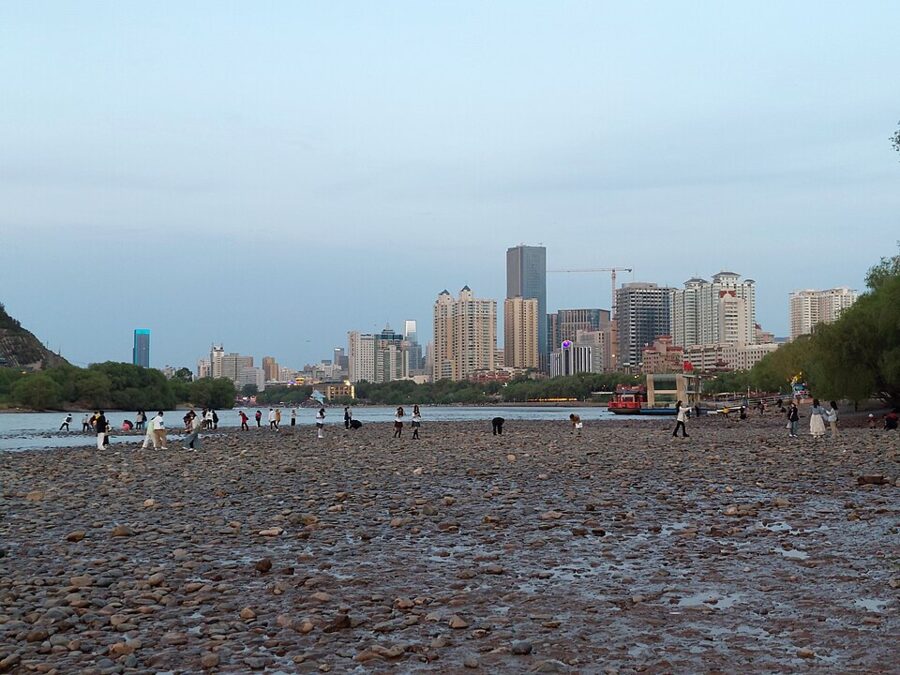
Both banks are lined with promenades for kilometers, part of a riverside park the city plans along 47.5 kilometers of its stretch of the river, and the south bank between the Mother statue and the bridge is the stretch everybody walks. Tea stalls set out low tables on the embankment. Order sanpaotai (三泡台), green tea in a lidded bowl with rock sugar, longan, red dates, goji and chrysanthemum, topped up with hot water three times as the flavor deepens.
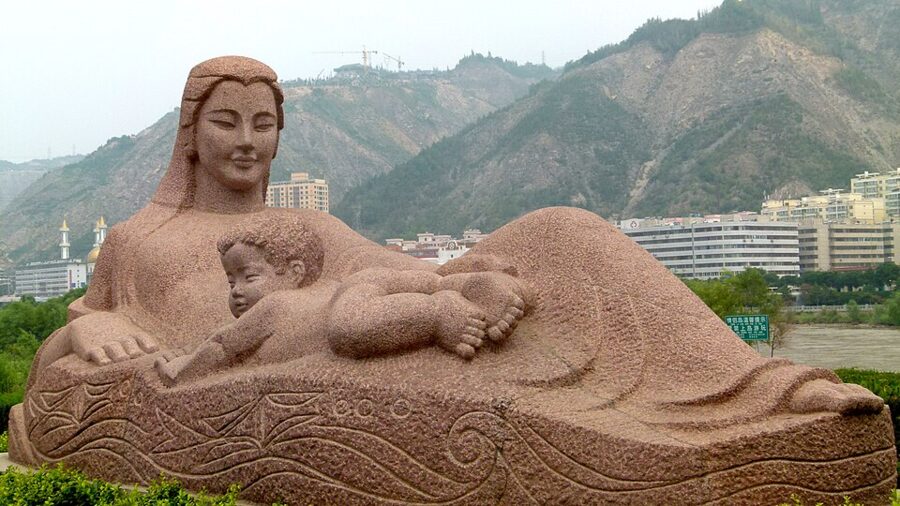
The Mother of the Yellow River (黄河母亲) lies on the bank north of Xiaoxihu Park: a woman reclining with a child lying against her, carved in red granite, six meters long and over 40 tonnes. The sculptor He E, born in 1937, spent 1962 to 1974 copying the painted clay figures in the Dunhuang caves, and she gave her mother a Northern Wei hairstyle and a Tang robe. The base carries the wave and fish patterns of Gansu’s Neolithic painted pottery.

After dark
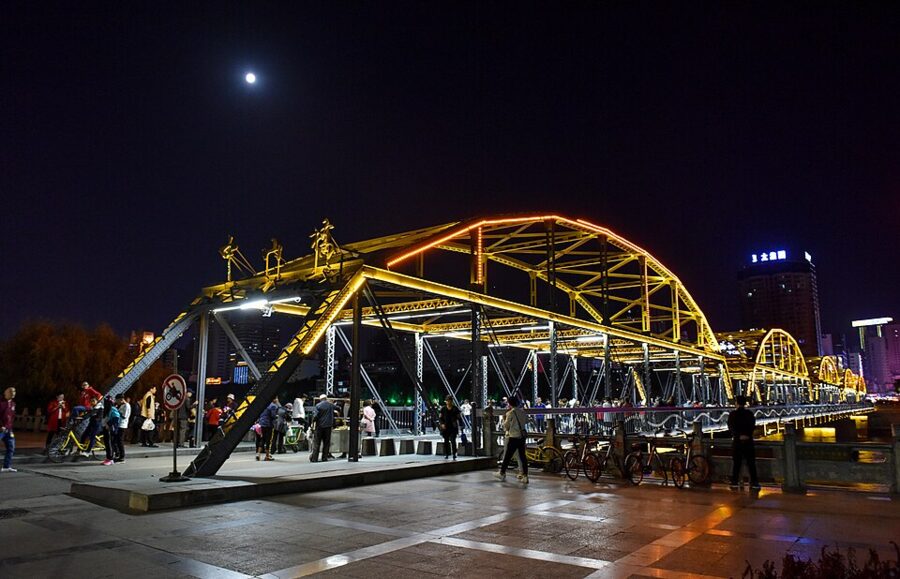
The bridge has been floodlit since 2004, and at night it glows gold against the dark bulk of Baita Shan, whose halls are lit too. The night cruises leave from four landings, at Baita Shan, the Mother statue, Yanchangbao and Lanzhou Port, from 19:30 to 21:30, with extra afternoon sailings from 13:00 to 17:00 at weekends and on holidays. The full fare is 100 yuan, and in 2026 the operator has repeatedly sold tickets at half price, 50 yuan. Buy at the landing or on the “Changyou Lanzhou” (畅游兰州) WeChat mini program.
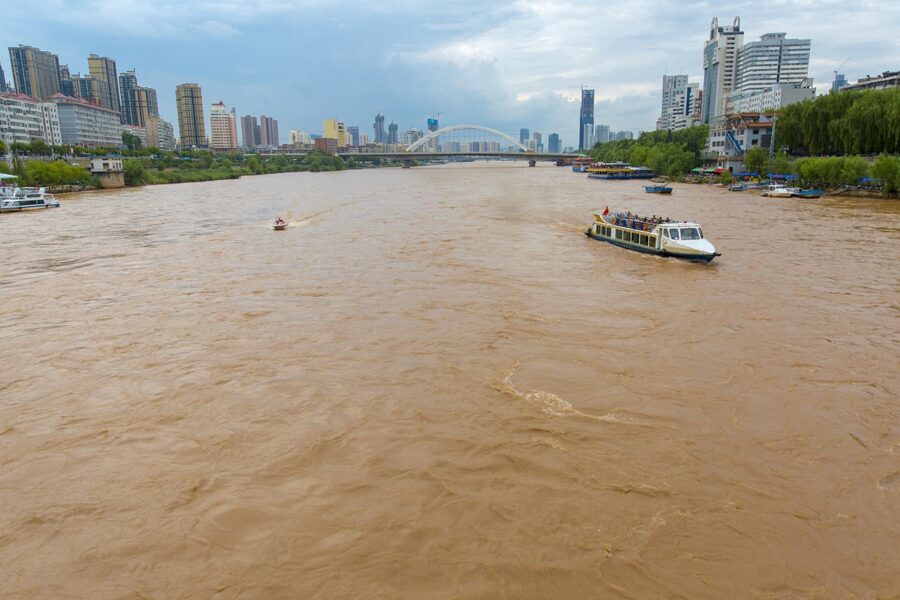
The water bus is a commuter service rather than a cruise: 3 yuan for any trip up to 10 kilometers, every 20 minutes at rush hours. Its 2026 season ran from April 8 to November 7, Saturdays excepted, so in winter it is laid up until spring.

A day and an evening along the river
Start the day with beef noodles, which is what Lanzhou does. Locals call it niurou mian (牛肉面), not lamian: “Lanzhou lamian” is the shop sign that cooks from Qinghai carried across the country. The standard is “one clear, two white, three red, four green, five yellow”: clear broth, white radish, red chili oil, green coriander and garlic shoots, and yellow noodles.
You order by thickness, from maoxi (毛细), thin as hair, to dakuan (大宽), a broad flat ribbon, nine sizes in all. A bowl costs 8–12 yuan; extra beef and an egg take it past 20. Shops open around 06:00, and many have finished their best broth by noon, so the queue at seven in the morning is the one to join. The making of the noodles has been national intangible heritage since 2021.
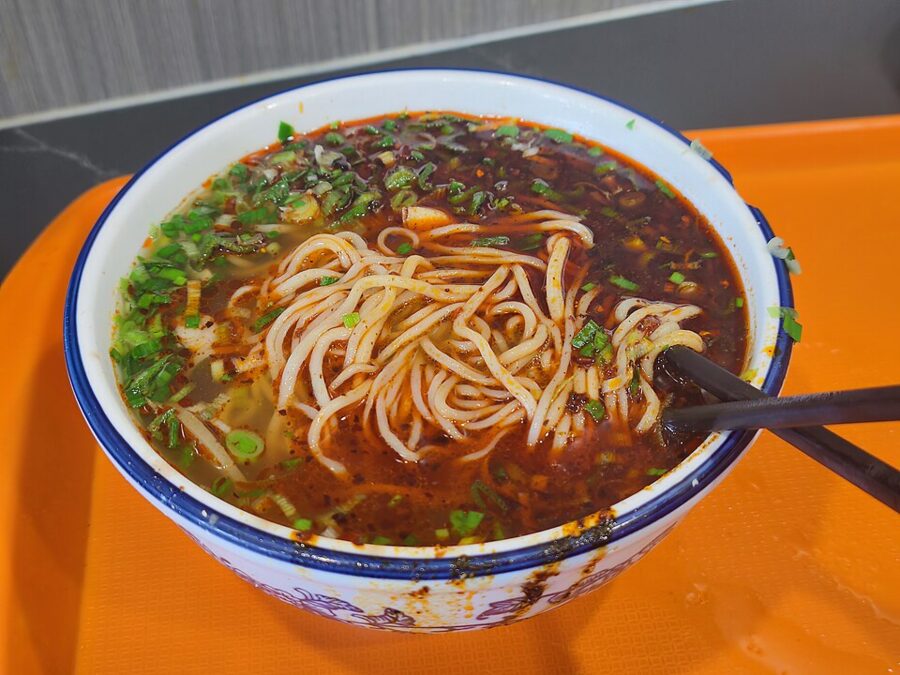

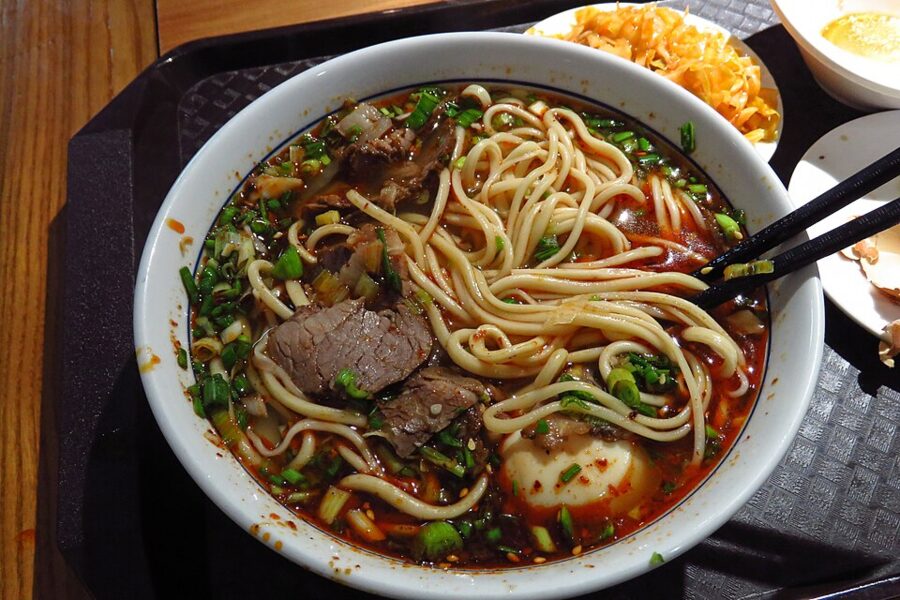

From Xiaoxihu metro station walk 400 meters to the Mother statue, then east along the south bank past the Waterwheel Garden and the raft landings at Baimalang to Zhongshan Bridge, about 1.7 kilometers in all. Take a raft in the late morning if the river is calm. Lunch can be niangpizi (酿皮子), chewy cold noodles with chili oil and cubes of wheat gluten, or hand-held boiled mutton.
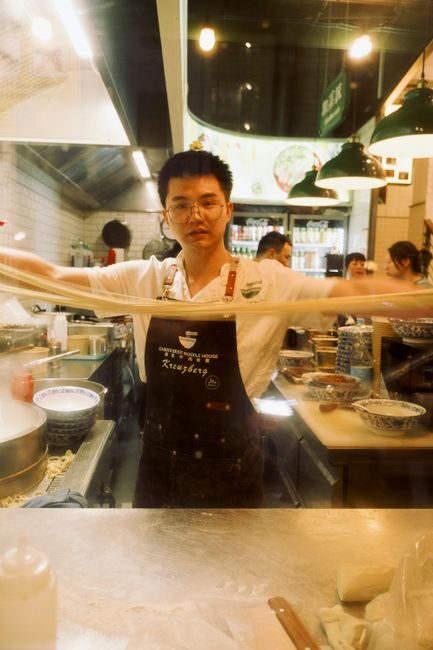
Cross the bridge in the early afternoon and give Baita Shan two hours, timing the descent for dusk. If you would rather spend the afternoon indoors, the Gansu Provincial Museum on Xijin West Road, near Lanzhou West station, is free with a booking on its official account, and the bronze galloping horse is there.
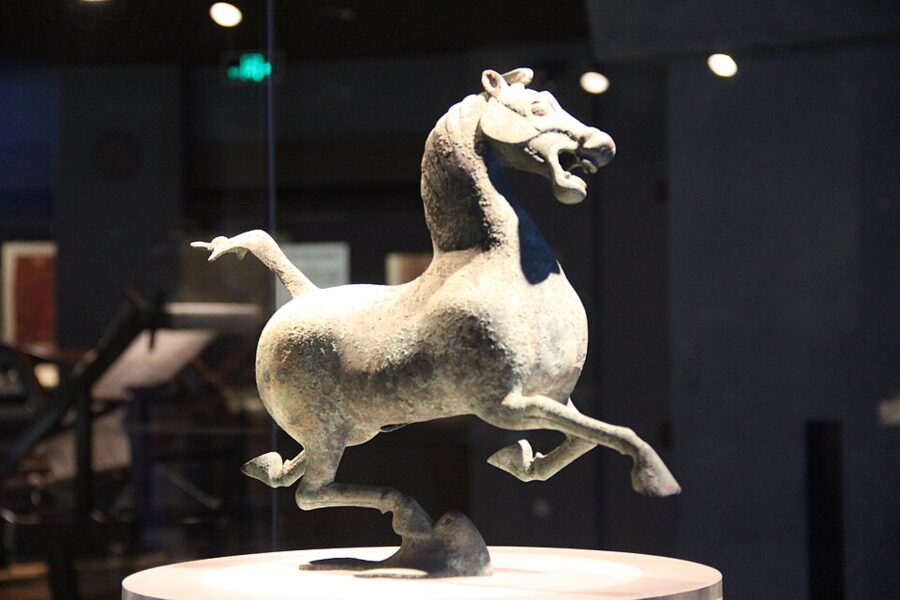
After the bridge lights come on, walk about a kilometer south-east of Xiguan station to the Zhengning Road night market (正宁路夜市), around 200 meters of stalls open from about 18:00 to midnight. The dish to find is milk and egg laozao (牛奶鸡蛋醪糟), warm fermented rice in sweet milk with egg stirred through. Look also for huidouzi (灰豆子), a thick sweet bean soup, tianpeizi (甜醅子), lightly fermented grain served cool, and in winter ruan’er pears (软儿梨), so soft you tear the skin and drink them.
Getting there and getting around
Most high-speed trains use Lanzhou West (兰州西站), the hub for the lines east to Xi’an and west through Xining and the Hexi Corridor. Metro Line 1 leaves from the station’s north square (兰州西站北广场站): three stops east to Xiaoxihu for the Mother statue, five to Xiguan for the bridge, about 550 meters north of the station. Line 1 runs roughly 06:30–22:30.
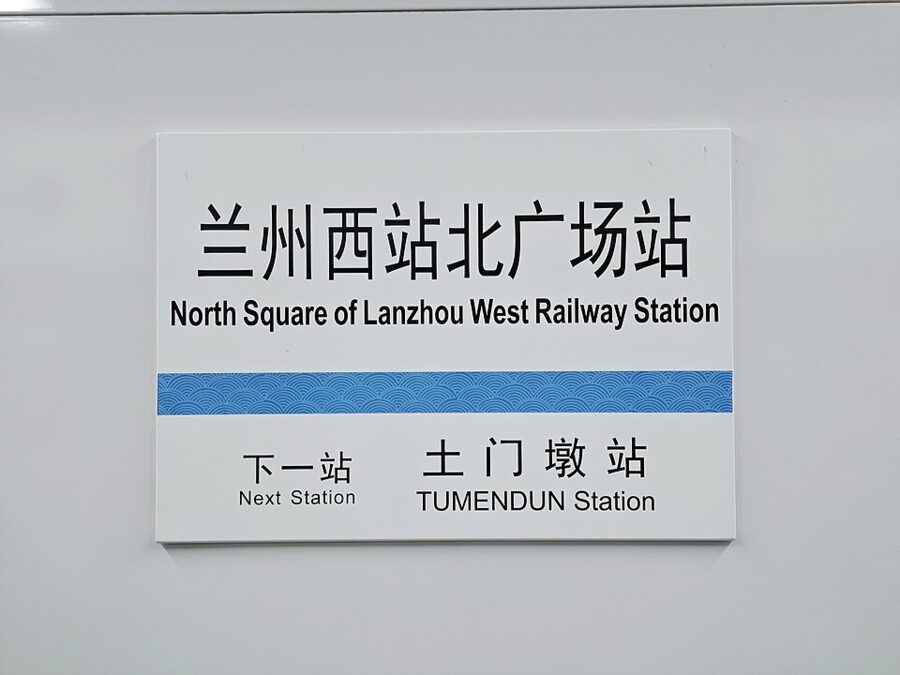

The older Lanzhou Station (兰州站) is on the east side of the center, about 4.5 kilometers from the bridge; a taxi is the simplest way down to the river. Everything else on the riverfront is a walk:
| From | To | Distance |
|---|---|---|
| Xiaoxihu station (Line 1) | Mother of the Yellow River | 400 m |
| Mother of the Yellow River | Lanzhou Waterwheel Garden | 450 m |
| Lanzhou Waterwheel Garden | Zhongshan Bridge | 1.2 km |
| Xiguan station (Line 1) | Zhongshan Bridge | 550 m |
| Zhongshan Bridge, north end | Baita Shan Park gate | 100 m |
| Zhongshan Bridge | Waterwheel Expo Garden | 2.5 km |
| Xiguan station | Zhengning Road night market | 1 km |
Lanzhou is dry all year, with an average temperature of about 10°C (50°F); summer days are hot and the nights cool, and winter is cold enough that the shaded steps on Baita Shan stay icy after the promenade has dried. Upstream, the reservoir at Liujiaxia makes a full day trip, with the trackways of the Liujiaxia Dinosaur National Geopark on the way.
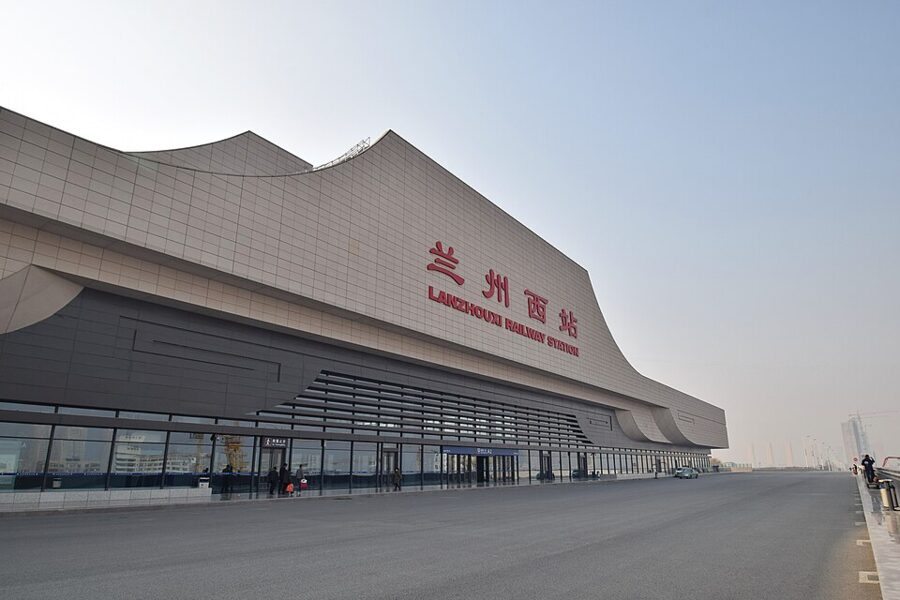

Come back to the bridge after dark on your last evening. The steel that took 21 months to haul from Tianjin is lit gold over the water where the 24 boats rode for five centuries, and the only rafts left on the river are still going the one way rafts have always gone here, downstream.