
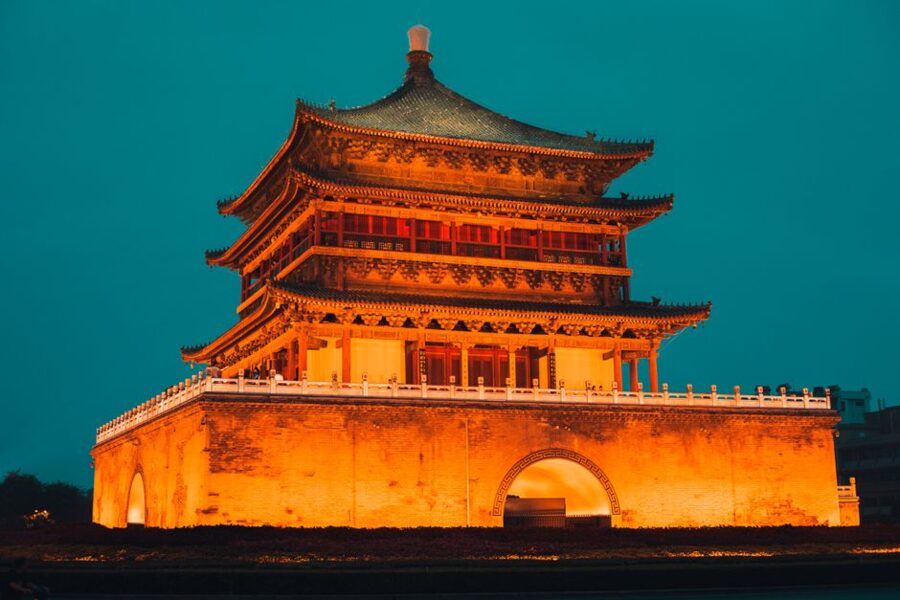
Four streets run dead straight out of the middle of old Xi’an, one to each gate in the city wall, and where they meet there is no crossroads at all. There is a brick platform 35.5 meters square and 8.6 meters high, and on top of it a timber tower with three tiers of green-glazed eaves and a gilded finial 36 meters above the traffic. Cars circle it all day. Nobody crosses to it on foot: you reach the Bell Tower (钟楼, Zhonglou) by going underneath the road.
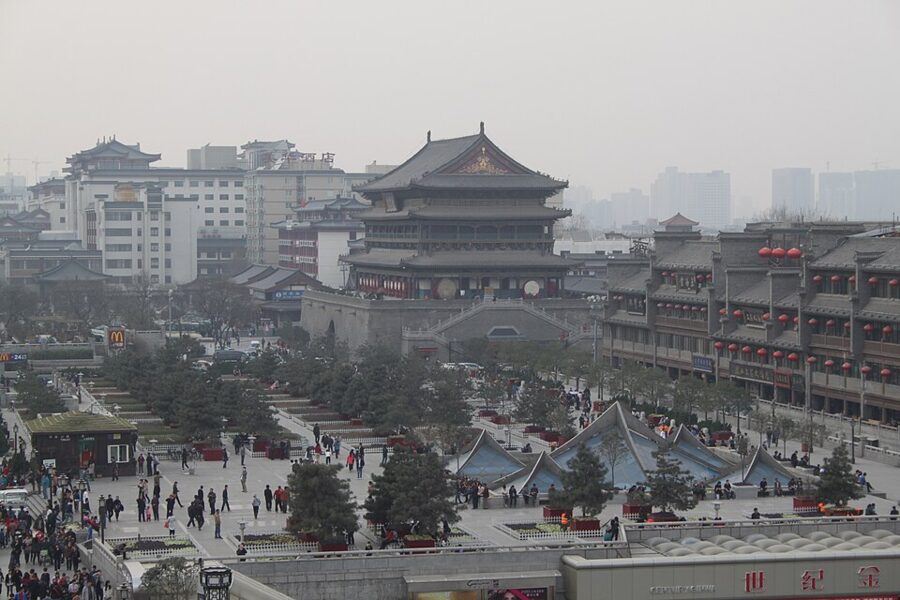
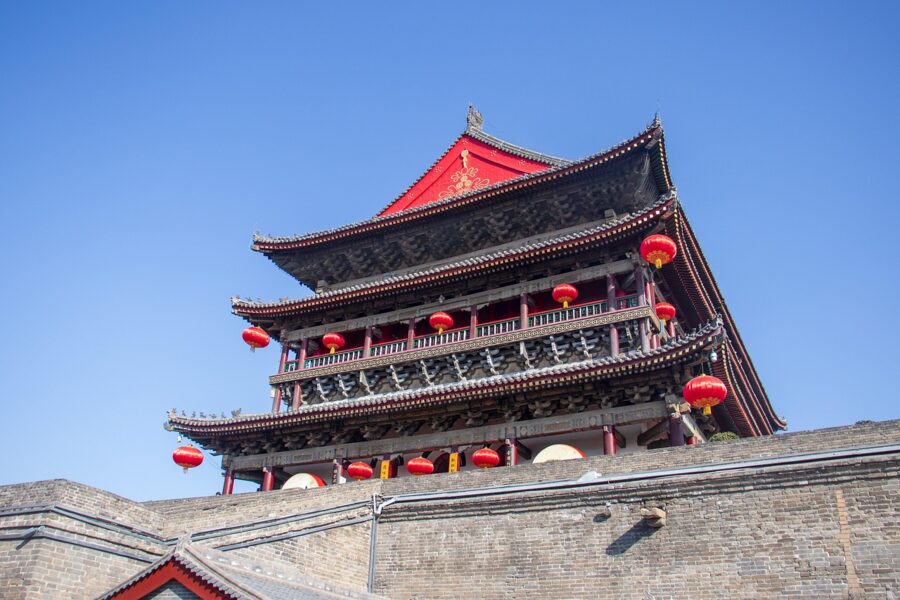
About 200 meters to the northwest, at the far end of a paved square, stands its partner. The Drum Tower (鼓楼, Gulou) is older by four years, broader and lower, with a road tunneled through its base into the lanes of the Muslim Quarter. For about five centuries a bell on one tower and drums on the other told the city when to wake and when to go home.
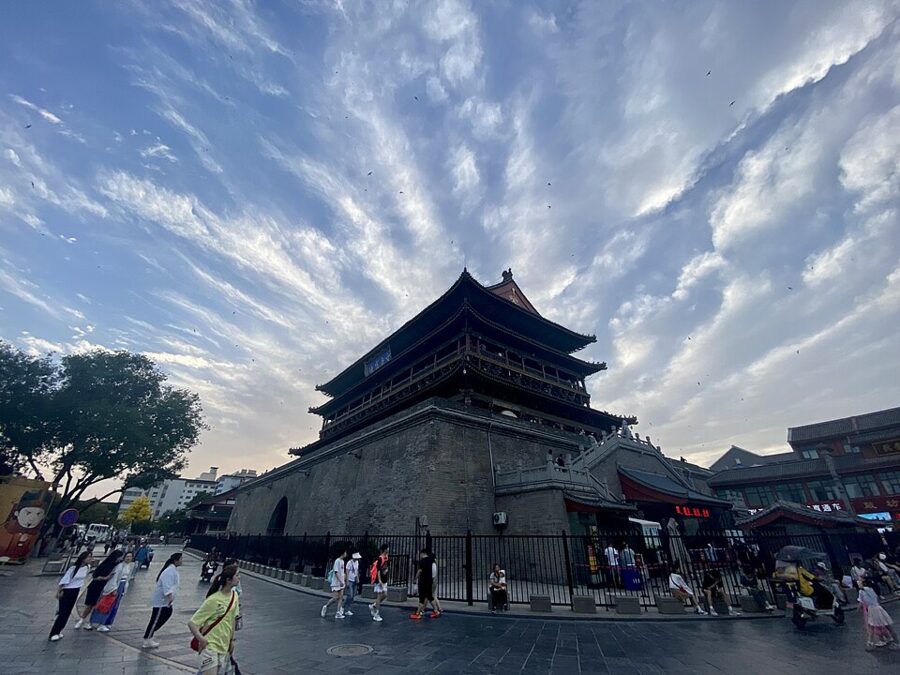

Neither tower keeps time now, and both are run as one museum. That makes them easy to do badly: a photo from the underpass exit, a glance at the drums, a shove through the snack lanes. Done in the right order and at the right hour, they are the clearest lesson Xi’an offers in how a Ming city was put together, and the best place in town to watch the lights come on.

On this page
- Morning bell, evening drum
- How the Bell Tower came to the crossroads
- The Bell Tower, base to finial
- The Drum Tower
- The performances, and whether to wait for one
- Tickets, hours and the way in
- Through the Drum Tower: Beiyuanmen and the Muslim Quarter
- South down Nan Dajie to the wall
- An evening at the towers, start to finish
Morning bell, evening drum
The phrase is chenzhong mugu (晨钟暮鼓), “morning bell, evening drum”, and it describes a working system rather than a poetic mood. In Tang Chang’an, the capital that stood here before Xi’an, the city was divided into walled wards, and drums at dusk warned that the ward gates were about to shut. Ming Xi’an kept the habit: the bell marked the morning, the drum the evening, and through the night the drum beat the five watches, so that “the third drum” meant around midnight.
Height was the whole design brief. Ming Xi’an was a walled rectangle more than 13 kilometers around, and a drum beaten at street level would not carry to the gates. Raised on a brick platform and a timber hall, it reached the government offices clustered around the Drum Tower and the houses beyond them.

The north face of the Drum Tower carries a plaque that sums up the job in four characters: 声闻于天, “its sound is heard in heaven”. Its south face says 文武盛地, roughly “a place of great learning and arms”, which is the city praising itself.
The towers had been silent as clocks for more than a century when, in the Golden Week holiday of 2007, the museum staged a “morning bell, evening drum” ceremony: the replica bell struck 24 times at 09:00, 12:00 and 15:00, and at 18:00 the drums sounded together before the big drum beat 24 strokes for dusk. No recent notice says it still runs daily, so treat it as an occasional event.

How the Bell Tower came to the crossroads
The Bell Tower is not where it was built. It went up in 1384, in the seventeenth year of the Hongwu Emperor (reigned 1368–1398), founder of the Ming (1368–1644), at the Yingxiang Guan (迎祥观), a Taoist temple off West Street near today’s Guangji Jie. At the time that spot sat on the city’s north–south axis, facing the Drum Tower.
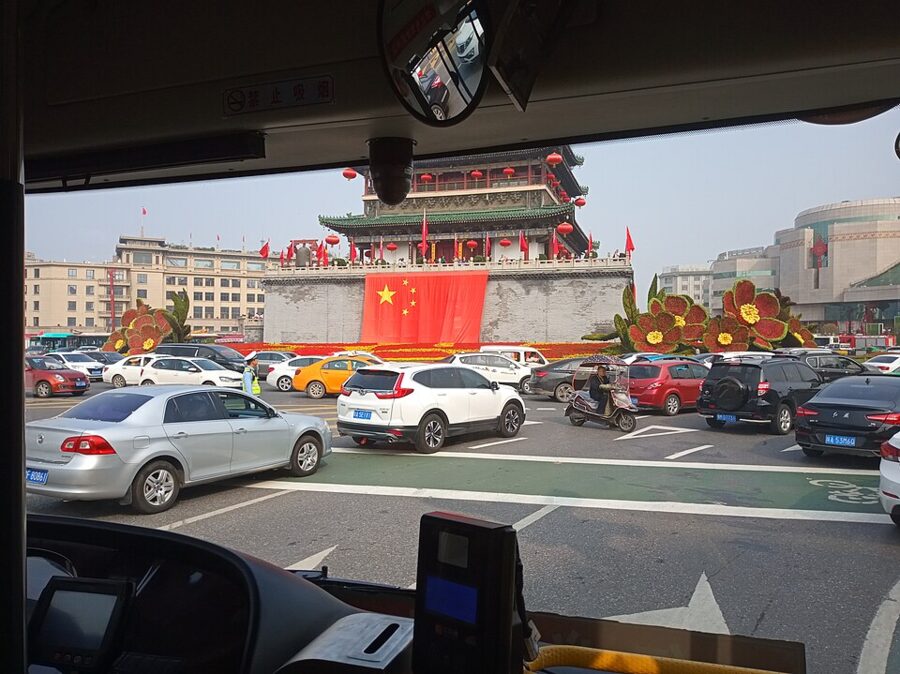

Then the city moved under it. The walls were extended, the gates shifted, and four new main streets formed whose meeting point lay well to the east. In 1582, the tenth year of the Wanli reign, Gong Maoxian (龚懋贤), the imperial censor posted to Shaanxi (some sources call him the governor), had the tower moved roughly a kilometer east to the new crossing.
Gong wrote the job up in a poem with a short preface, “Song of the Bell Tower’s Move East” (钟楼东迁歌), carved on a tablet inside the tower. Apart from the new base, he says, the tower was “not altered in any part”, which is why the work cost little and went quickly. Timber halls of this kind are held together by mortise-and-tenon joints, so the frame could be taken apart, its members numbered, carried down the street and put back up.
Not every source accepts the story. One reading of the local records holds that the 1582 tower was a new building, and the old one stayed at the temple with its bell. The museum follows Gong’s words in its own account of the move, and so do I, but the point is argued.

The Qing repaired it in 1699, 1740 and 1840. In 1740 the governor Zhang Kai (张楷) found that the bell hung in a closed room where its sound was “taken in and not let out”, so he moved it outside. The twentieth century was louder: fighting in 1911, Japanese bombs on October 10, 1939, wartime service as an air-raid warning post, and prisoners held in its arches. It opened to visitors in 1984 and became a national monument in 1996.
The Bell Tower, base to finial
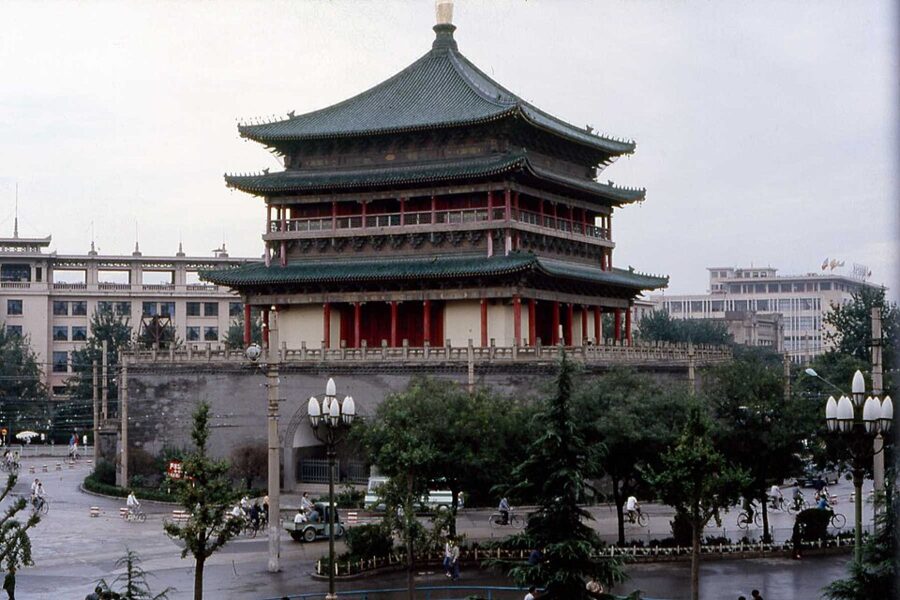
Start with the base: solid grey brick, pierced by four arched passages about 6 meters high that meet in a cross in the middle. Until the traffic outgrew them, every vehicle crossing the city center went through these arches. They have long been closed, and the only way up is from the underpass ticket hall to the terrace on top of the base.
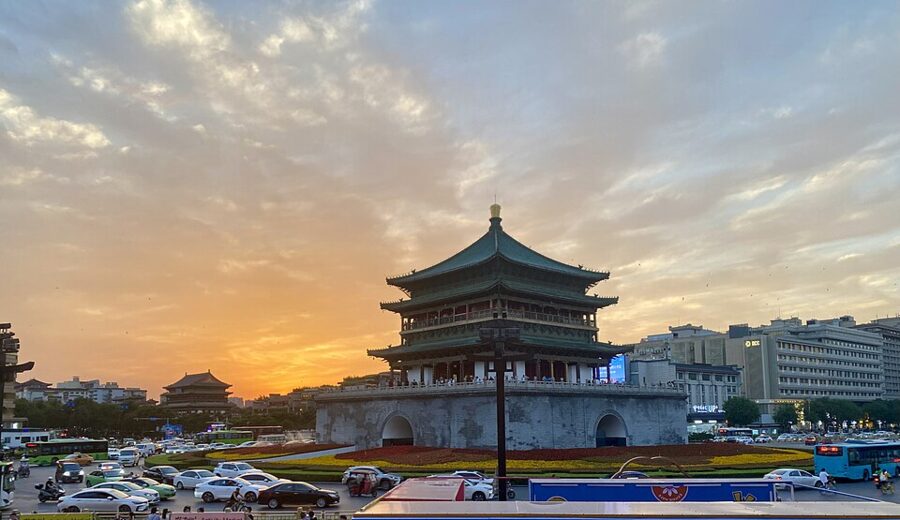

The tower is two storeys of timber inside three tiers of eaves, a form builders called chongyan sandishui (重檐三滴水), “double eaves, three drips”, because rain falls off three roof edges on its way down. The four-sided pyramid roof is dark green glazed tile on painted bracket sets, and the finial is a wooden core wrapped in gold leaf.

The carved doors
Look closely at the doors on both floors. Each panel carries a relief of a story every Ming and Qing reader knew. On the ground floor’s east doors, Chang’e flies to the moon and Li Bai raises his cup to it; on the north, Hua Mulan goes to war in her father’s place and Cai Wenji returns from the steppe. The south doors include Boya playing the qin, Bole judging horses and the painter who brought a dragon to life by dotting its eyes.
Upstairs, the south and north doors belong to the Eight Immortals, crossing the sea on one side and drinking on the other. The east doors carry filial children and good mothers, among them Mencius’s mother moving house three times to find her son the right neighbors. Nothing labels them, so it helps to know a few stories before you go up.

The tablets and the view
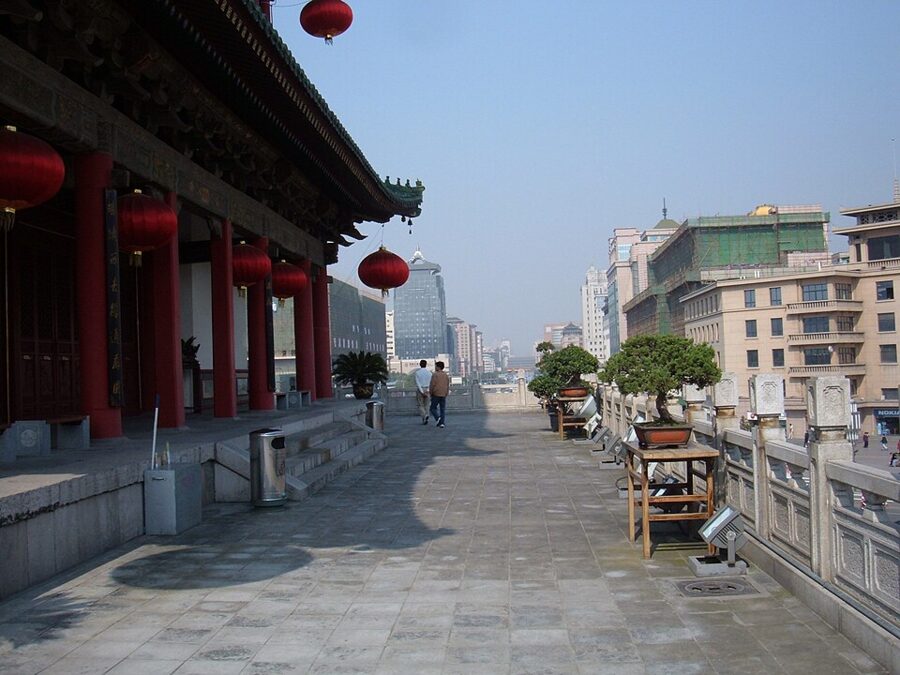
On the west wall of the ground-floor hall are three stone tablets: the 1953 restoration record, Zhang Kai’s 1740 account and Gong Maoxian’s poem about the move. They are the tower’s own paper trail.
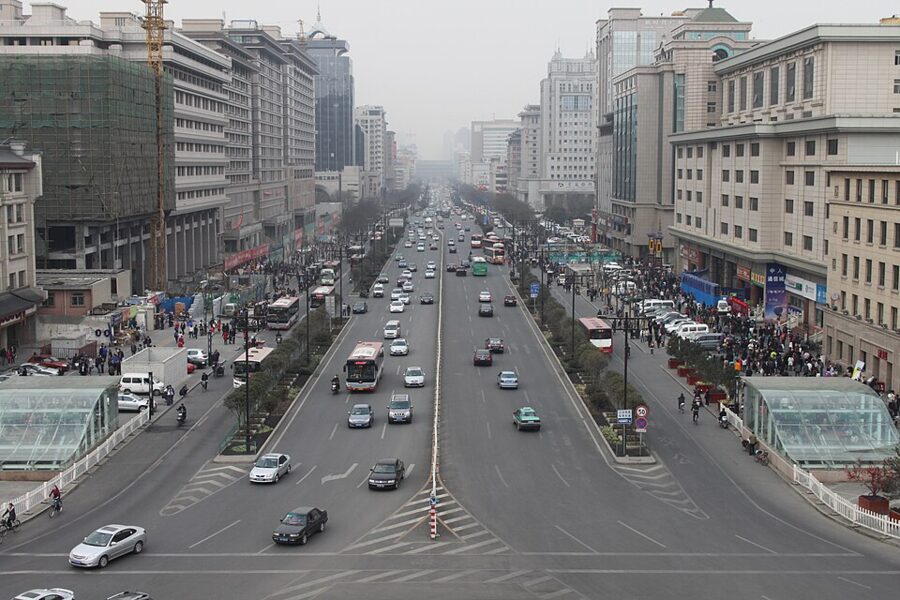
From the upper gallery each of the four streets runs to a gate, and on a clear day you can see the gate towers at the ends of them. The Ming plan is easier to read from here than from anywhere else.
The Jingyun Bell and its double
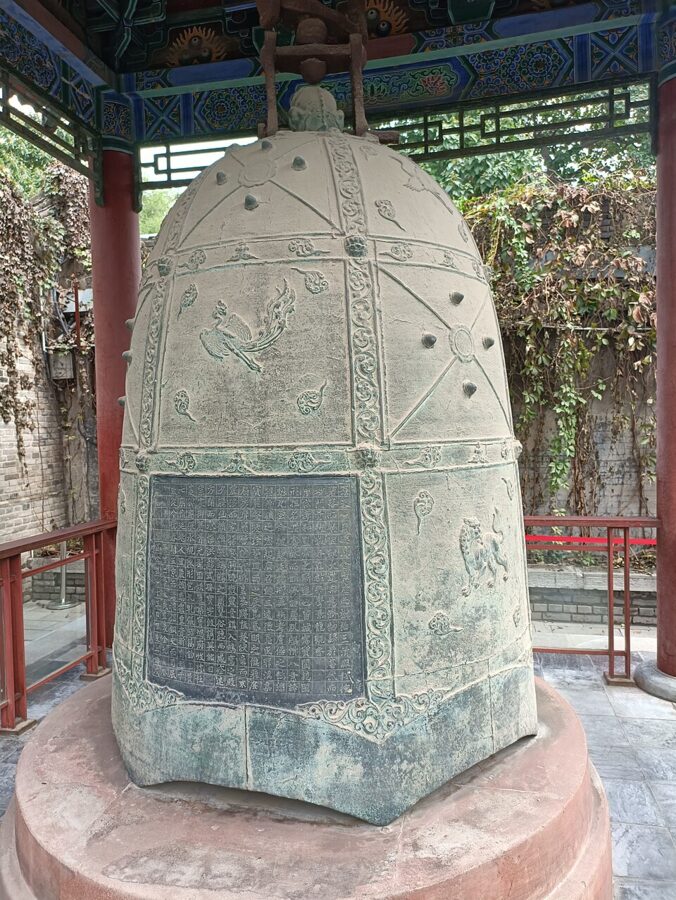
The bell on the terrace is a copy. The original Jingyun Bell (景云钟) was cast in 711 for the Jinglong Guan, a Taoist temple of the Tang (618–907), and named for the Jingyun reign of the Emperor Ruizong. It is 247 centimeters tall, weighs about 6 tonnes and carries a 292-character inscription that Ruizong composed and wrote himself.
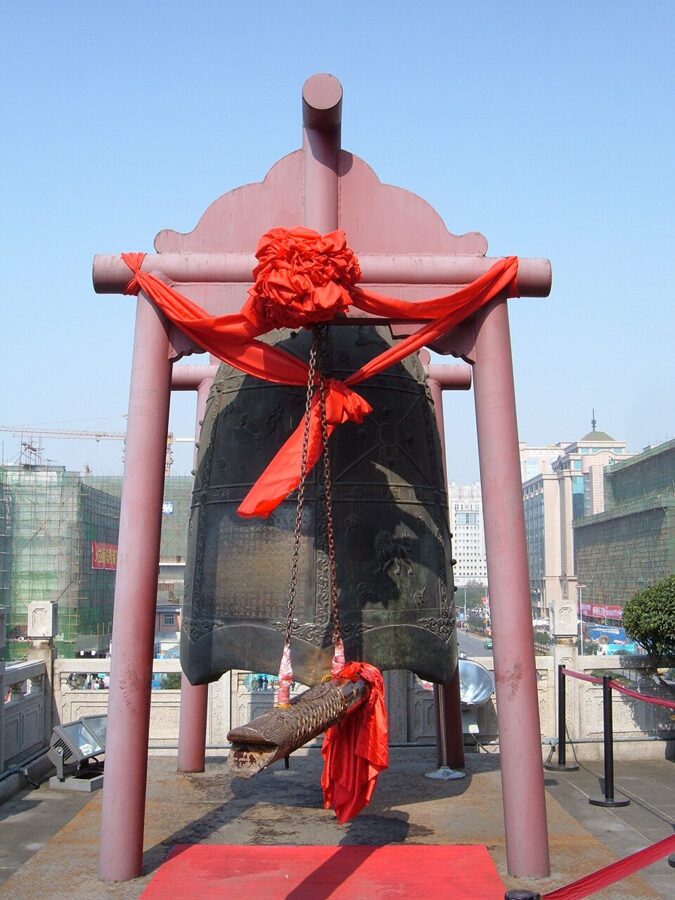

The temple took the name Yingxiang Guan in the eighth century, and the bell hung in its tower when the first Bell Tower was built there in 1384. Whether it ever hung in the present tower is argued. One version says that after the 1582 move it was carried over but “would not sound when struck”, so it went back to the temple; another keeps it in the new tower through the Qing. Either way, in 1953 it went to the Forest of Steles Museum (西安碑林博物馆), where it is today.
The copy is close in size and carries the same decoration and inscription. A recording of the original is the “New Year bell” that Chinese national radio has played at midnight on New Year’s Eve. If you have a spare morning, go and see the real one in its pavilion inside the museum’s second gate, just east of the South Gate.

What is inside the halls now
The museum began in 1953 as an exhibition hall in the Drum Tower and took its present name, the Xi’an Bell and Drum Tower Museum, in 2008. It owns about 521 objects, among them paintings by Qi Baishi, Qing porcelain and Ming and Qing furniture. The Bell Tower halls hold a display on the towers’ history and a special exhibition, in 2026 a show of Warring States and Han metalwork. They closed from October 11 to November 15, 2026 for refitting under the museum’s notice on the 2026 works, with the terrace kept open.
The Drum Tower
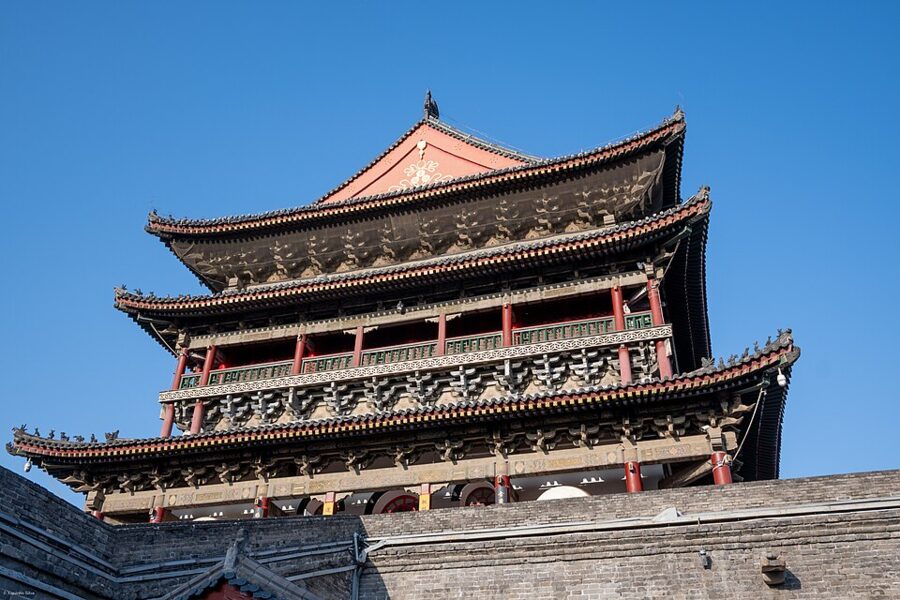
The Drum Tower is the bigger building. Its brick base is 52.6 meters by 38 and 7.7 meters high, and the timber hall on top is seven bays wide and three deep with a gallery all round. The museum gives its height as 34 meters; other references say 36. It is the largest drum tower left in China.
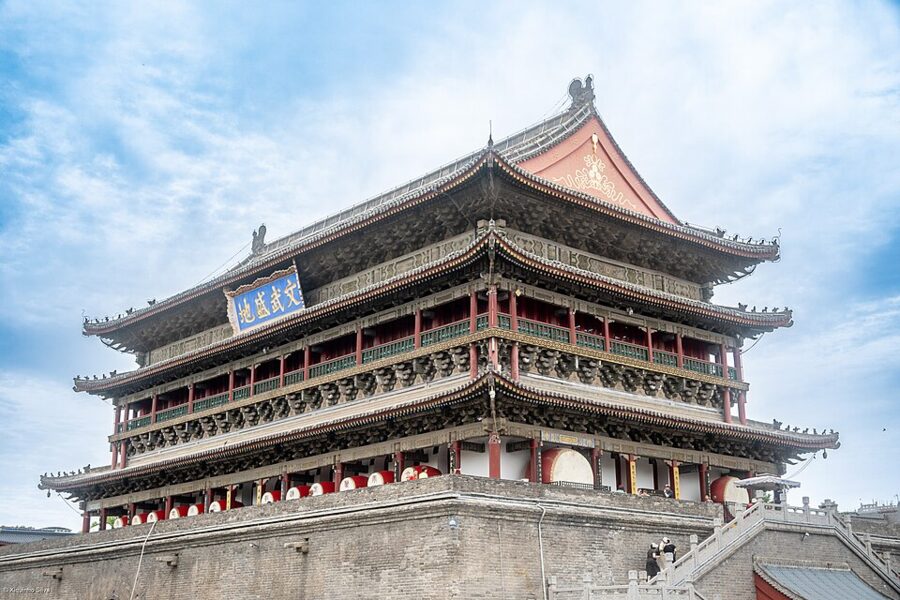

Where the Bell Tower has a pyramid roof, the Drum Tower has a double-eaved hip-and-gable roof, the same high-ranking form as Tiananmen in Beijing, in grey tile edged with green glaze. The paintwork on the outer eaves dates from 1952–1953, redone in the dragon-and-grass and swirl patterns that match the building’s rank.

The two plaques
The south plaque, 文武盛地, was written in 1590 by Zhao Kehuai (赵可怀), then governor of Shaanxi. The north plaque, 声闻于天, is attributed to Li Yunkuan (李允宽), a local scholar of the Guangxu reign (1875–1908). Both originals were destroyed during the Cultural Revolution; the plaques you see went up in 2005. They read right to left, the old way.
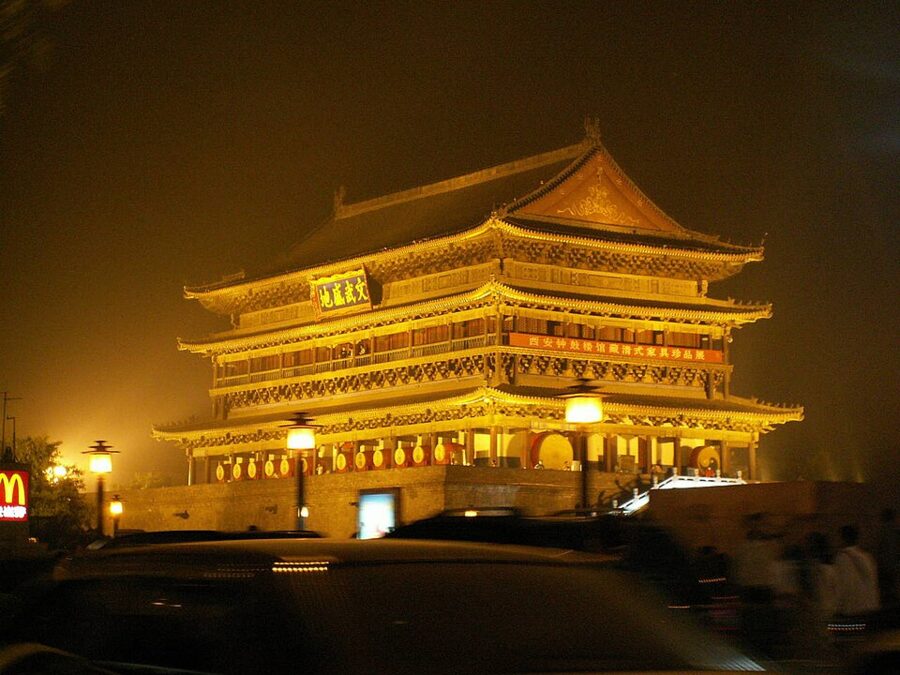

Drums, in and out
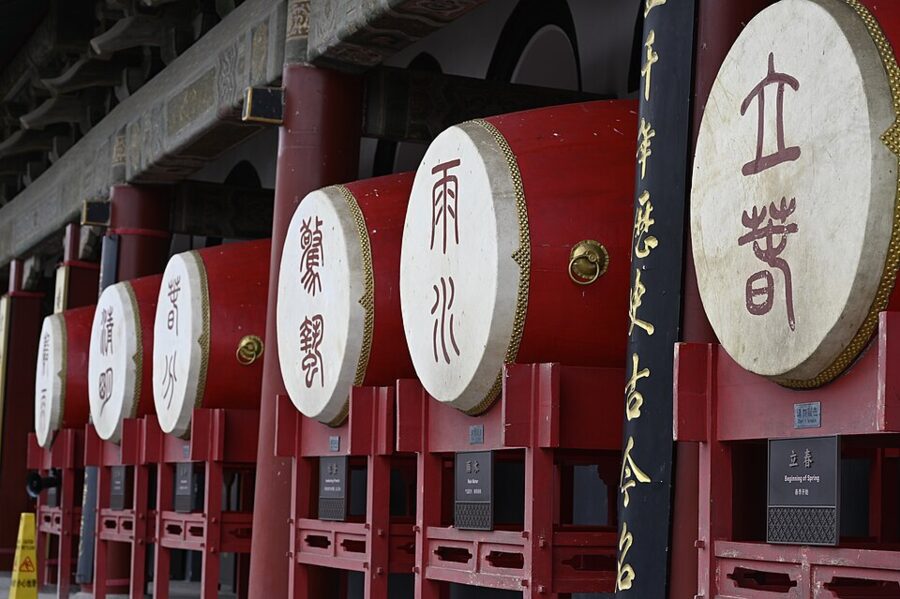
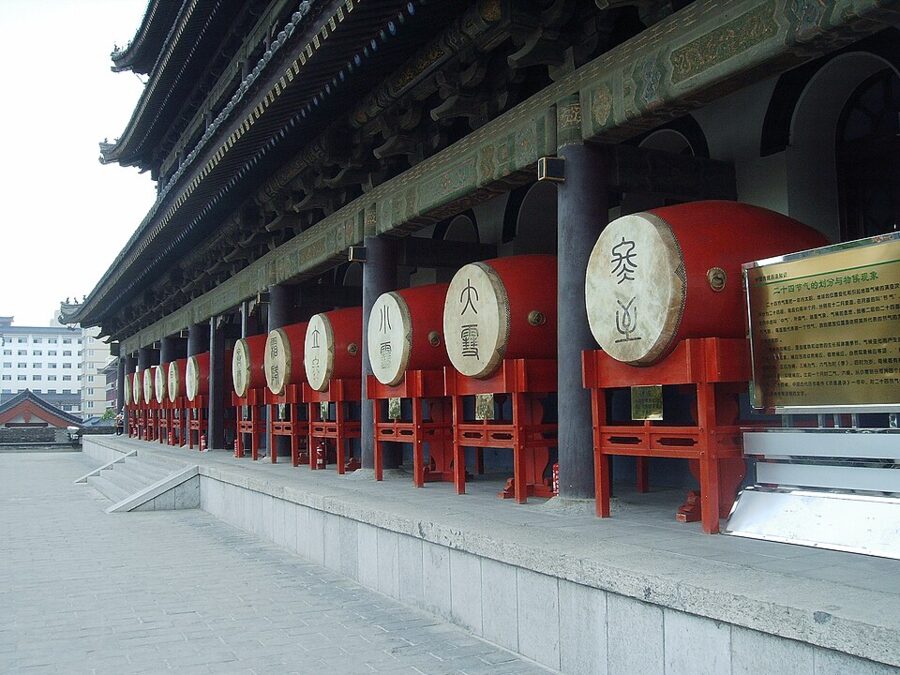
Outside, the galleries hold the twenty-four solar-term drums and, on the west side, a night-watch drum and the Wentian Drum (闻天鼓, “heard in heaven”), said to weigh about 1.8 tonnes. All are modern, installed to show how the tower was used.
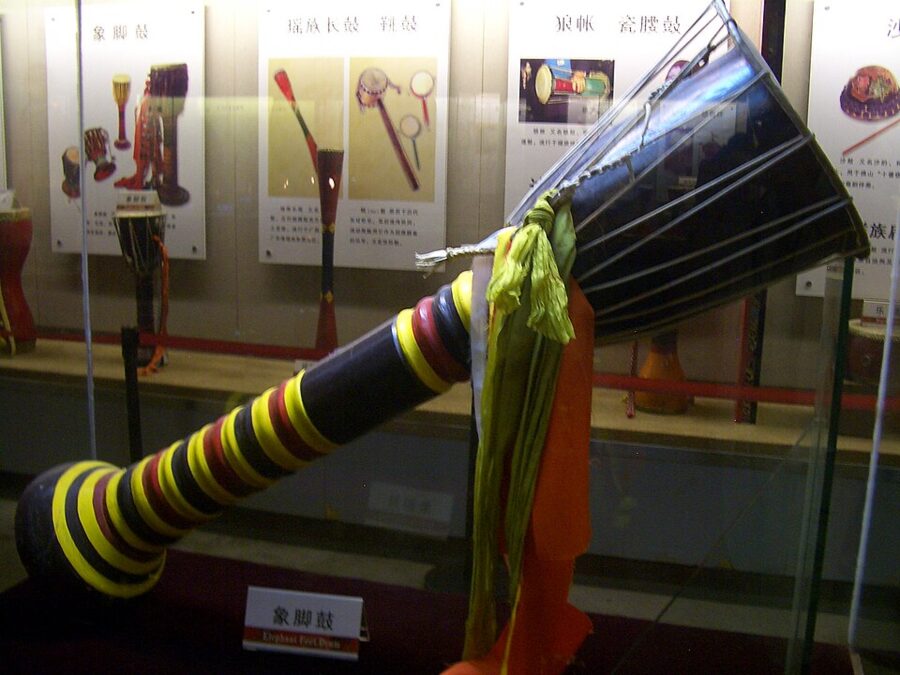
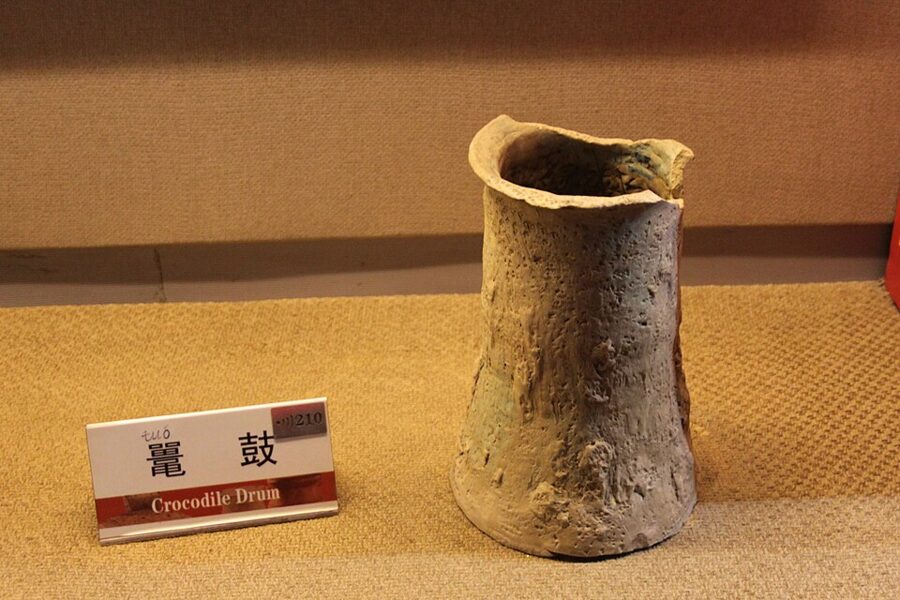
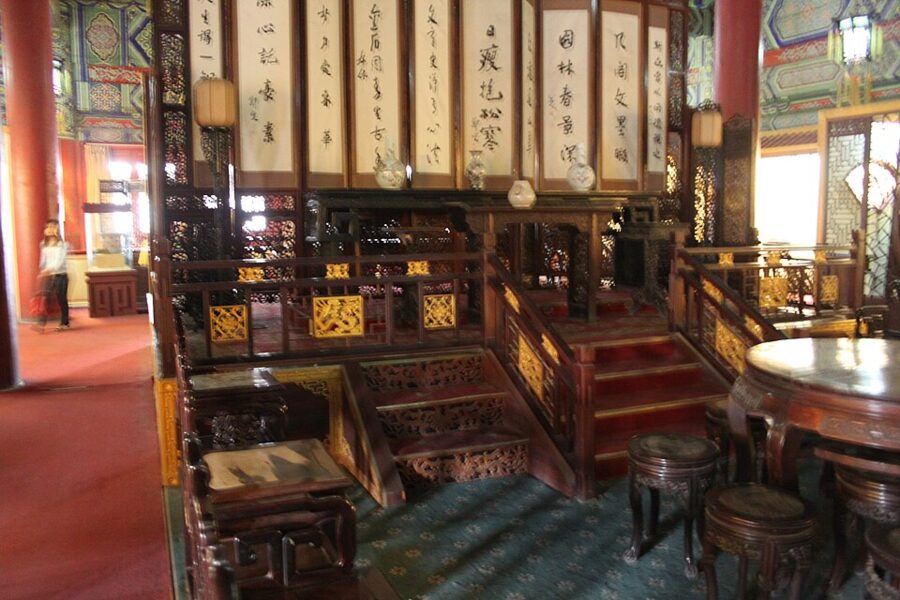
Inside, the main hall has long held a drum exhibition, “Drums Across China” (鼓舞中国): war drums, storytelling drums, pottery drums and bronze drums from across the country. Another hall holds the Ming and Qing furniture. The Drum Tower’s halls were also closed for refitting, from November 1 to 30, 2026, with only the terrace open.

The performances, and whether to wait for one
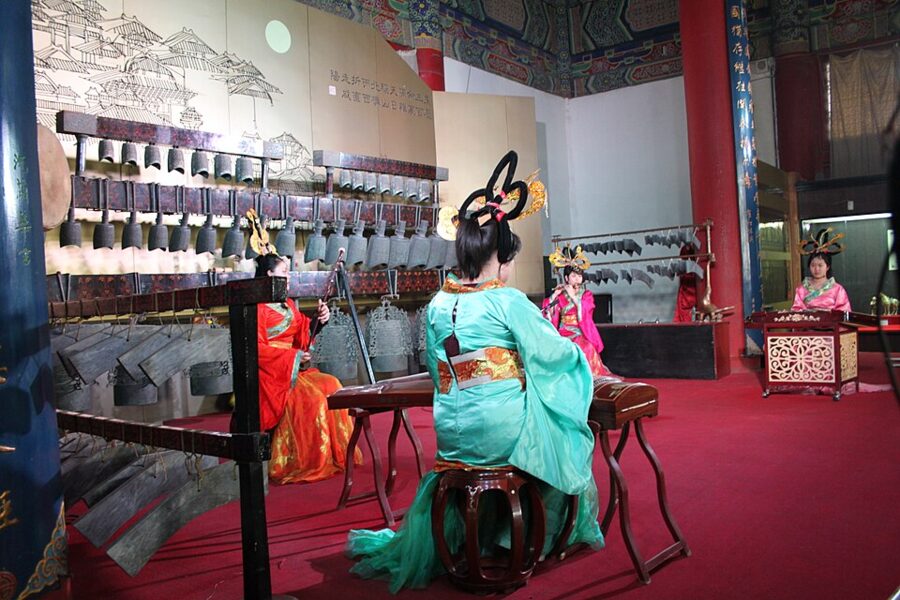
For years the towers have staged short concerts of chime bells, drums and Tang-style music, on a stage in the Drum Tower’s upper hall. The museum’s published schedule has run to eight shows a day at 09:30, 10:15, 11:00, 11:45, 14:00, 15:00, 16:00 and 17:00, each 10–15 minutes long. Recent visitors also describe chime-bell sets in the Bell Tower, with pieces such as Spring River in the Flower Moon Night (春江花月夜).
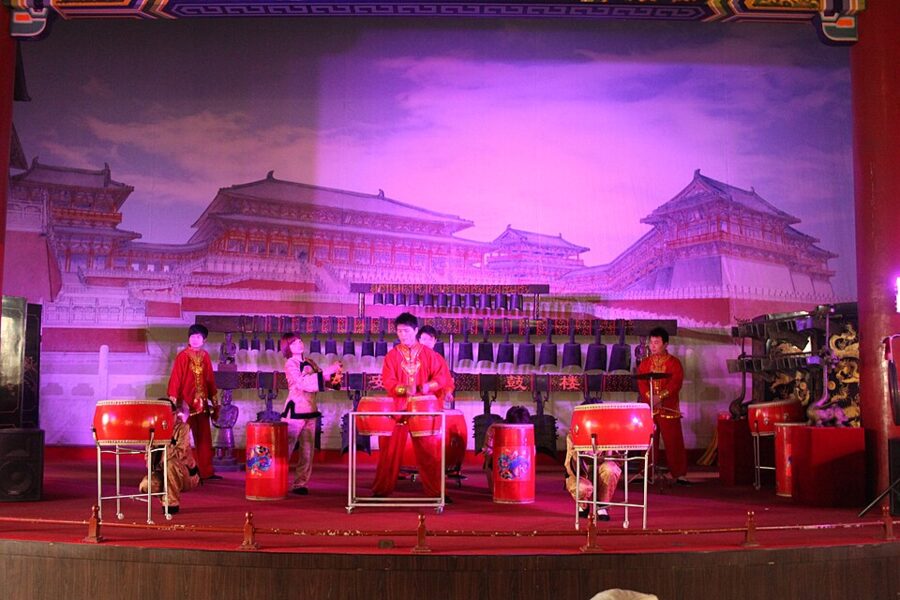
The times shift from year to year, and other recent guides give six shows a day. During the late-2026 refit the halls with the stage were closed, and no notice said the shows carried on. Check the times posted at the ticket window.
Are they worth timing your visit around? Only loosely. Fifteen minutes of chime bells in the room where they belong is a pleasure, and if you can reach the Drum Tower ten minutes before a show, do. But the light and the buildings matter more, and I would not move an evening by an hour to catch one.
Tickets, hours and the way in
Each tower costs 30 yuan, and a combined ticket is 50 yuan. During the late-2026 works single-tower tickets were cut to 15 yuan until the halls reopened, so check the price when you book. A combined ticket cannot be refunded once you have used half of it.
From April 1 to October 10 the museum is open 08:30–21:30, with combined tickets on sale until 20:00 and single tickets until 21:00. From October 11 to March 31 it is open 08:30–18:00, with combined tickets until 16:30 and last entry at 17:30. Spring Festival and National Day usually bring the summer hours back for a week or so.
Tickets are real-name, sold online through the museum’s official WeChat account up to three days ahead, or at the window. Foreign visitors book with a passport number. Free and half-price tickets are for Chinese citizens only, as the museum’s booking rules make plain. There is a security check at each tower, and lighters are not allowed in.
The underpass and the metro
Zhonglou station, on Metro Lines 2 and 6, connects directly to the ring of pedestrian tunnels under the roundabout. Exit C is the one most guides give for the Bell Tower ticket hall, but the tunnels, opened in 2003, were being refurbished through 2026, so follow the signs for 钟楼 (Bell Tower) or 钟鼓楼广场 (Bell and Drum Tower Square) rather than an old exit number. For the Drum Tower, come up on the square and walk west for five minutes. From Xi’an North railway station, Line 2 takes about 30–40 minutes.
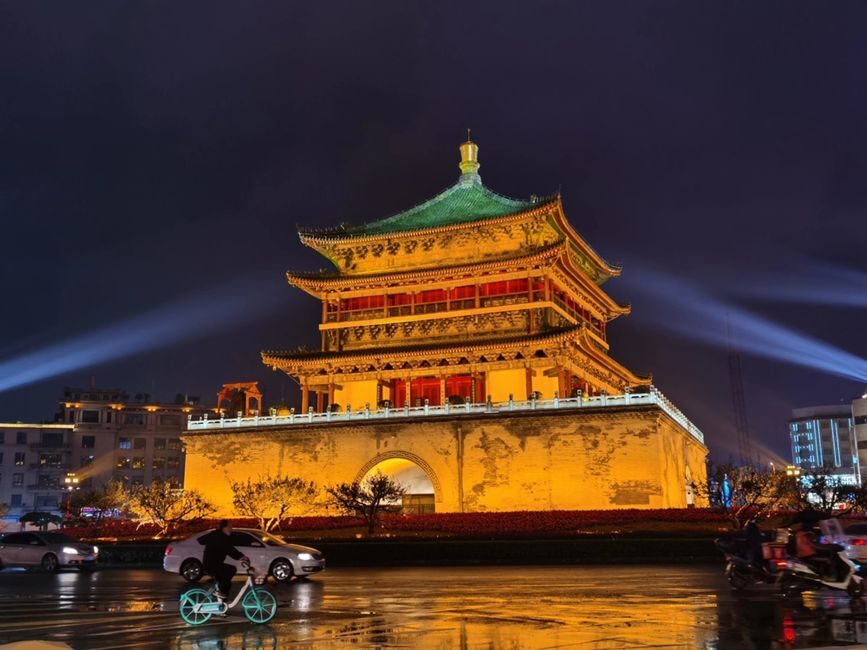
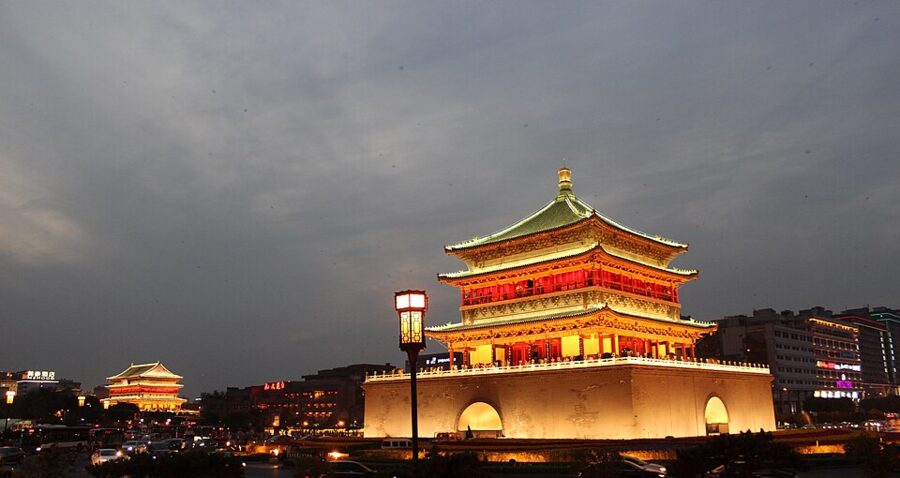
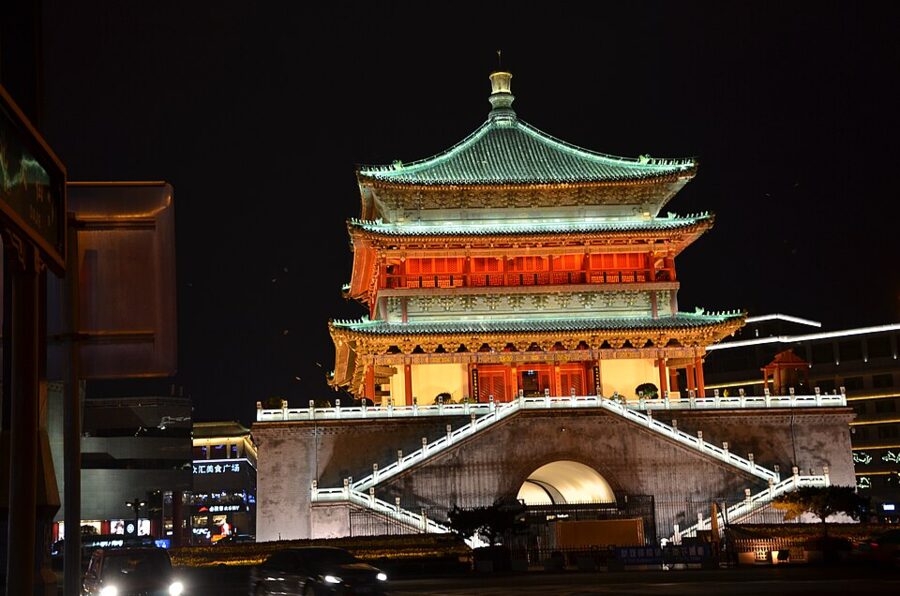
The best views of both towers lit at night
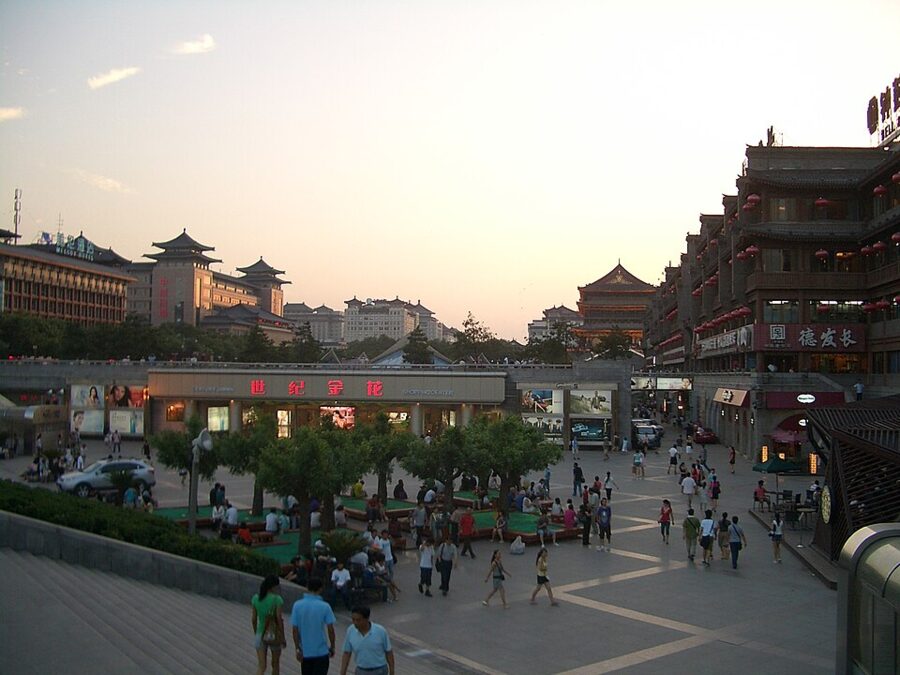
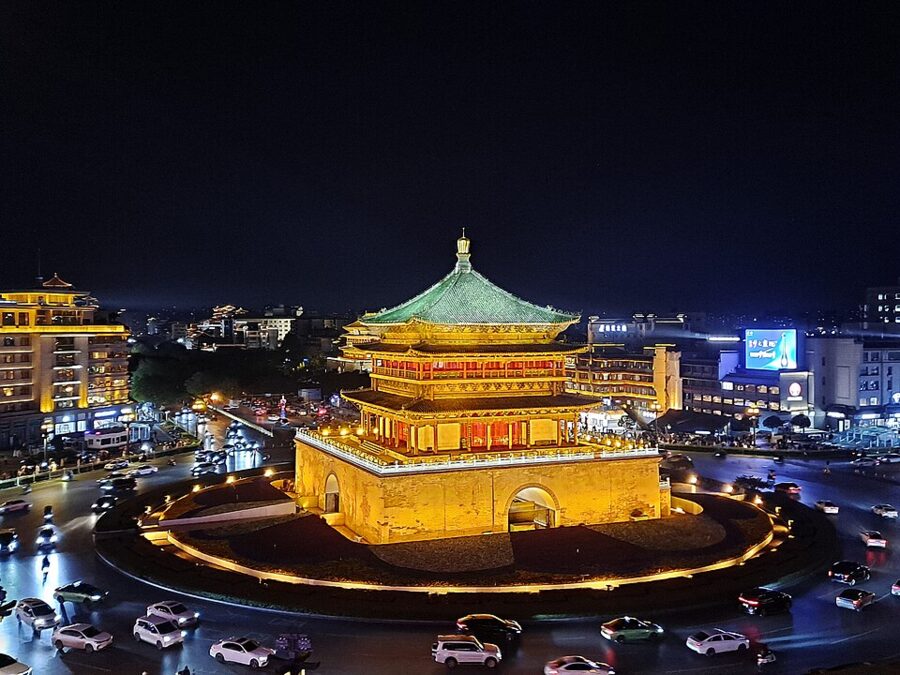
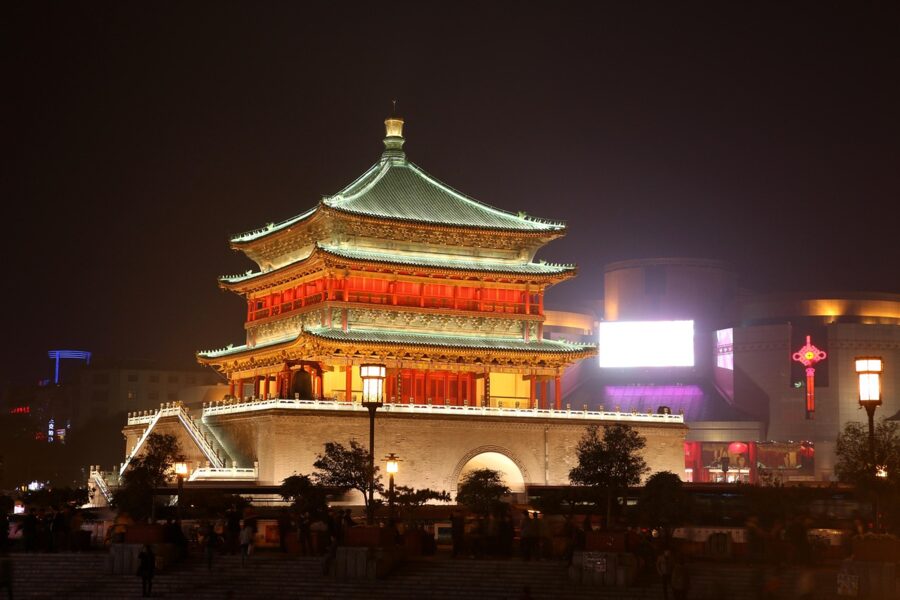
The lights come on at dusk, roughly 18:30–19:30 depending on the season, and stay on until around 23:00. I would stand in four places:
- The middle of the square, for both towers at once.
- The fifth-floor terrace of Kaiyuan Mall (开元商城), facing the Bell Tower across the roundabout and free to walk out on, for the view down on to the tower and its ring of traffic.
- The corners of the roundabout, for light trails circling the tower.
- Luomashi (骡马市) pedestrian street, just east of the Bell Tower, for the low angle up at the eaves.


Through the Drum Tower: Beiyuanmen and the Muslim Quarter
Walk through the arch under the Drum Tower and you are on Beiyuanmen (北院门), a stone-paved street 560 meters long. The name means “North Yamen Gate”: under the Qing, the Shaanxi governor’s office at its north end was the North Yamen. In 1900, when the Empress Dowager Cixi and the Guangxu Emperor fled Beijing after the Boxer War, they set up their temporary court here.
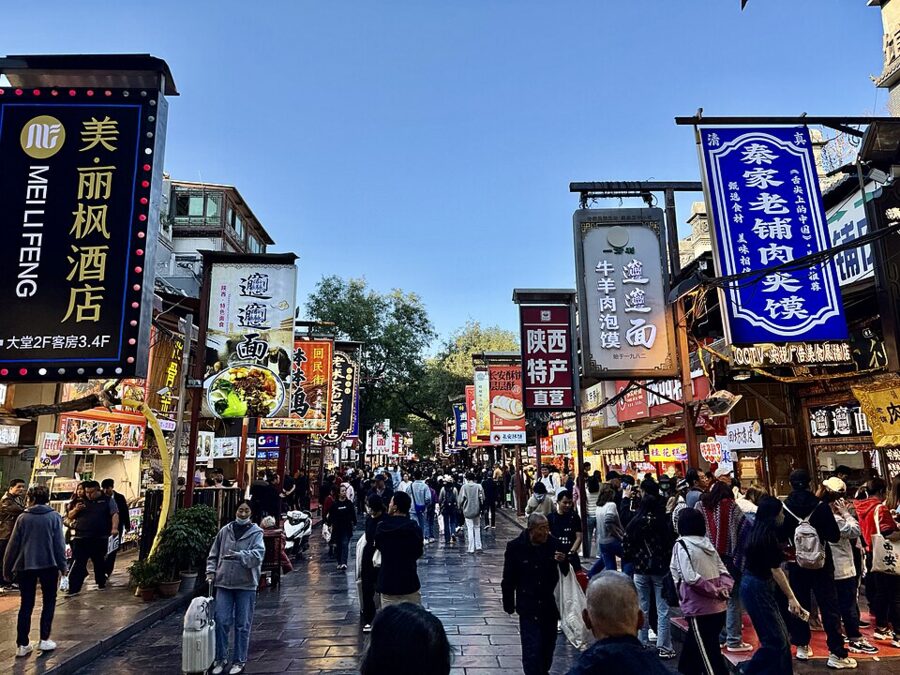

The lanes north and west of the Drum Tower are the Muslim Quarter, which locals call Fangshang (坊上), “up in the wards”, and visitors call Huimin Jie (回民街), “Hui people’s street”. It is a knot of streets: Beiyuanmen, Beiguangji Jie, Xiyangshi, Dapiyuan, Huajue Xiang, Sajinqiao. Hui families have lived here since at least the end of the Northern Song in the twelfth century, and under the Ming and Qing it became their trading district, with a mosque for each neighborhood.


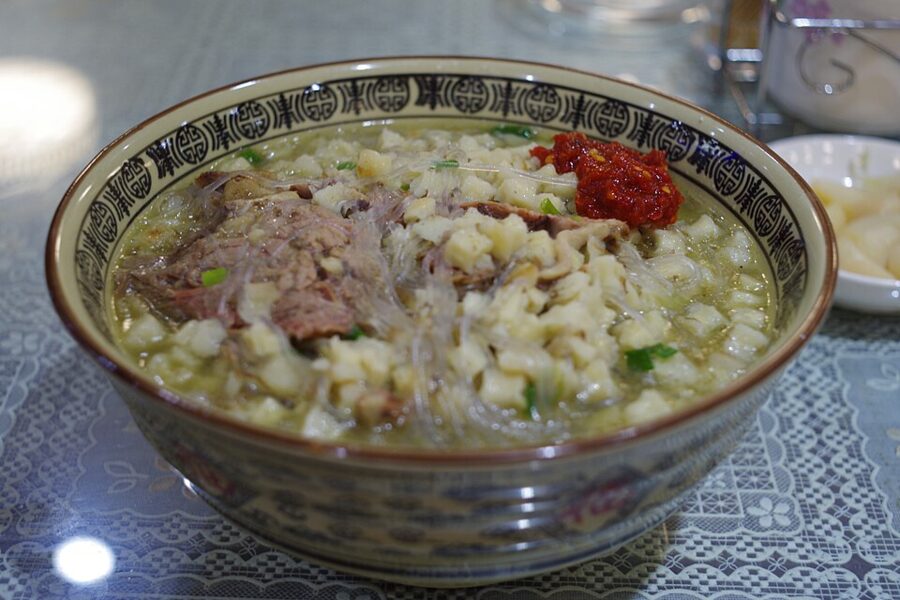
Beiyuanmen is the showpiece and the most crowded. Walk it once, then turn west into Xiyangshi (西羊市) and Dapiyuan (大皮院), where the stalls are closer to what families in the quarter buy and prices drop. Look for yangrou paomo (羊肉泡馍), flatbread you break up yourself before it is cooked in mutton broth; soup dumplings; lamb skewers; roujiamo (肉夹馍) buns stuffed with spiced beef; and cold sour-plum drink.

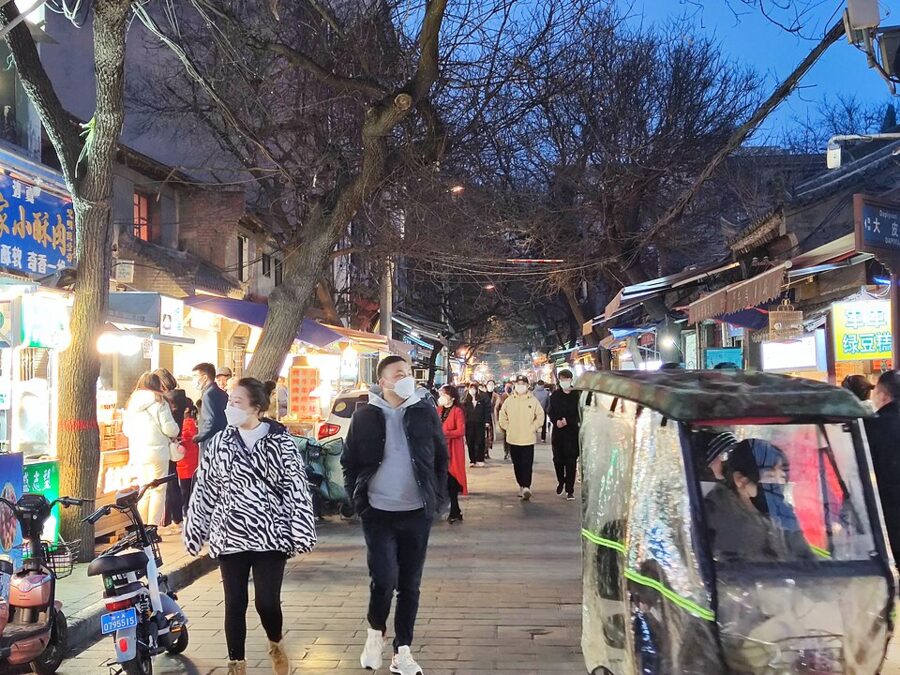

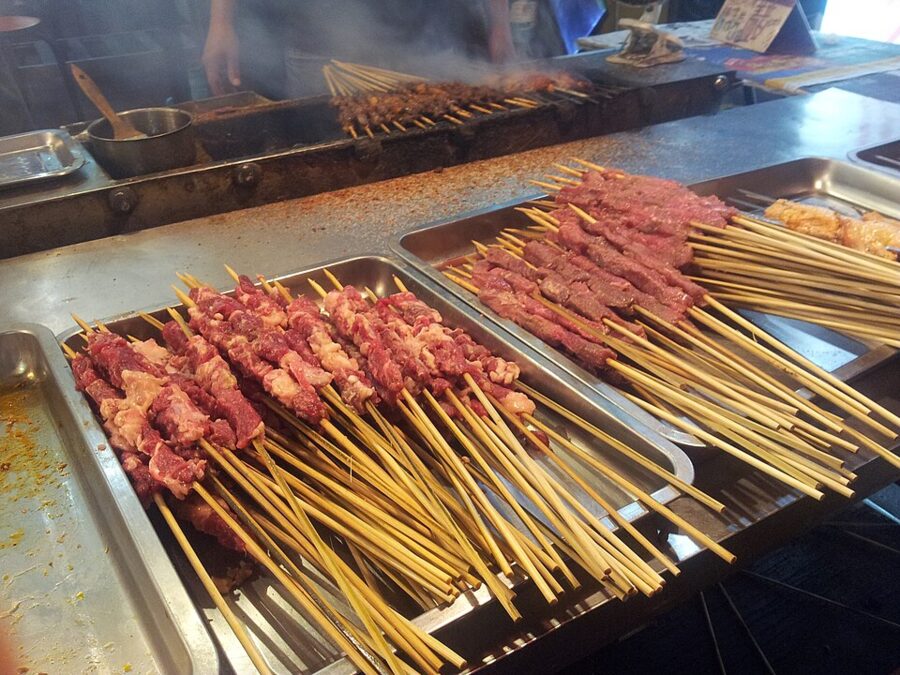

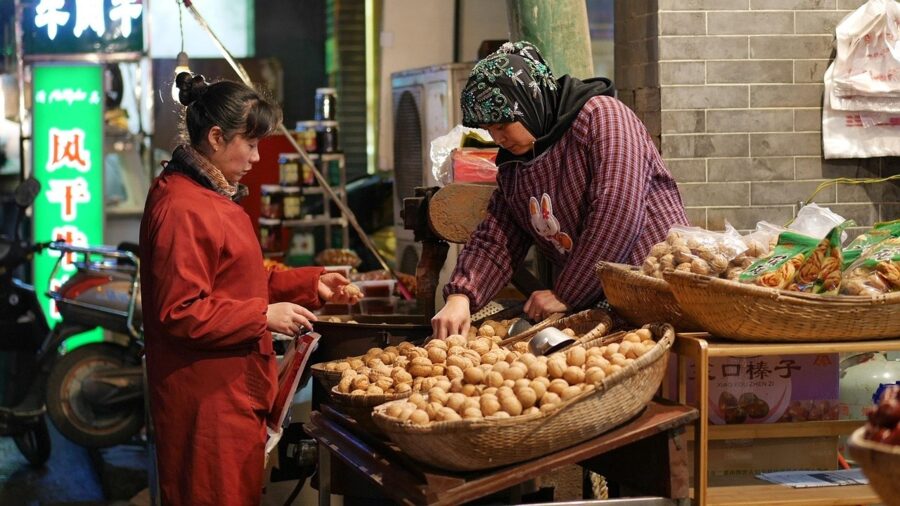
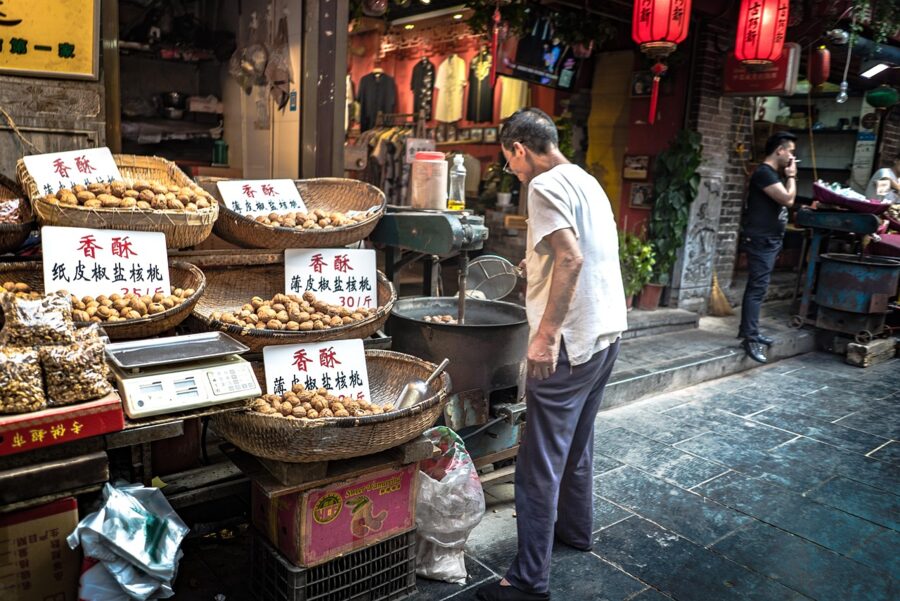
This is a neighborhood, not a theme park. Everything sold here is halal, so do not bring pork into a restaurant, and dress modestly for a mosque: no shorts or short skirts.
The Great Mosque on Huajue Xiang
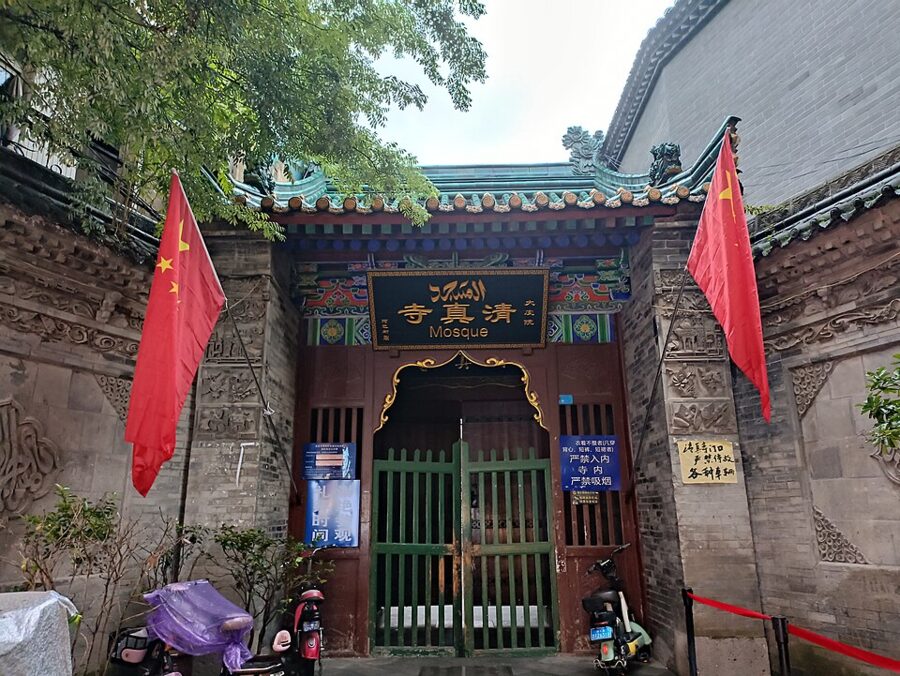
A few minutes northwest of the Drum Tower, at No. 30 Huajue Xiang (化觉巷), a narrow lane of souvenir stalls opens into the Great Mosque (清真大寺), the largest in the city and one of its two oldest. Tradition dates its founding to 742; the buildings are Ming, with Qing repairs. It covers about 1.23 hectares and is still a working mosque.
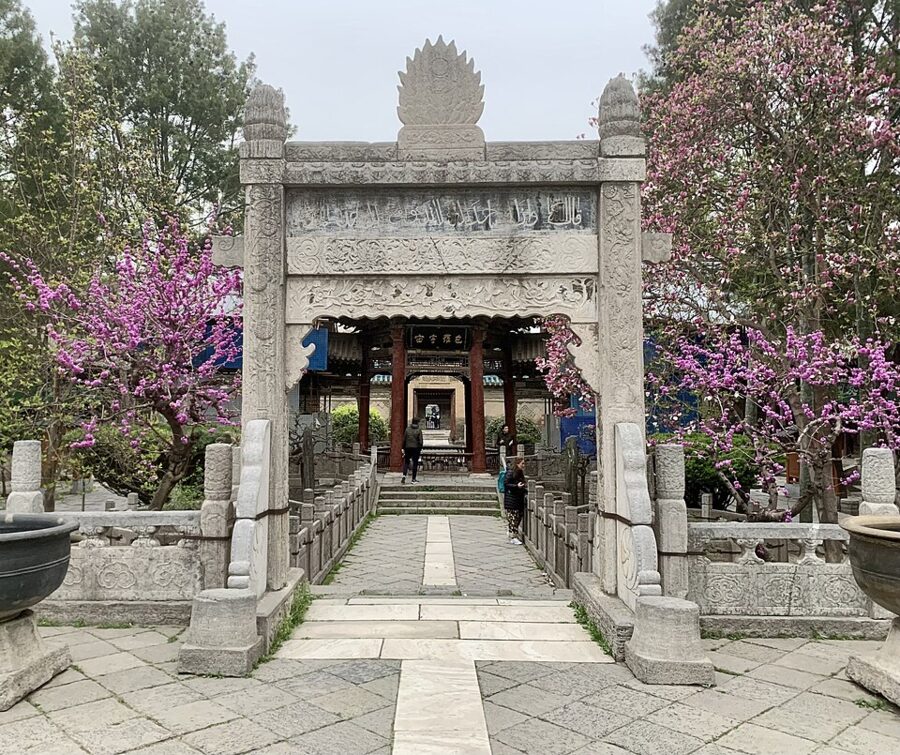
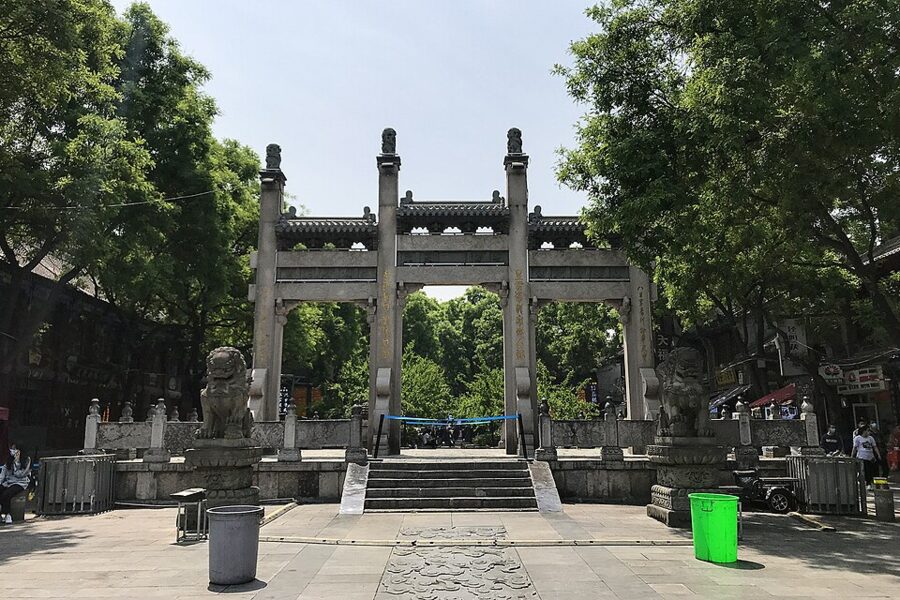
The plan is a Chinese temple’s turned to face Mecca: a string of courtyards runs east to west, and the prayer hall sits at the western end. You pass a wooden archway, a stone archway, a hall with a plaque by the Ming calligrapher Dong Qichang, and the Xingxin Lou (省心楼), an octagonal tower that serves as the minaret. Nothing in the outline says mosque; the Arabic inscriptions do.
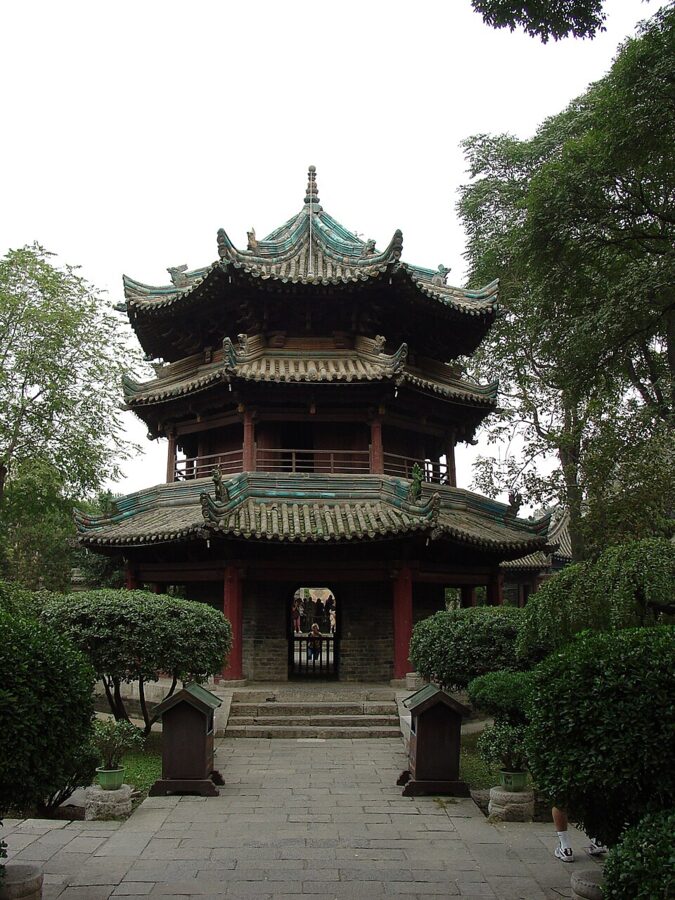

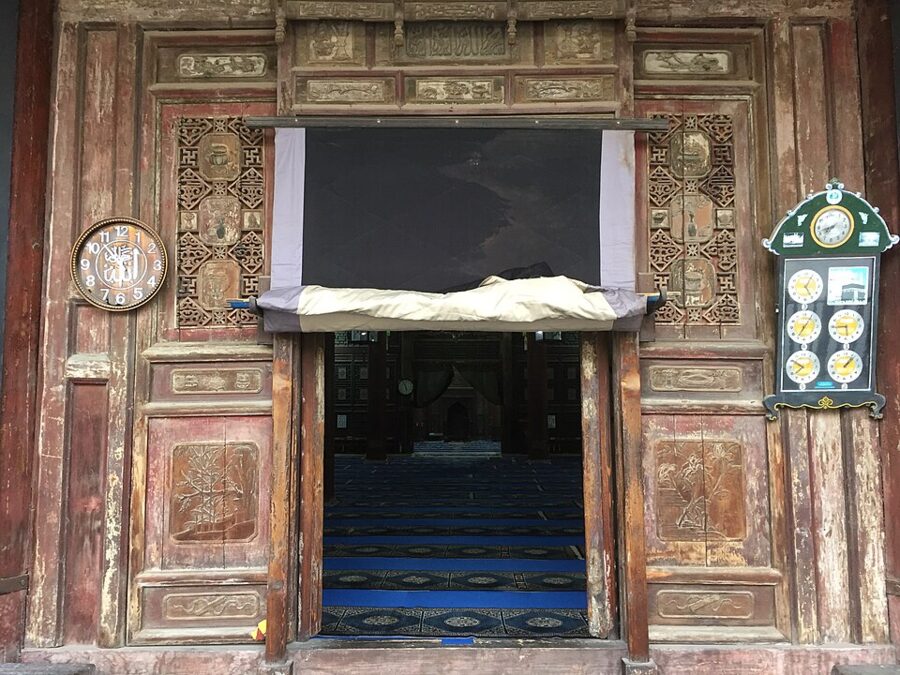

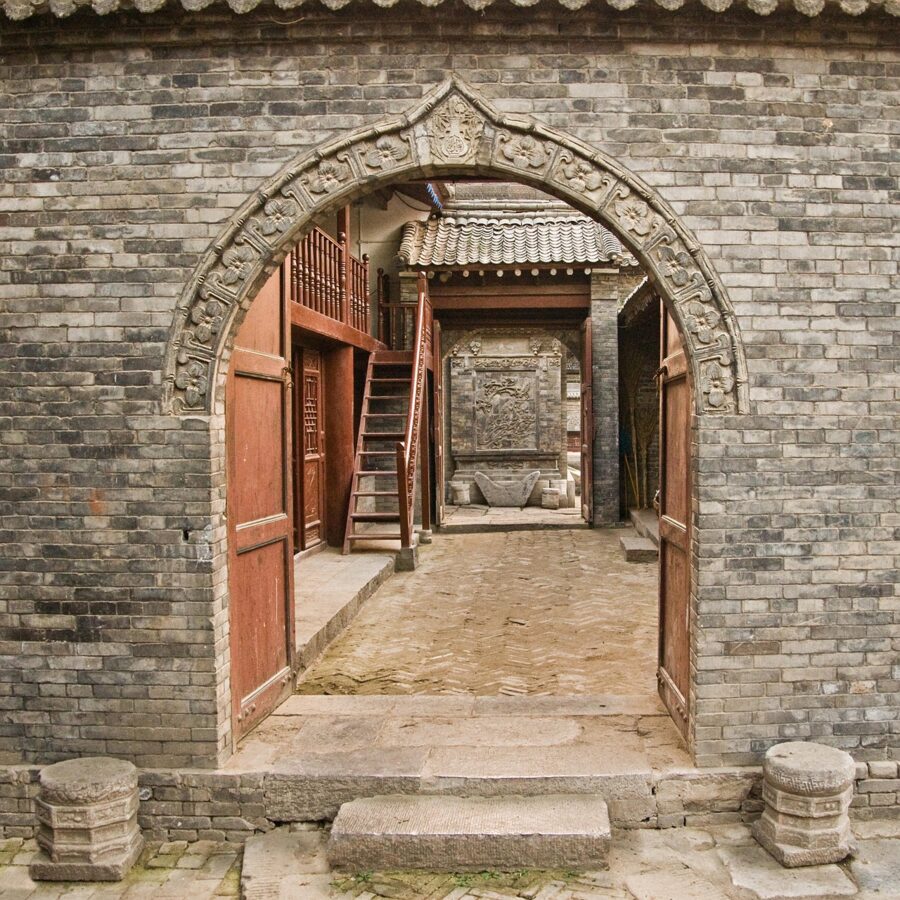
Admission is 25 yuan. The mosque is open 08:00–18:40 from September to April and 08:00–20:00 from May to August, with last entry at 19:00 in summer. It became a national monument in 1988, after a spell during the Cultural Revolution as a steelworks.
South down Nan Dajie to the wall
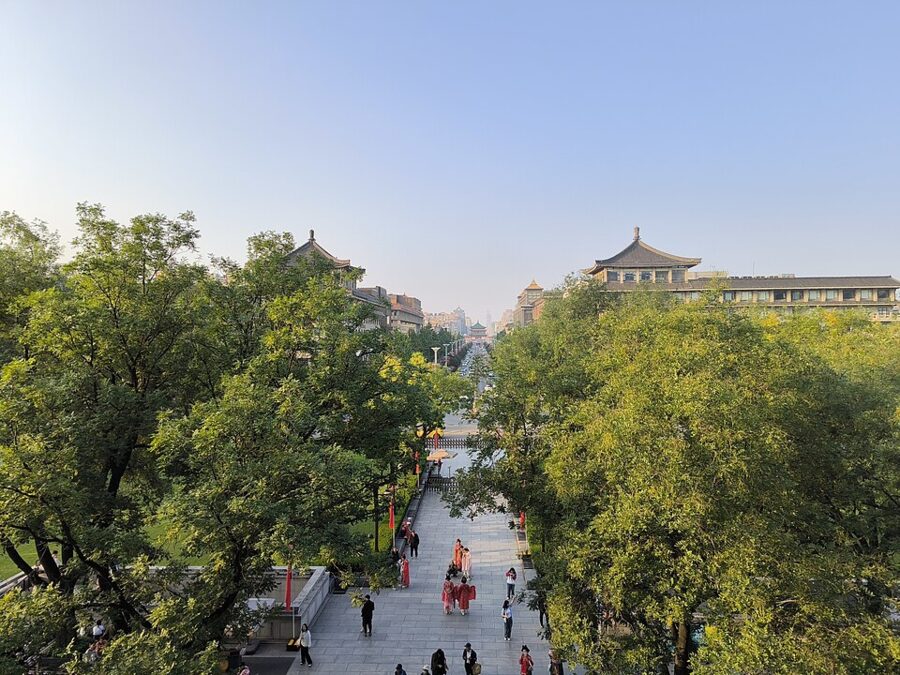
From the Bell Tower, Nan Dajie (South Street) runs about a kilometer straight to Yongning Gate (永宁门), the South Gate, in view the whole way. It is a fifteen-minute walk, or one stop on Line 2 to Yongningmen.
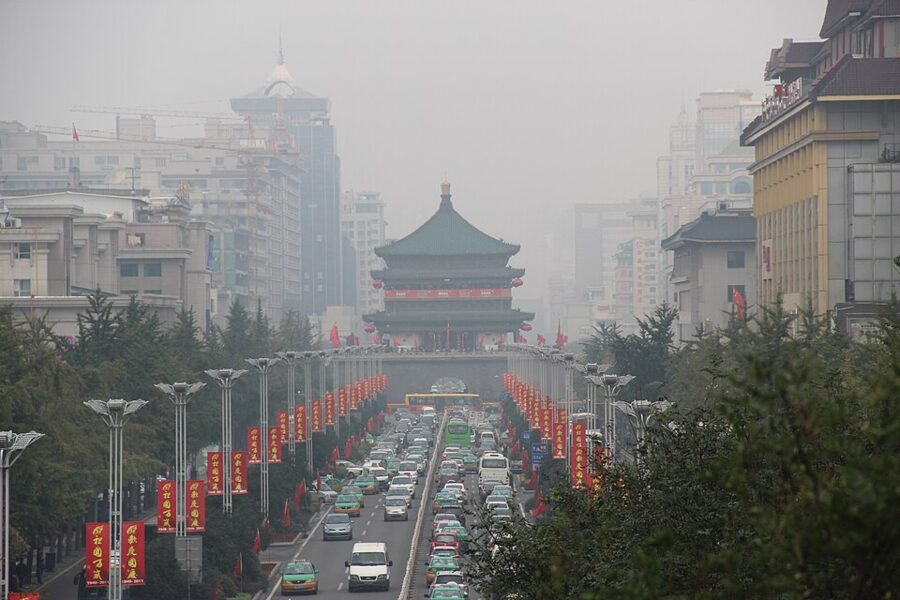
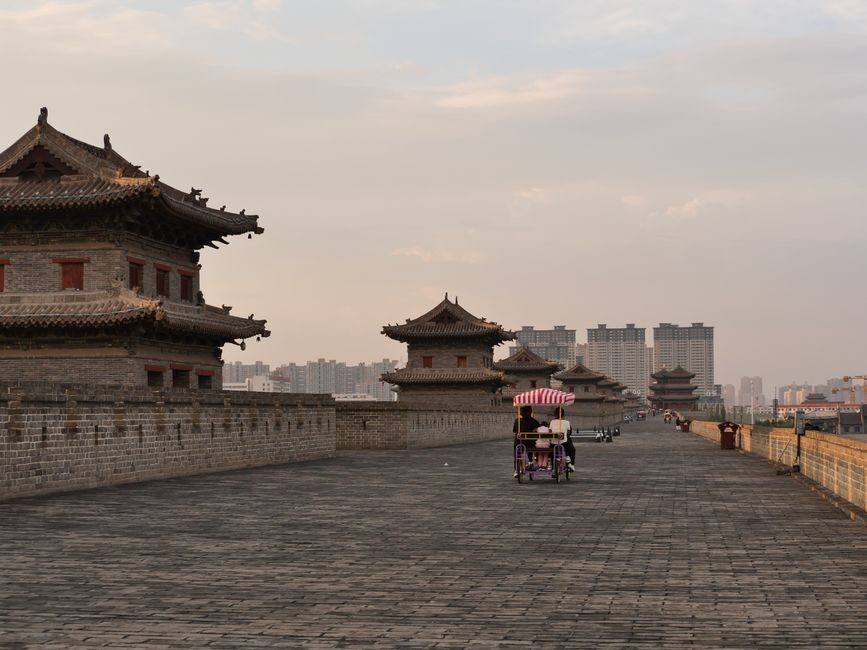
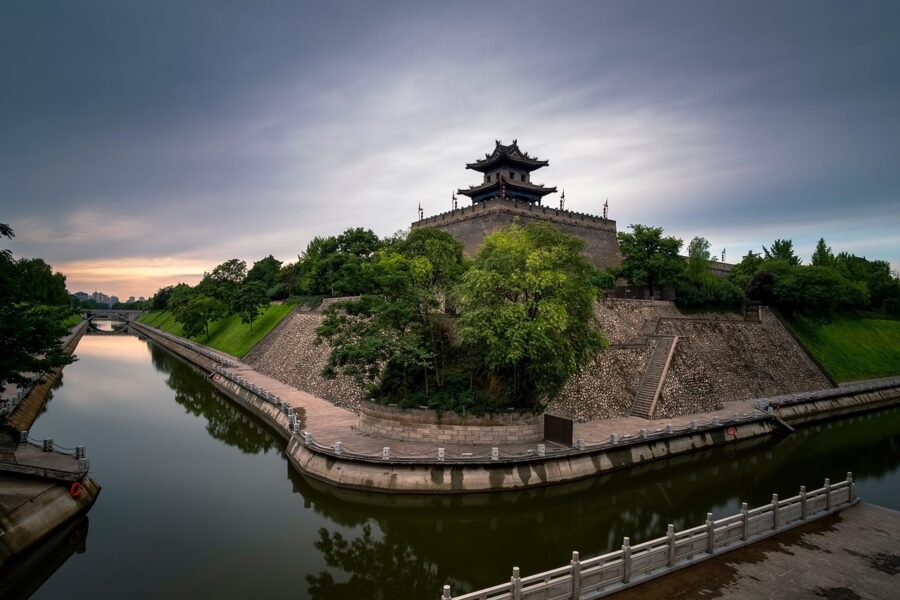
Yongning Gate is the oldest gate in the wall. It began as the Anshang Gate of the Sui imperial city in 582 and was kept when the Ming extended the walls in the 1370s. The wall is 13.74 kilometers around and 12 meters high, wide enough on top to cycle, and the moat, gate towers and barbican here are intact.
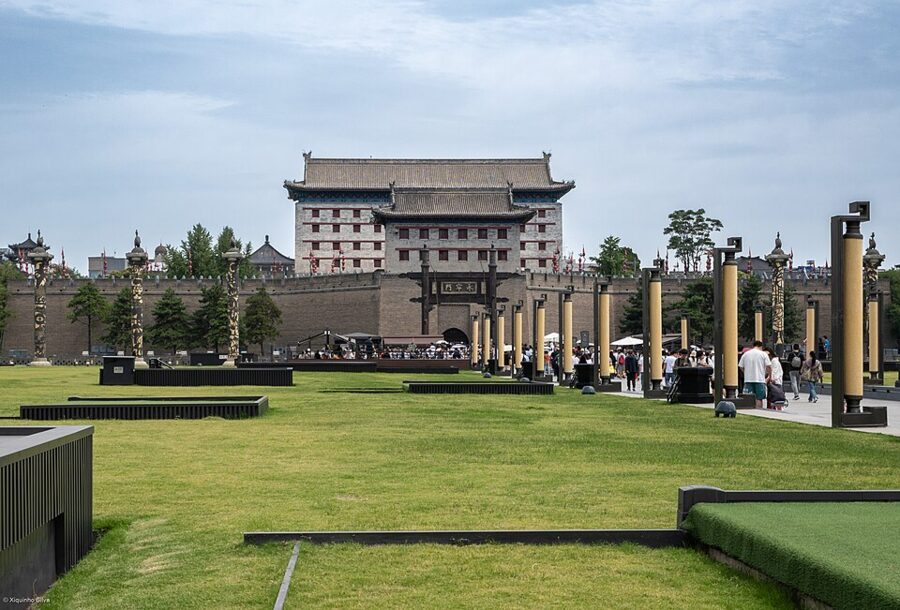

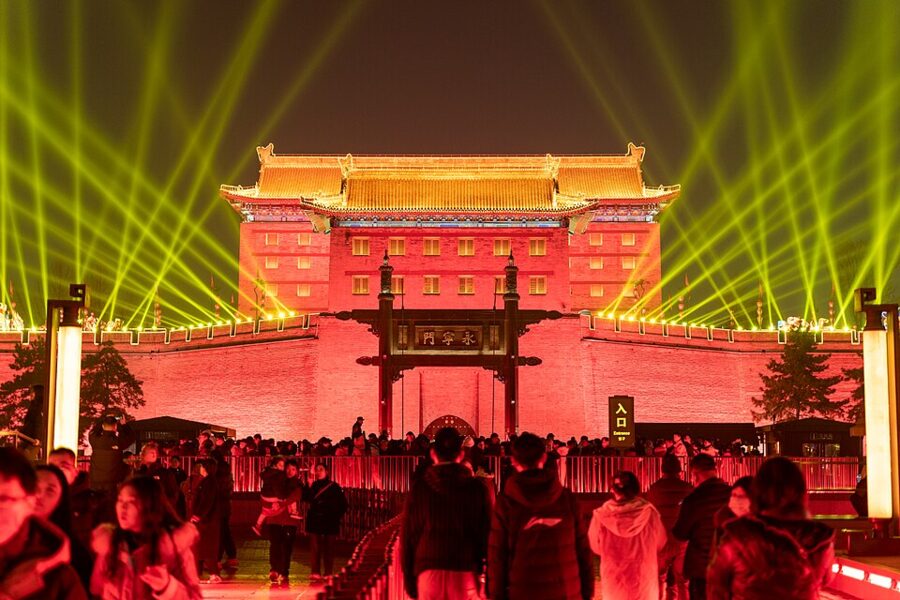
Tickets to walk the wall are 54 yuan. It is open 08:00–22:00 with last entry at 21:00, and Yongning Gate is one of the entrances open late, the one I would use for a night walk. The city wall’s own site lists hours and closures.

Shuyuanmen, just inside the gate
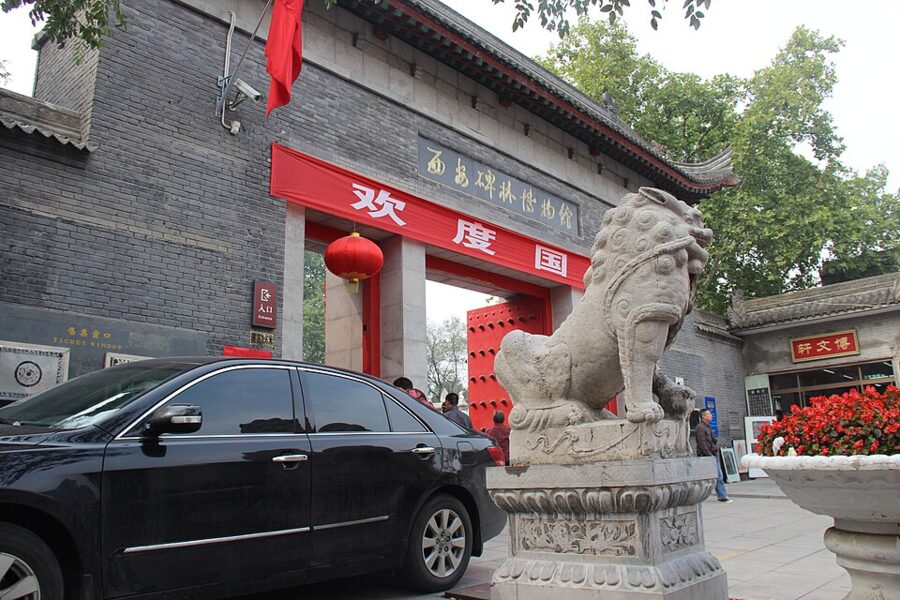
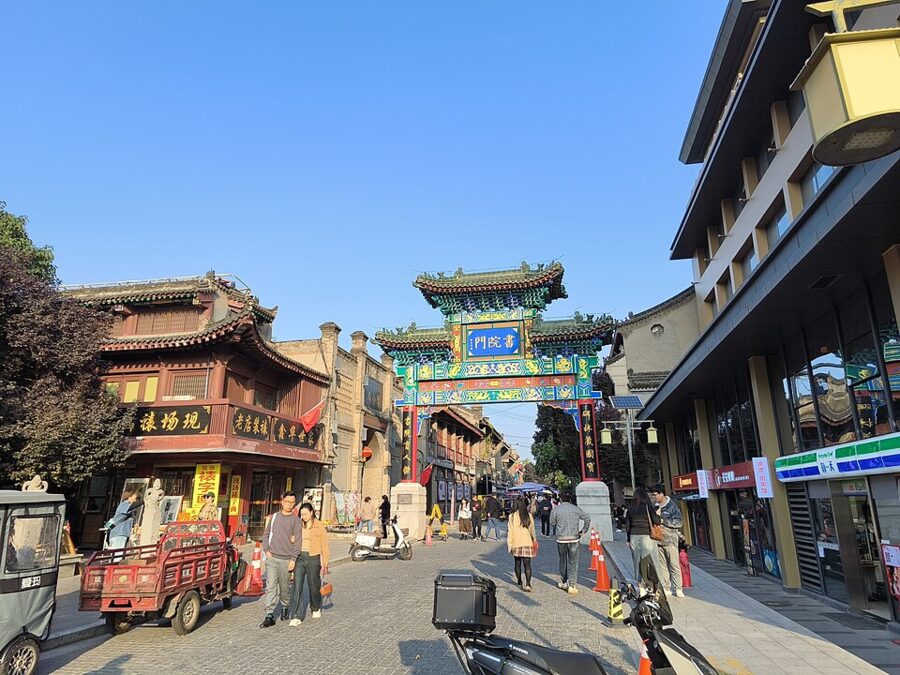
Turn east inside the South Gate onto Shuyuanmen (书院门), named for the Guanzhong Academy the scholar Feng Congwu founded here in 1609. It is a street of brushes, ink, seal carving and stele rubbings, and of clay flutes: the egg-shaped xun (埙), a vessel flute whose ancestors go back seven thousand years. The Forest of Steles Museum, with the real Jingyun Bell, is at its eastern end.

The lantern show
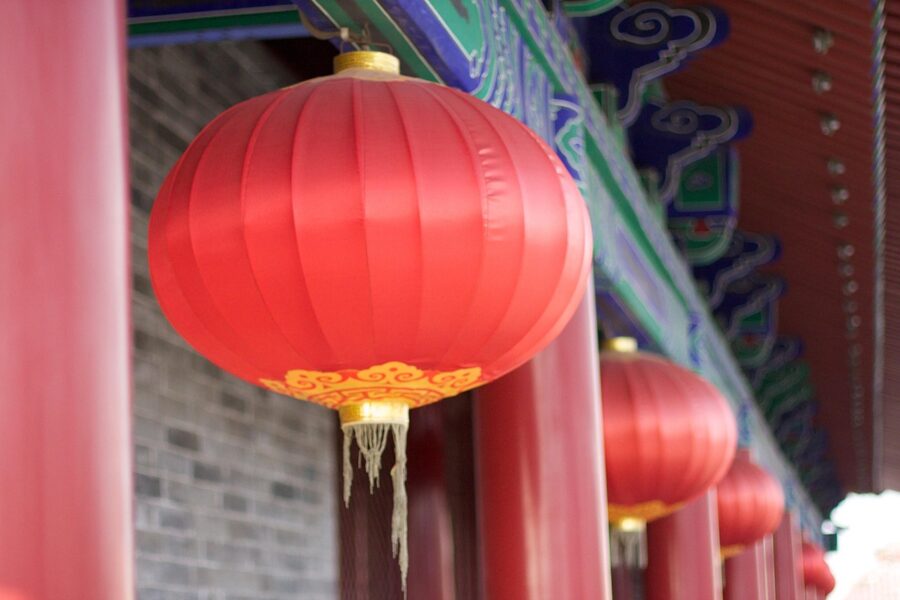
Each Spring Festival the wall becomes the stage for Xi’an’s biggest lantern display, tied to the Lantern Festival that closes the New Year season. In recent years the lanterns have run along the wall from Hanguang Gate to Jianguo Gate, through Yongning Gate, and tickets during the show have cost 100 yuan. The 2027 Spring Festival falls on February 6 and the Lantern Festival on February 20; the lantern installations were contracted in November 2026, and opening dates will follow.

An evening at the towers, start to finish
This is the sequence I would follow in winter, when the towers close at 18:00. It starts in daylight at the mosque and ends on the wall.
- 14:30, the Great Mosque. Go while the courtyards catch the low sun. Allow an hour.
- 15:45, the Drum Tower. Walk back down Beiyuanmen and in under the arch. Read both plaques, see the drums, catch a show if one is on.
- 16:45, the Bell Tower. Cross the square, go down into the underpass and up to the terrace for sunset, around 17:30 in late November. Last entry is 17:30.
- 18:00, dinner in the quarter. Back across the square as the lights come on, and west into Xiyangshi or Dapiyuan.
- 19:30, the square. Stand in the middle and look both ways.
- 20:00, Nan Dajie. Walk south to Yongning Gate and climb the wall before the 21:00 last entry.
From April to early October the towers stay open until 21:30, so reverse it: the wall in the late afternoon, dinner, and the Bell Tower last, after dark, for the view down on to the lit streets.
Up on the wall above Yongning Gate, with the gate tower lit behind you, Nan Dajie runs north in a straight line of lights. At the far end, small from here and gold against the dark, is the tower the whole street was drawn to meet, still ringing nothing, still exactly in the middle.